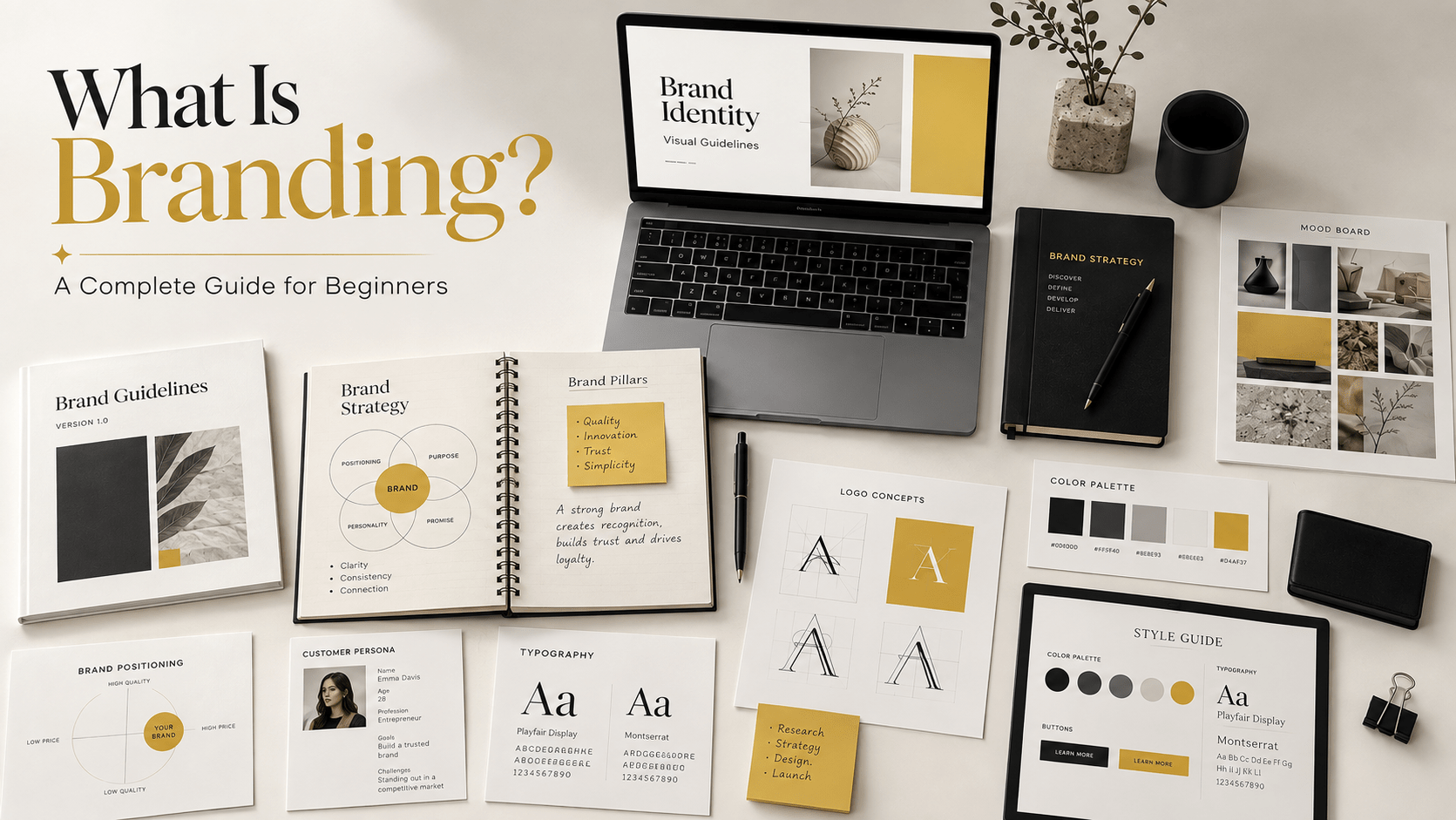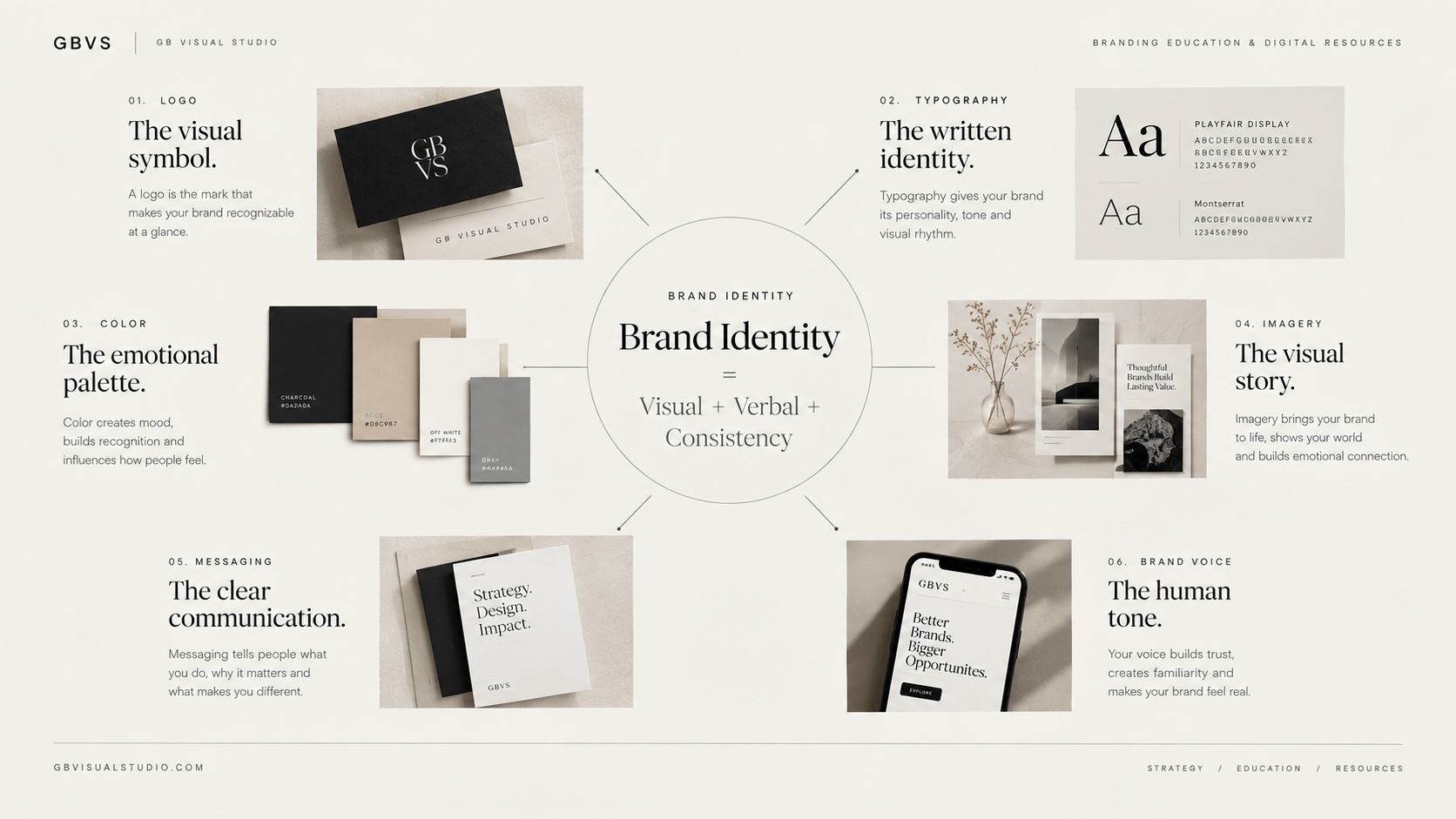

A business can have a strong product, professional branding, consistent social media, and an attractive website—and still struggle to explain why customers should choose it.
Often, the problem isn’t the design.
It’s the positioning.
Brand positioning determines how a business wants to be understood by its target audience in relation to competing alternatives. When positioning is unclear, everything built on top of it can become harder: messaging becomes generic, content starts covering unrelated topics, visual decisions lack direction, and marketing repeatedly falls back on discounts or vague claims.
The problem is that positioning mistakes are not always obvious.
Sometimes a brand appears polished while communicating almost nothing distinctive.
Sometimes the business knows exactly what makes it different, but its customers never see that difference.
And sometimes the brand has changed so frequently that people no longer know what it stands for.
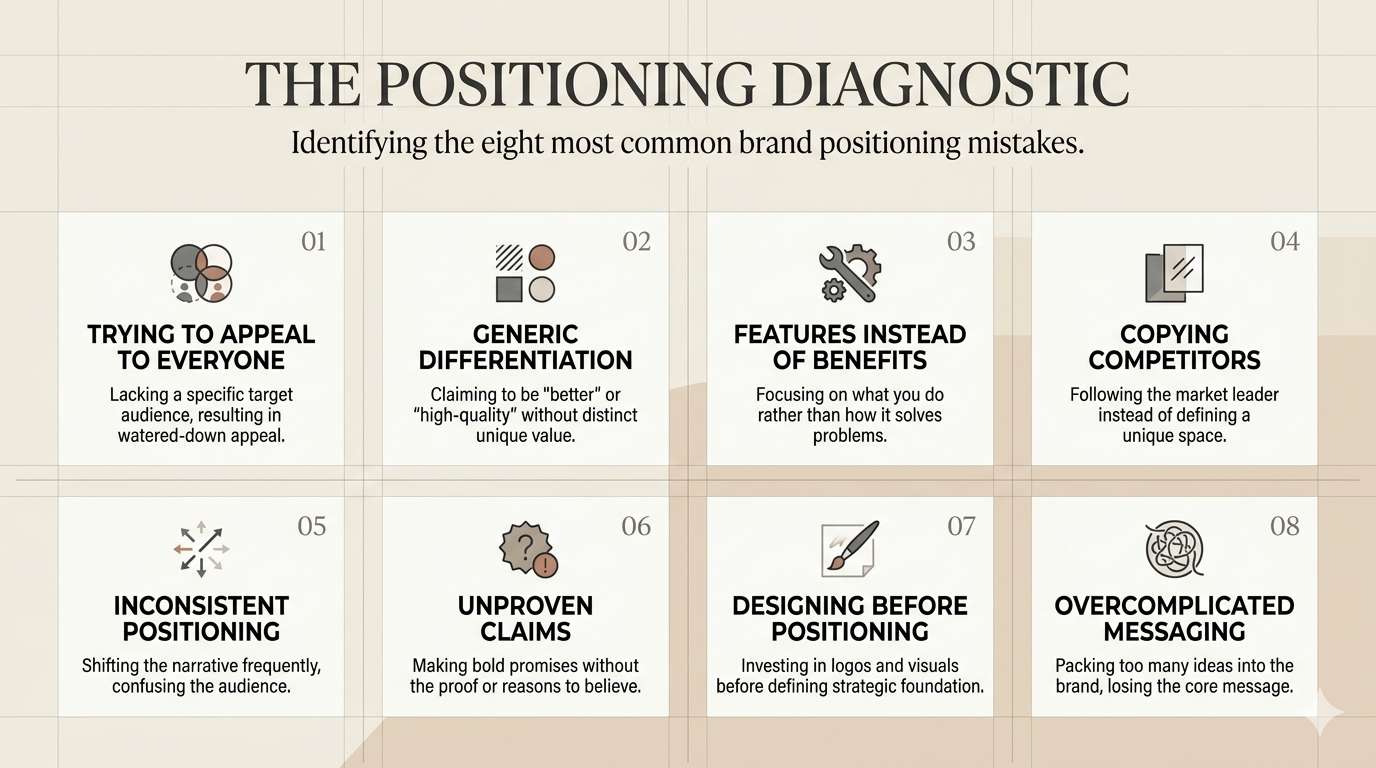
This guide examines the most common brand positioning mistakes, why they happen, and what you can do to correct them without immediately rebuilding your entire brand.
If you haven’t read it yet, start with the Brand Positioning Guide 2026 for the strategic foundation.
What You'll Learn
Toggle1. Trying to Position Your Brand for Everyone
One of the most common positioning mistakes is trying to make the brand relevant to everyone.
A business might say:
“We help individuals, startups, small businesses, creators, entrepreneurs, agencies, and established companies grow through better branding.”
It sounds broad and inclusive.
But strategically, it doesn’t tell a particular customer why the business is especially relevant to them.
Positioning requires choices.
You don’t necessarily have to reject customers outside your primary audience. Instead, identify the group whose needs, problems, and expectations your brand understands particularly well.
Compare:
“We provide marketing services for businesses.”
with:
“We help founder-led businesses turn unclear ideas into a consistent brand and marketing system.”
The second statement gives the audience a clearer reason to pay attention.
Fix: Define a primary audience based on a meaningful problem, situation, or need—not simply demographics.
2. Confusing Your Product With Your Position
Your product describes what you sell.
Your position explains how you want that offer to be understood.
For example:
“We sell branding templates.”
That’s an offer.
But perhaps the strategic position is:
“Practical branding resources for small businesses that need professional systems without building everything from scratch.”
The product hasn’t changed.
The context around the product has.
This distinction is particularly important for digital products. A template can be positioned around speed, education, accessibility, specialization, quality, methodology, or another meaningful value.
The mistake is assuming that listing features automatically creates positioning.
It doesn’t.
3. Using Generic Differentiation
“We care about our customers.”
“We deliver quality.”
“We’re innovative.”
“We provide excellent service.”
These statements may be true.
But they rarely create strong differentiation on their own.
The problem isn’t necessarily the words. It’s the lack of specificity.
Instead of saying:
“We provide personalized service.”
explain what personalization actually means.
Perhaps every client receives a strategy session before design begins.
Perhaps the process is specifically designed for businesses without an internal marketing team.
Perhaps clients receive a system they can continue using independently after the project ends.
The behavior makes the claim meaningful.
Fix: Replace abstract differentiators with specific methods, experiences, capabilities, or principles that customers can actually recognize.
4. Positioning Your Brand Around Features Alone
Features are useful.
But features rarely explain why those features matter.
Imagine two project-management tools.
One says:
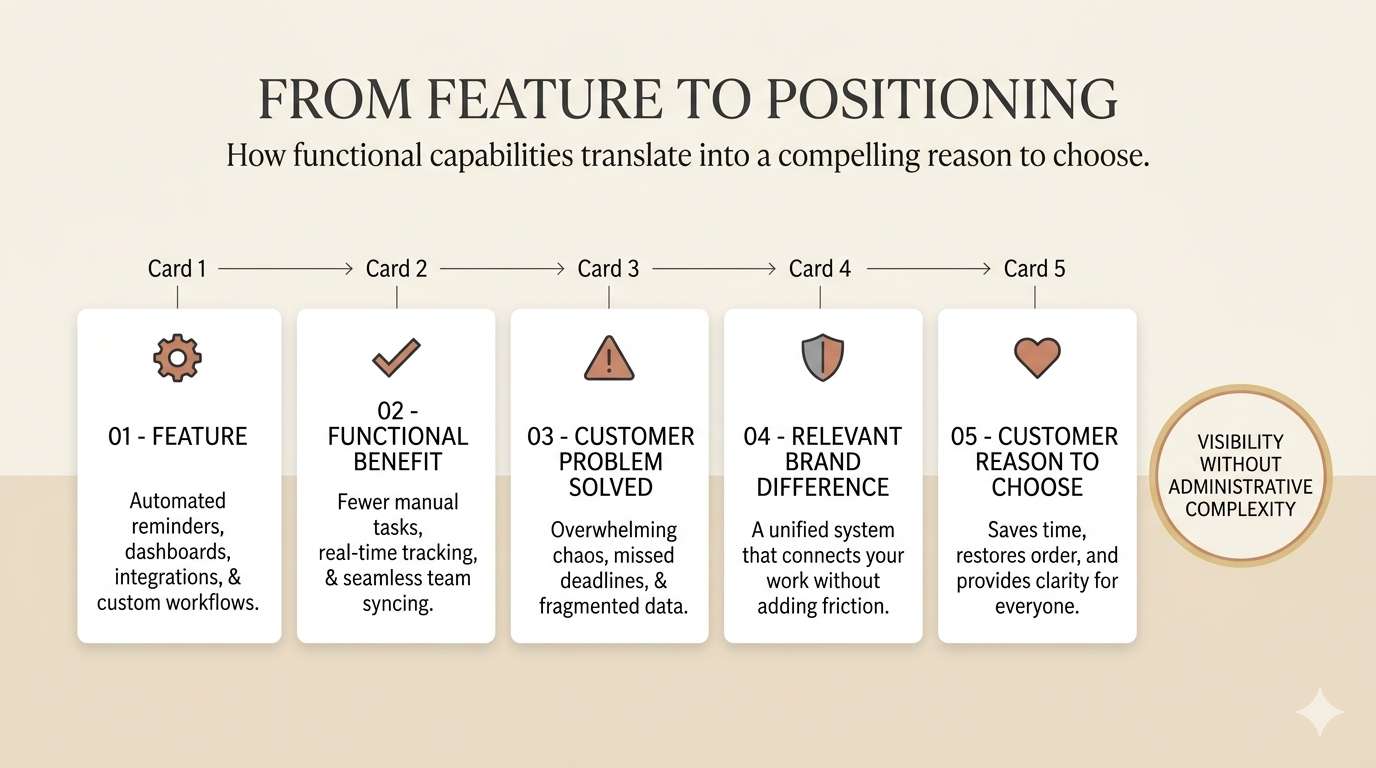
“Includes automated reminders, dashboards, integrations, and custom workflows.”
Another says:
“A project-management system designed for small creative teams that need visibility without administrative complexity.”
The first communicates functionality.
The second communicates positioning.
Features can support your position, but they shouldn’t have to carry it.
A strong strategy connects:
Feature → Benefit → Customer Problem → Brand Difference
That creates a much stronger reason for the feature to matter.
5. Copying a Competitor's Position
Competitive research is essential.
Copying a competitor isn’t.
A competitor might position itself around affordability.
You may discover that your strongest advantage is specialization.
Another company might emphasize premium service.
You may be better positioned around accessibility and education.
If you simply imitate the competitor’s language, visual style, offers, or claims, you create a weaker version of someone else’s strategy rather than developing your own.
Study competitors to understand the market.
Then ask:
Where can our actual strengths create a meaningful alternative?
Your differentiation has to be supported by what the business can genuinely deliver.
6. Changing Your Position Every Few Weeks
A new trend appears.
The brand changes its message.
A competitor launches something interesting.
The brand changes again.
A new social platform becomes popular.
Another repositioning.
This creates a consistency problem.
Positioning needs enough stability for customers to understand and remember it.
That doesn’t mean your brand can never evolve.
It means evolution should have a strategic reason.
If your target audience, offer, category, or competitive environment has materially changed, repositioning may make sense.
If you’re simply bored with your current message, changing it may create unnecessary confusion.
Fix: Separate strategic evolution from temporary marketing experimentation.
You can test campaigns, headlines, formats, and content angles without changing the fundamental position of the brand.
7. Choosing a Position You Cannot Prove
A positioning claim creates an expectation.
If a business positions itself around speed, customers will notice delivery speed.
If it positions itself around expertise, customers will look for evidence of expertise.
If it positions itself around premium quality, customers will evaluate the experience accordingly.
This is why positioning needs a reason to believe.
For example:
“The most strategic branding solution for small businesses.”
The claim requires evidence.
What makes it strategic?
Is there a defined methodology?
Research process?
Framework?
Specialized expertise?
Case studies?
Deliverables?
Educational resources?
Without supporting evidence, positioning becomes a statement rather than a credible market position.
8. Treating Your Positioning Statement as Marketing Copy
A positioning statement is primarily a strategic tool.
It doesn’t have to sound like an advertisement.
In fact, trying to make it clever can make it less useful.
A good positioning statement should help answer:
Who is this for?
What problem does it address?
What category does it belong to?
What makes it different?
Why should people believe it?
Once those answers are clear, you can transform them into website copy, campaigns, content themes, product descriptions, and other customer-facing messaging.
Don’t force the positioning statement itself to become the headline.
9. Ignoring Your Brand Values
Positioning and values should support one another.
Suppose a business says it values simplicity but positions itself around an extremely complicated service structure.
There is a contradiction.
Or a brand claims transparency while using vague pricing and unclear deliverables.
Again, the positioning and behavior conflict.
Your brand values should help determine how your positioning is delivered.
Positioning says:
“This is the place we want to occupy.”
Values help answer:
“How do we operate while occupying it?”
That relationship creates a more coherent brand strategy.
10. Designing Before Positioning
This is particularly common with new businesses.
The founder chooses:
A logo.
A color palette.
Fonts.
Instagram templates.
A website design.
Then asks:
“Now, what should the brand say?”
The sequence can become backwards.
Design is important, but visual identity is an expression of strategy.
If the strategic direction isn’t clear, design decisions often become based on personal taste or current trends.
Before building the visual system, clarify:
Who you’re serving.
What you want to be known for.
What makes the business different.
What the brand should communicate.
Your brand identity can then express those decisions visually.
11. Trying to Differentiate Through Visuals Alone
A distinctive visual identity can help recognition.
But a different-looking brand isn’t automatically strategically differentiated.
Changing your logo from blue to orange doesn’t create a new market position.
Using an unusual font doesn’t automatically create relevance.
Visual differentiation becomes more powerful when it reinforces a meaningful strategic difference.
For example, if your brand is positioned around making complex financial concepts accessible to first-time investors, the identity could support that position through clear information design and approachable communication.
The visual system becomes evidence of the positioning rather than a substitute for it.
12. Forgetting About Customer Perception
Your intended positioning and actual positioning can be different.
You might think:
“We’re a premium strategic consultancy.”
But customers might think:
“They’re a design service that also offers strategy.”
That gap matters.
Positioning isn’t determined entirely by what the company says about itself.
It is influenced by what customers repeatedly experience, see, hear, and remember.
Ask existing customers:
“What would you say this business is best at?”
Then ask:
“What makes it different from alternatives?”
Their answers can reveal whether your intended position is actually getting through.
13. Making Your Position Too Complicated
Positioning involves strategic thinking.
The final message doesn’t have to be complicated.
If your internal positioning framework contains ten different dimensions, that’s fine.
But customers shouldn’t need to study your strategy document to understand the business.
A useful test is:
Can someone explain what your business does, who it’s for, and what makes it different after encountering your brand for the first time?
If not, simplify.
Clarity doesn’t mean reducing your business to a generic slogan.
It means reducing unnecessary complexity around the core idea.
A Simple Brand Positioning Audit
You don’t necessarily need a complete repositioning exercise to identify problems.
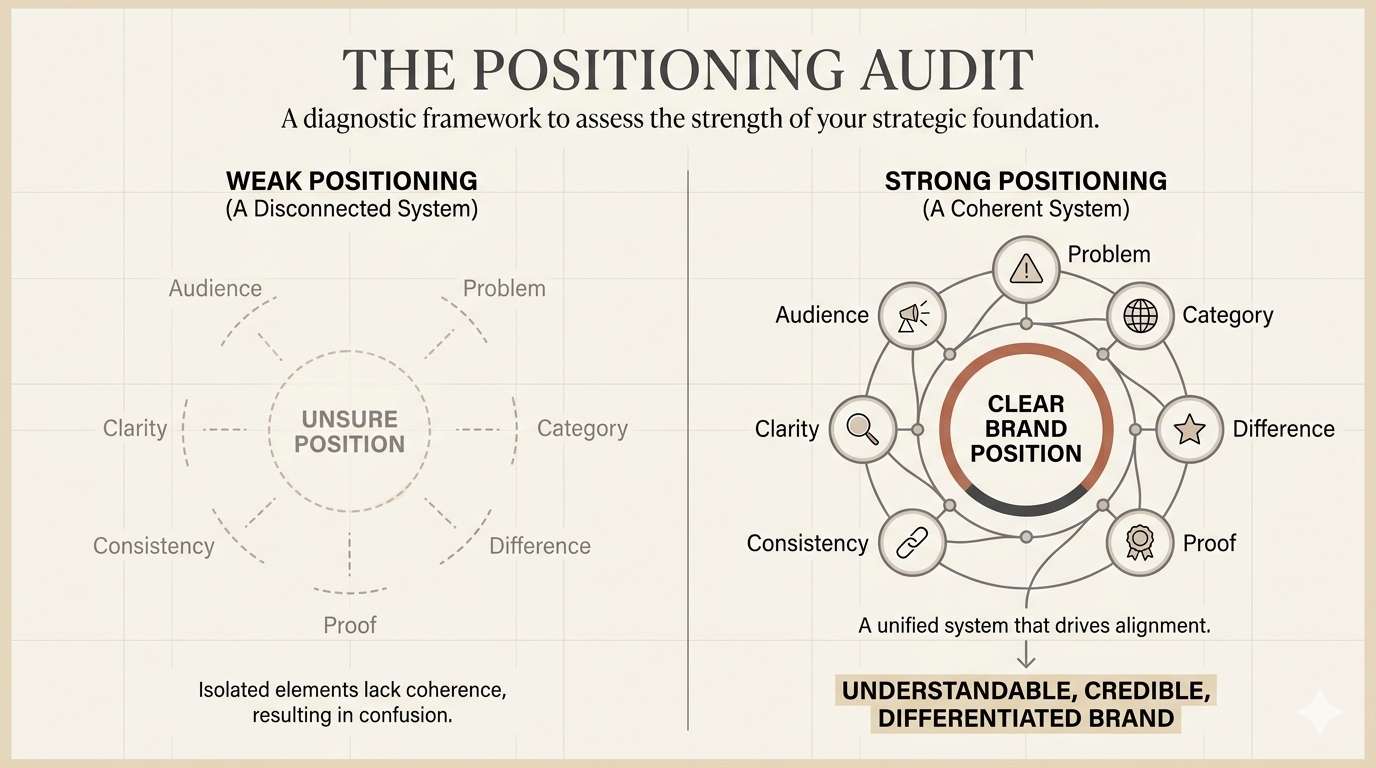
Take your current website homepage, social bio, product description, or sales page and answer these questions:
Audience: Who is this clearly for?
Problem: What important problem does it address?
Category: What does the customer understand the business to be?
Difference: Why this brand instead of another option?
Proof: What evidence supports the difference?
Consistency: Does the same idea appear across major customer touchpoints?
Clarity: Could a new visitor explain the brand after a short interaction?
The goal isn’t to produce perfect answers immediately.
The goal is to identify where the strategy becomes vague.
How to Fix Weak Brand Positioning Without Starting Over
A weak position doesn’t always require a complete rebrand.
Start by identifying the problem.
If the audience is unclear, refine the audience.
If the differentiation is weak, investigate competitors and customer needs.
If the message is confusing, simplify your value proposition.
If the visual identity doesn’t match the strategy, adjust the relevant identity elements.
If the brand has become inconsistent, establish clearer messaging and visual guidelines.
In other words:
Fix the strategic problem before redesigning the surface.
Sometimes the brand doesn’t need a new logo.
It needs a clearer answer to:
“Why should this particular customer choose us?”
Final Takeaway
Most brand positioning mistakes come from trying to communicate too much without making enough strategic choices.
A brand doesn’t become distinctive because it says it is different.
It becomes distinctive when a specific audience can understand:
what the brand is,
who it is for,
what problem it solves,
why its approach matters,
and why the difference is credible.
Positioning is therefore less about finding the perfect sentence and more about creating a coherent strategic direction.
Once that direction is clear, your messaging, content, visual identity, offers, and customer experience can reinforce the same idea.
And that consistency is what turns positioning from a document into an actual brand.
Frequently Asked Questions
What is the biggest brand positioning mistake?
One major problem is failing to make a clear strategic choice about the audience and the distinctive value the brand provides. When a brand attempts to appeal broadly without meaningful differentiation, its communication can become generic.
How do I know if my brand positioning is weak?
Look for signs such as customers misunderstanding what you offer, difficulty explaining your difference, generic messaging, inconsistent communication, or customers comparing you primarily on price. These signals can indicate that the intended position isn’t sufficiently clear or differentiated.
Can I change my brand positioning without rebranding?
Yes. Repositioning doesn’t automatically require a new logo or visual identity. Depending on the situation, the necessary changes may primarily involve audience definition, messaging, offer structure, value proposition, or customer experience.
Should a brand have only one positioning?
A brand generally benefits from having one coherent core position. Different products or campaigns can emphasize different benefits or audiences, but those variations should remain compatible with the broader brand strategy.
Is brand positioning the same as differentiation?
No. Differentiation describes meaningful ways a brand or offer differs from alternatives. Positioning is broader: it establishes how the brand should be understood by a specific audience in relation to those alternatives. Differentiation is one important component of positioning.
How often should I review my brand positioning?
Review it when there are meaningful changes in your audience, competitors, category, business model, products, or customer perception. You can monitor these factors regularly without constantly changing your core positioning.