
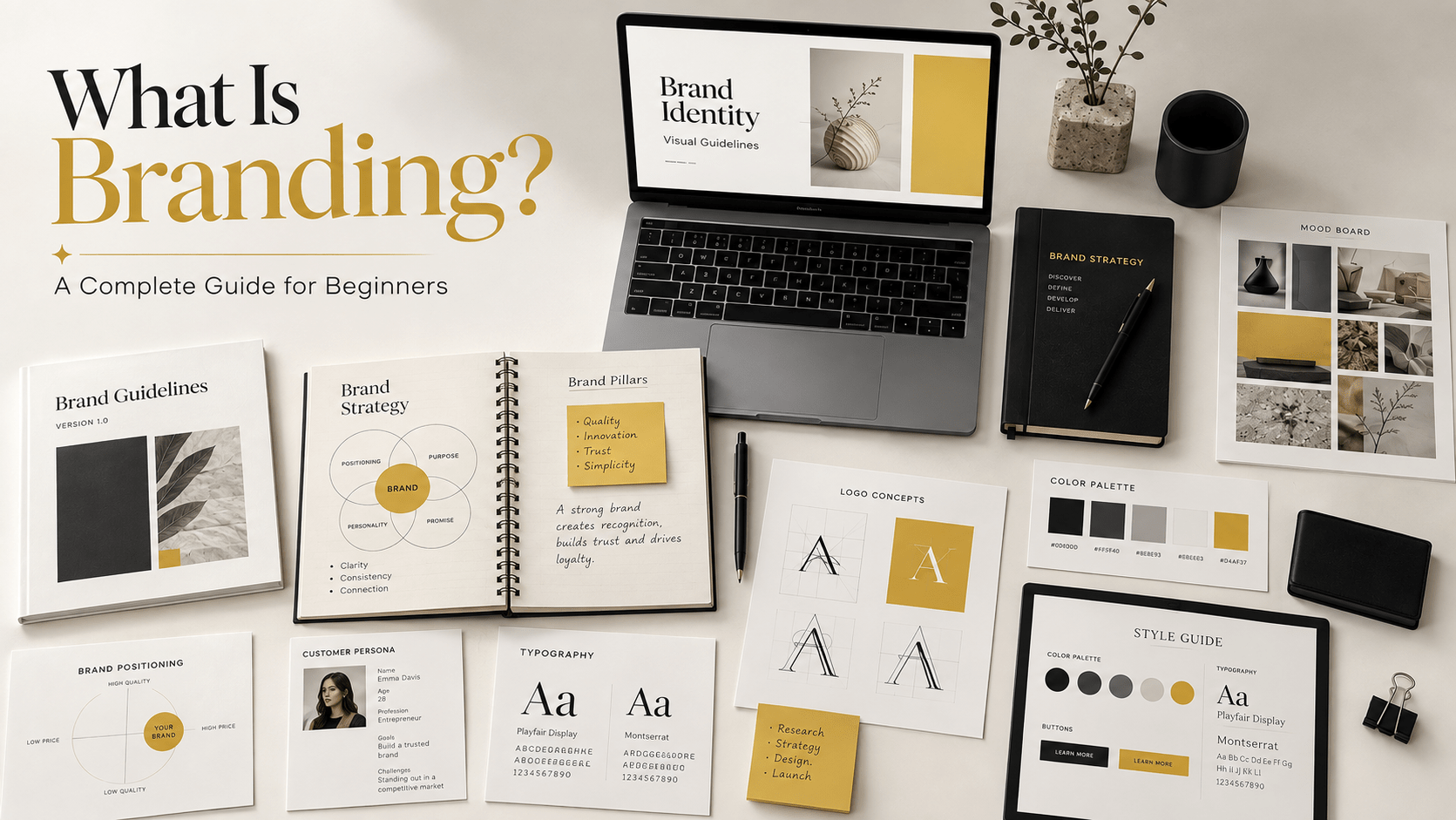
If you are building a business, personal brand, creative service, startup, or digital product, you have probably heard the same advice repeatedly:
“You need better branding.”
But what does that actually mean?
Does it mean a better logo? A new color palette? A more professional Instagram feed? A new website? Better packaging?
Those things can be part of branding, but they are not branding by themselves.
Branding is the larger system behind those decisions. It determines what your business stands for, who it is for, how it is different, how it communicates, how it looks, and ultimately what people remember when they encounter it.
That distinction matters because many businesses start with the visible layer.
They choose a logo. Then colors. Then fonts. Then templates.
Only later do they ask the questions that should have come first:
Who exactly are we trying to reach? What should people understand about us? Why should they choose us instead of another option? What should our brand feel like?
That is where effective brand building begins.
At GB Visual Studio, our approach starts with the belief that every strong brand begins with strategy, not aesthetics. Design becomes significantly more useful when you already understand what it needs to communicate.
This guide breaks branding down from the foundation upward—from strategy and positioning to identity, messaging, implementation, and consistency.
What You'll Learn
ToggleWhat Is Branding?
In simple terms, branding is the process of intentionally shaping how a business is understood and recognized by the people it wants to reach.
It includes strategic decisions about your audience, positioning, values, personality, messaging, voice, visual identity, and customer experience.
That means branding is not simply “making a business look professional.”
A useful way to think about it is:
“Branding is deciding what your business should mean to the right people—and then making that meaning recognizable everywhere.”
Your brand exists in the space between what you communicate and what people actually perceive.
You control the inputs: your positioning, messaging, identity, website, content, products, service experience, and communication.
You do not completely control the final perception.
That is why branding requires more than attractive design.
A beautiful visual identity attached to unclear positioning can still create confusion. A strong strategy with inconsistent execution can also become difficult to recognize.
The strongest brands connect the two.
Current branding guidance from Canva similarly separates brand strategy from brand identity while showing how audience research, positioning, voice, and visual identity work together.
What Is a Brand?
A brand is the collection of associations people connect with a business, product, service, person, or organization.
Think about what happens when someone hears a company name.
They may immediately associate it with a particular category, personality, visual style, promise, experience, or expectation.
That mental association is far more valuable than a logo alone.
A logo helps people recognize you.
A brand gives that recognition meaning.
This is why two businesses can sell similar products and still feel completely different.
One may feel sophisticated and premium.
Another may feel accessible and playful.
Another may feel technical and highly specialized.
The underlying products might overlap, but their positioning, personality, communication, identity, and customer experience create different perceptions.
Why Does Branding Matter?
Branding gives your business a recognizable point of view.
Without it, every communication decision tends to become independent.
You choose one style for Instagram, another for your website, another for your sales page, and another for your emails. Your messaging changes depending on the day. Your audience is broad because you are afraid of excluding anyone.
The result is not necessarily bad design.
It is inconsistency.
And inconsistency makes it harder for people to understand what you represent.
Branding creates a framework for making decisions.
It can help you answer questions such as:
- Does this design feel like us?
- Does this message speak to the right audience?
- Does this offer fit our positioning?
- Would someone recognize this content without seeing our name?
- Are we communicating the same core idea across different platforms?
Modern brand-building guidance increasingly treats branding as a system that extends beyond logos and colors into positioning, voice, messaging, and consistent application across customer touchpoints.
That is the real business value of branding.
It reduces randomness.
Branding vs Brand Strategy vs Brand Identity vs Marketing
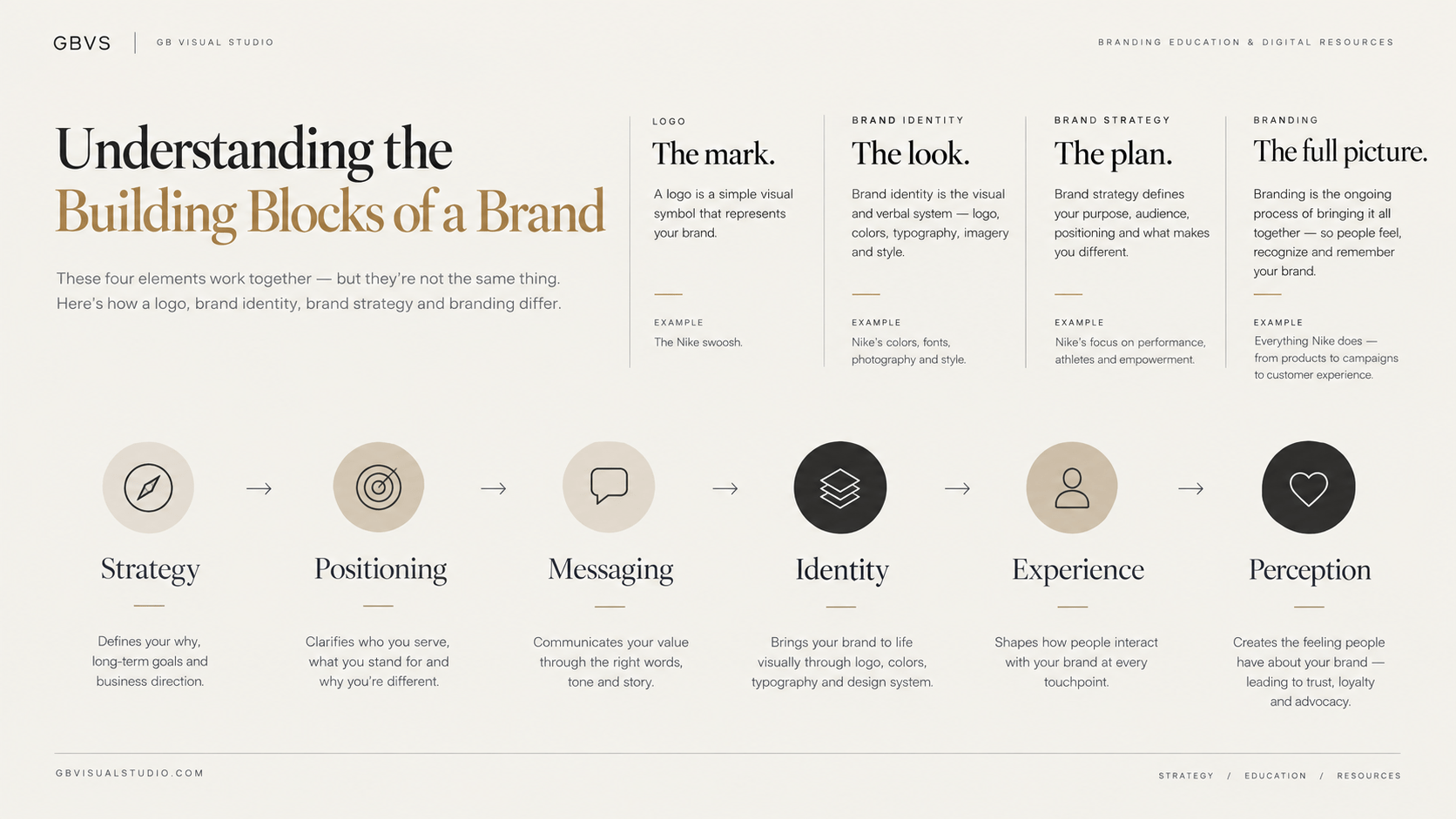
These terms are often used interchangeably, but they describe different layers of the same system.
Branding
Branding is the broader process of building and managing the brand.
It includes strategic, verbal, visual, and experiential decisions.
Brand Strategy
Brand strategy is the thinking behind the brand.
It defines where you want to compete, who you want to serve, what you want to be known for, how you differentiate, and what principles guide your communication.
If you want to go deeper, our guide to what brand strategy actually is and how it works explains the strategic layer separately.
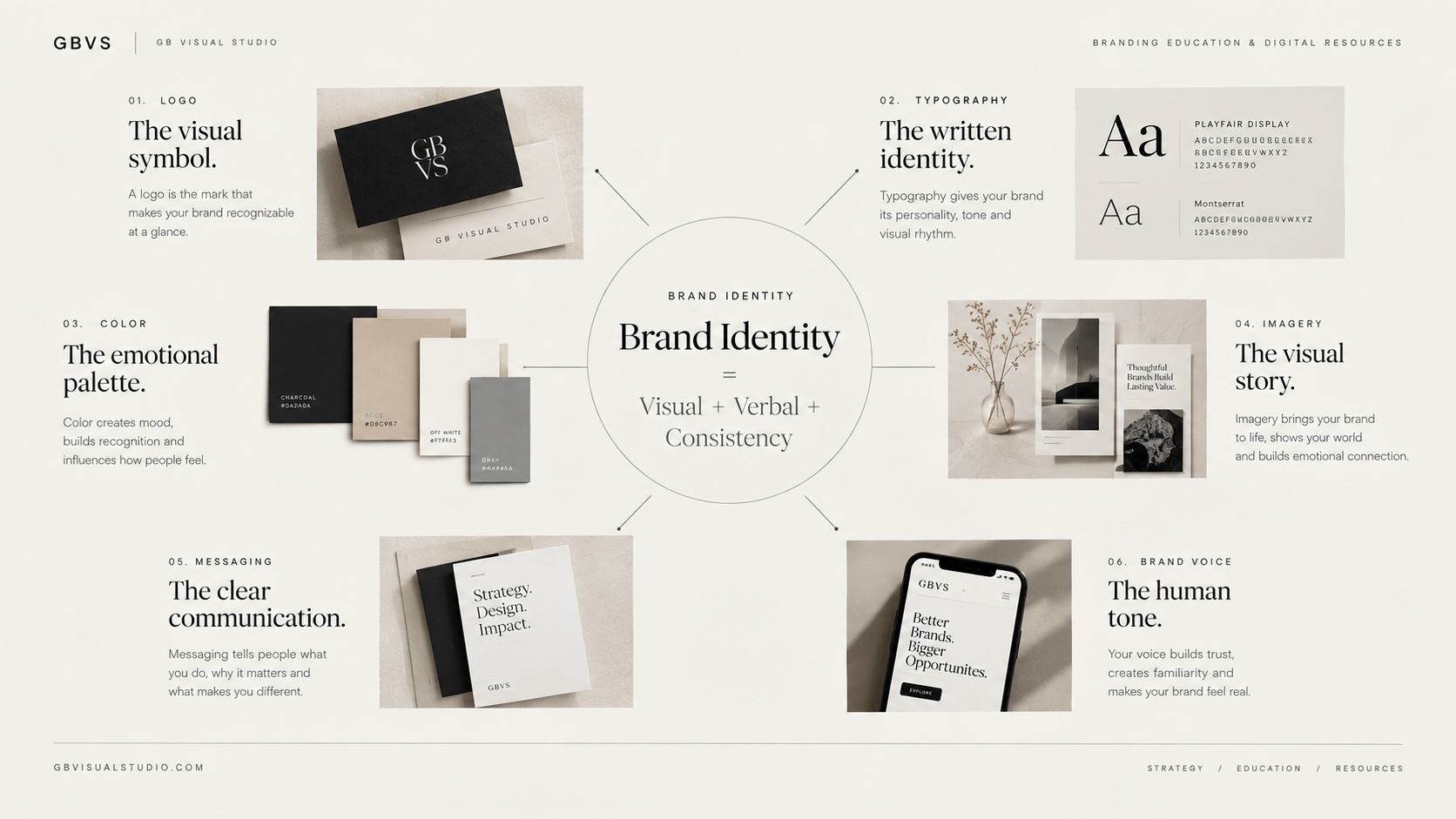
Brand Identity
Brand identity is how the brand expresses itself.
That can include:
- logo
- colors
- typography
- imagery
- graphic elements
- voice
- tone
- messaging
Shopify similarly describes brand identity as a collection of visual and verbal elements that represent a business.
Marketing
Marketing is how you promote your business, offers, products, and services.
Marketing can generate attention.
Branding helps determine what that attention becomes associated with.
A useful sequence is:
Strategy → Positioning → Messaging → Identity → Marketing → Experience → Perception
The exact process can vary by business, but the important principle is that the visible layer should not exist independently from the strategic one.
The Core Elements of Branding
Branding has many components, but they should not be treated as disconnected boxes.
They influence one another.
Brand Purpose
Your brand purpose explains the broader reason your business exists beyond simply making a sale.
It should give direction to the brand rather than becoming a vague inspirational sentence.
For example, instead of saying:
“We want to make the world better.”
A stronger purpose would clarify the specific change your business exists to create.
Your purpose should help influence decisions.
If it never affects your offers, communication, customer experience, or priorities, it is probably decoration rather than strategy.
Target Audience
A brand cannot effectively communicate to everyone.
Your audience definition should go beyond age, location, or job title.
You need to understand the problems people are trying to solve, what influences their decisions, what alternatives they currently use, what they value, and what might prevent them from choosing you.
That information influences everything that follows.
Your messaging changes.
Your positioning changes.
Your visual direction changes.
Even the complexity of your language can change.
For a deeper audience exercise, connect this article with the Ideal Customer Profile Guide.
Brand Values
Values define the principles your brand is willing to consistently represent.
The mistake is creating a list of impressive words such as “innovation,” “integrity,” “excellence,” and “passion” without defining what those words actually mean in practice.
A useful brand value should influence behavior.
If “simplicity” is a value, perhaps your website should be easier to navigate.
If “education” is a value, perhaps your content should explain rather than merely promote.
If “craftsmanship” is a value, perhaps quality control becomes part of your process.
Values become powerful when they affect decisions.
You can explore this further in How to Define Brand Values Step by Step.
Brand Positioning
Positioning answers a critical question:
Why should the right customer see your brand as a meaningful choice?
It is not simply a slogan.
It is the strategic space you want to occupy in your audience’s mind relative to alternatives.
A strong positioning decision considers your audience, category, competitive landscape, strengths, and the value you want to own.
Canva describes positioning as defining a brand’s position in the market relative to competitors and identifying the unique value or benefit associated with that brand.
This is why copying a competitor’s visual style is rarely a good branding strategy.
You may end up looking similar precisely when you need to become more distinguishable.
For a deeper breakdown, read the Brand Positioning Guide.
And if your positioning already feels unclear, the Brand Positioning Mistakes guide is the more relevant next step.
Brand Personality
If your brand were a person, how would it behave?
Would it be analytical?
Direct?
Playful?
Sophisticated?
Approachable?
Experimental?
Traditional?
Personality creates a consistent human quality around the business.
It also helps prevent communication from becoming generic.
Brand Voice
Your brand voice determines how your brand communicates.
Two companies can sell almost identical services but sound completely different.
One may communicate with short, direct sentences.
Another may use conversational storytelling.
Another may sound highly technical.
The important part is not choosing the “best” voice.
It is choosing a voice that fits the positioning, audience, and personality—and using it consistently.
For a deeper treatment, link readers to Brand Voice: The Complete Beginner’s Guide.
Messaging
Messaging turns strategic ideas into language people can understand.
Your messaging should communicate what you offer, who it is for, the problem you solve, why your approach matters, and what makes your offer different.
Good messaging is not necessarily clever.
It is clear.
A visitor should not need to decode your homepage to understand what your business does.
Visual Identity
This is the layer most people associate with branding.
It includes your logo, color system, typography, imagery, layout principles, graphic elements, and other visual assets.
But visual identity should be an expression of the strategy that came before it.
If your positioning says “premium strategic partner” but your visuals feel inconsistent, improvised, and overly decorative, there is a disconnect.
If your audience expects simplicity but your identity is visually overwhelming, there is another disconnect.
This is why I recommend treating visual identity as a system, rather than a collection of attractive assets.
Our Brand Identity Beginner Guide goes deeper into this layer.
How to Build a Brand Step by Step
Now we can turn all of those components into a practical process.
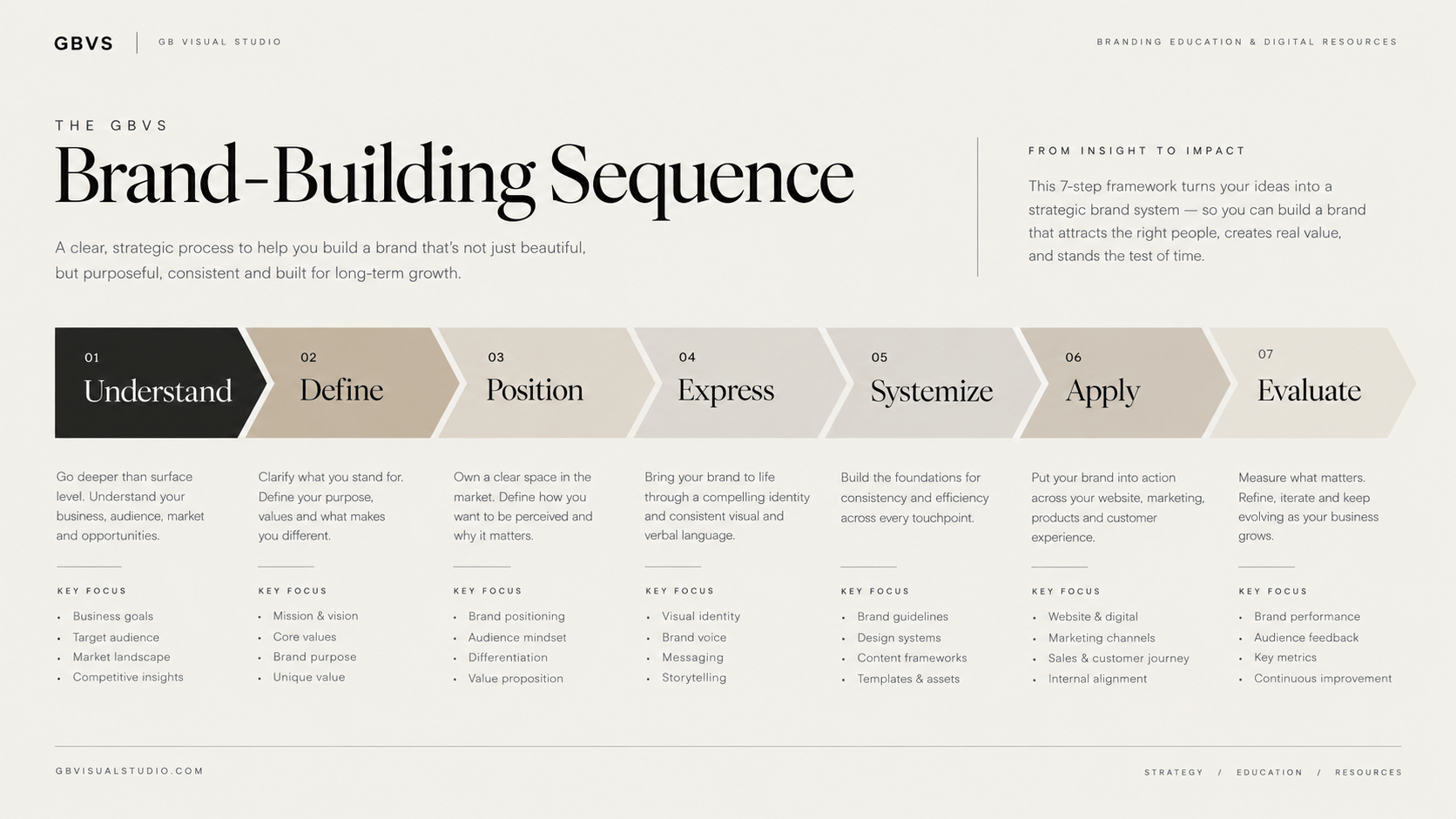
At GBVS, I prefer to think about brand building as seven connected stages:
Understand → Define → Position → Express → Systemize → Apply → Evaluate
The advantage of this sequence is that it prevents you from starting with the most visible part of branding before understanding the most important part.
1. Understand
Start with research.
Study your audience, category, competitors, customer problems, alternatives, and existing perception.
Do not begin with:
“What colors should my brand use?”
Begin with:
“What does my audience need to understand about us?”
That question changes the quality of everything that follows.
2. Define
Once you understand the environment, define your foundation.
Clarify your purpose, values, personality, audience, and core promise.
This becomes the internal reference point for later decisions.
Think of it as creating the strategic brief before opening the design software.
3. Position
Now decide where your brand belongs in the market.
You need to understand the alternatives your audience has and identify the meaningful difference your brand can own.
This does not necessarily mean inventing something nobody has ever done.
Sometimes differentiation comes from your audience, specialization, process, experience, philosophy, product structure, or combination of benefits.
The objective is not to look different for the sake of looking different.
It is to become meaningfully distinct.
4. Express
Only now should you translate strategy into communication.
Develop your messaging, voice, personality, and visual direction.
This is where strategy becomes visible and audible.
Your logo, typography, colors, imagery, layouts, content style, website copy, and social media should begin to feel like parts of the same brand.
That relationship is critical.
A brand should not have one personality on its website and another on Instagram simply because different templates were used.
5. Systemize
A brand becomes much easier to maintain when decisions are documented.
This is where brand guidelines, templates, content systems, design rules, messaging references, and reusable assets become useful.
The goal is not to create a 100-page brand manual nobody opens.
The goal is to make important brand decisions easier to repeat correctly.
6. Apply
Now take the system into the real world.
Your brand should appear consistently across the places where customers encounter it:
your website, social media, emails, sales pages, proposals, presentations, products, packaging, advertisements, and customer communication.
This is where many brands discover that their identity works beautifully in a presentation but falls apart in actual use.
A real brand system has to survive real-world applications.
7. Evaluate
Branding is not finished when the logo files are exported.
You need to observe whether the brand remains recognizable, relevant, consistent, and understandable.
Look for signals such as:
Are people describing your business in the way you intended?
Do customers understand your offer quickly?
Does your content feel connected across platforms?
Can someone recognize your communication without seeing your name?
Does the brand still fit your business as it evolves?
Brand building is an ongoing process rather than a one-time design event.
Branding Is a System, Not a Collection of Assets
This is one of the most important distinctions for beginners.
Imagine a business has:
a beautiful logo,
three excellent brand colors,
professional typography,
high-quality social templates,
and an impressive website.
But its homepage does not clearly explain what it offers.
Its Instagram content speaks to three completely different audiences.
Its sales page uses a different tone.
Its visuals change every week.
Its offers are positioned differently across platforms.
Does it have a strong brand?
Not necessarily.
It has brand assets.
A brand system is different.
The system connects those assets to a consistent strategic idea.
That is why I would rather see a simple identity applied consistently than an impressive collection of disconnected visuals.
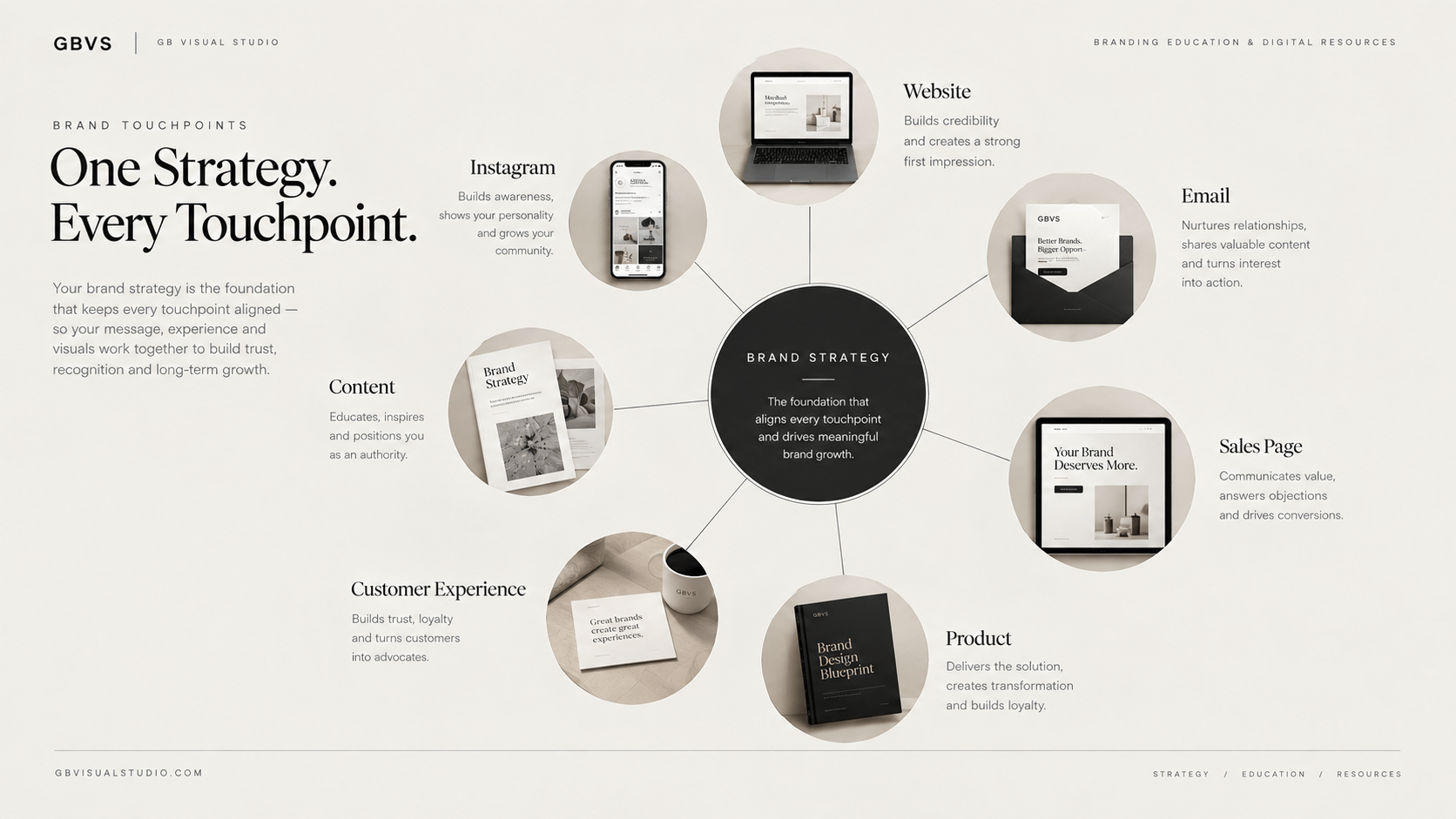
Branding at Real Customer Touchpoints
A brand becomes real through repeated encounters.
Consider a fictional design studio.
A potential customer first discovers it through Instagram.
The Instagram content communicates strategic expertise.
They visit the website.
The website reinforces the same positioning.
They download a free resource.
The writing style feels consistent.
They receive an email.
The tone remains recognizable.
They visit the sales page.
The offer is explained using the same core message.
They purchase.
The product experience follows the same visual and communication principles.
That is branding working as a system.
Not because every screen looks identical, but because every interaction reinforces the same underlying idea.
Common Branding Mistakes Beginners Make
One of the biggest mistakes is starting with aesthetics.
Design is exciting because you can immediately see the result.
Strategy is slower.
But choosing a color palette before deciding what the brand should communicate often creates unnecessary redesign later.
Another mistake is trying to appeal to everyone.
A broad audience sounds attractive, but vague positioning makes communication harder.
A third mistake is copying competitors.
Researching competitors is useful. Reproducing their identity is not.
You want to understand the market well enough to identify opportunities for distinction.
Another common problem is changing the brand every time a trend changes.
A brand should be capable of evolving without losing its recognizable core.
And finally, many businesses confuse more branding with better branding.
More colors, more fonts, more graphics, more templates, and more content do not automatically create a stronger brand.
Clarity usually creates more value than complexity.
How to Know If Your Branding Is Working
Brand performance is not measured simply by whether someone says:
“Your branding looks good.”
That is nice feedback, but it is incomplete.
Ask whether the brand is helping people understand the business.
Can your audience identify what you do?
Can they recognize your content?
Do they understand who the offer is for?
Can they describe what makes the business different?
Does the experience feel consistent from discovery to purchase?
And perhaps most importantly:
Does your visual identity reinforce your strategic positioning instead of contradicting it?
Those questions give you more useful information than simply asking whether the logo looks attractive.
A Simple 10-Minute Brand Audit
You do not need a complicated audit to identify obvious weaknesses.
Open your website and one of your main social profiles.
Look at them as though you have never seen the business before.
Ask:
What does this business do?
Who is it clearly for?
What does it seem to stand for?
What makes it different?
Does the visual identity match the impression the business wants to create?
Does the language sound like the same brand everywhere?
Would I recognize another piece of content from this business without seeing the username?
If your answers are unclear, do not immediately redesign the logo.
You probably need to revisit the strategy underneath the identity.
Branding Example: From Strategy to Visual Identity
Imagine two fictional businesses selling productivity templates.
The first says:
“We sell productivity templates for everyone.”
The second says:
“We create simple planning systems for independent creatives who need structure without corporate complexity.”
Both businesses might sell similar products.
But the second has more strategic direction.
The positioning influences the messaging.
The messaging influences the tone.
The tone influences the visual direction.
The visual direction influences typography, imagery, layout, social content, product presentation, and website design.
Suddenly, the design decisions have a reason.
That is the difference between decorating a business and building a brand.
Can You Build a Brand Without a Designer?
Yes.
You can absolutely establish your strategic foundation yourself.
In fact, you should be involved in it because nobody understands your business, audience, offer, and ambitions as deeply as you do.
You can research your audience, define your values, clarify your positioning, develop your messaging, document your personality, and establish your brand direction.
A designer becomes particularly valuable when you need to translate those decisions into a cohesive visual system.
That distinction is important.
A designer should not have to guess your strategy while simultaneously designing your identity.
The better the strategic foundation, the more useful the design process becomes.
If you’re working with a limited budget, our guide on how to build a brand identity without a designer is a useful next step.
What About AI and Branding?
AI has changed how quickly businesses can generate names, copy, images, concepts, moodboards, and visual experiments.
But speed does not automatically create strategy.
AI can generate ten logo directions in seconds.
It cannot decide which positioning is strategically appropriate for your business without the right context and human judgment.
This distinction is becoming increasingly important as AI-assisted design becomes normal.
Use AI to accelerate research, ideation, exploration, production, and iteration.
Do not outsource the fundamental brand decisions simply because a tool can generate attractive options.
For businesses exploring this area, our AI Brand Strategy Guide explores how AI can fit into the strategic process.
Frequently Asked Questions About Branding
What is branding in simple terms?
Branding is the intentional process of shaping how your business is understood, recognized, and remembered by the people you want to reach.
What are the main elements of branding?
The major elements include audience, purpose, values, positioning, personality, voice, messaging, visual identity, brand guidelines, and customer experience.
Is branding the same as a logo?
No. A logo is one component of visual identity. Branding is the broader system that connects strategy, communication, identity, experience, and perception.
What comes first: branding or marketing?
Brand strategy should generally inform marketing. Marketing communicates and promotes the business, while branding establishes what that communication should consistently represent.
How do you build a brand from scratch?
Start with research and audience understanding, define your foundation, establish positioning, develop messaging and personality, create the visual identity, systemize the brand, apply it across touchpoints, and evaluate how well it works.
Can a small business benefit from branding?
Yes. Small businesses often benefit from clarity because they have fewer resources to waste on inconsistent communication. Strong positioning can also make it easier to decide what opportunities to pursue and which customers to prioritize.
How long does it take to build a brand?
There is no universal timeline. A simple brand foundation can be developed relatively quickly, while a complete identity and implementation system may require considerably more work. The appropriate timeline depends on the business, scope, research requirements, and number of touchpoints.
The Branding Process in One Sentence
If you remember only one idea from this entire guide, remember this:
Do not start by asking what your brand should look like. Start by deciding what your brand should mean.
Then build the visual and verbal system that makes that meaning recognizable.
That is the difference between choosing branding elements and actually building a brand.
The process can be summarized as:
Understand → Define → Position → Express → Systemize → Apply → Evaluate.
Your audience informs your strategy.
Your strategy informs your positioning.
Your positioning informs your messaging.
Your messaging and personality influence your voice.
Your strategy and personality inform your visual direction.
Your identity becomes a system.
That system is then applied consistently across the business.
And over time, repeated exposure creates recognition and stronger associations.
Where Should You Start?
If you’re currently looking at your business and thinking, “I know my branding needs work, but I don’t know where to begin,” resist the temptation to redesign everything immediately.
Start with clarity.
Before changing your logo, colors, website, Instagram templates, or typography, understand the business underneath the visuals.
The free Brand Clarity Checklist is designed for exactly that starting point. It gives you a structured place to work through your audience, positioning, values, differentiation, and foundational brand decisions.
Once your strategic foundation is clear, the next question becomes visual:
How do you turn that strategy into a cohesive identity?
That is where the GBVS Brand Design Blueprint fits.
It focuses on the process of translating brand strategy into visual direction—including logo direction, color, typography, imagery, layout, social media design, and the broader visual system.
The goal is not to make your business look like every other “professional” brand online.
The goal is to create a brand that looks, sounds, and behaves like itself.
Final Thought
Good branding is not about making more things.
It is about making better decisions.
When the strategy is clear, design becomes easier.
When positioning is clear, messaging becomes easier.
When messaging is clear, content becomes easier.
When the identity is systemized, consistency becomes easier.
And when all of those layers work together, your audience has a much better chance of understanding what your business represents.
That is what makes branding valuable.
Not the logo by itself.
Not the color palette by itself.
Not the Instagram feed by itself.
The system connecting all of them.
2 Comments
[…] you need the broader context first, start with the complete beginner’s guide to branding, which explains how strategy, positioning, identity, messaging, and customer experience fit […]
[…] you haven’t read the broader pillar yet, start with the complete beginner’s guide to branding. It explains how brand strategy, positioning, identity, messaging, and experience […]