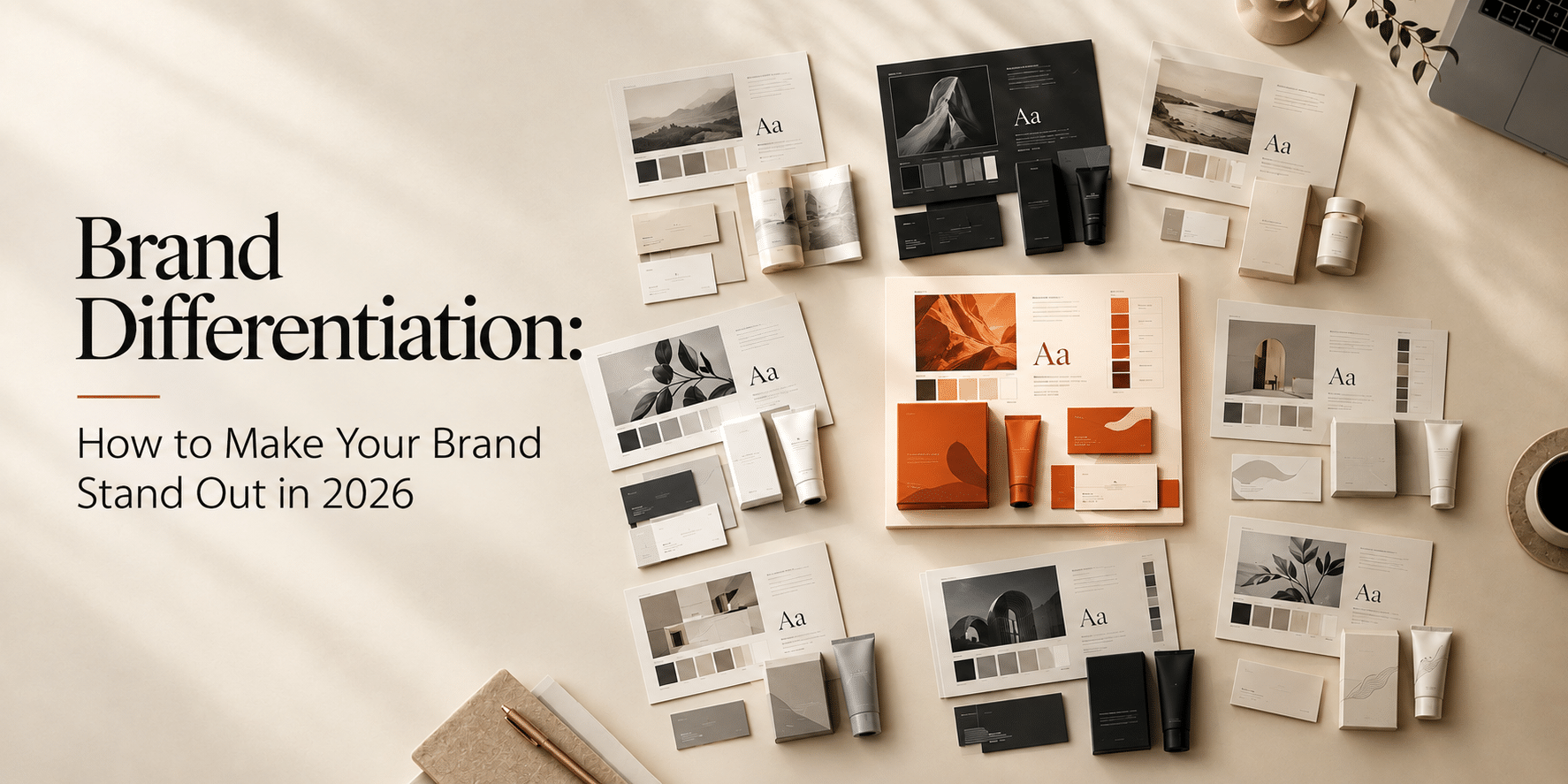
In 2026, it is easier than ever to look like your competitors.
A small business can use the same website templates, AI writing tools, stock photography, social media formats, colors, fonts, and marketing advice as thousands of other businesses.
A designer can describe their service as “creative solutions for modern brands.”
A marketing consultant can say they provide “strategic, results-driven marketing.”
A coach can say they help clients “unlock their full potential.”
A SaaS company can describe itself as an “all-in-one platform.”
None of these statements are necessarily wrong.
The problem is that they do very little to help a customer understand why this brand is different.
That is where brand differentiation becomes important.
Brand differentiation is not simply about being unusual. It is about creating meaningful reasons for your target audience to recognize your brand as distinct from available alternatives.
And that distinction has to show up across the brand—not just in a tagline.
Your positioning, offer, customer experience, messaging, visual identity, content, and even the way you sell should reinforce the same difference.
This guide explains how brand differentiation works, how to find a genuine point of difference, what makes differentiation strong or weak, and how smaller businesses can use specificity as a competitive advantage in 2026.
What You'll Learn
ToggleWhat Is Brand Differentiation?
Brand differentiation is the process of establishing meaningful characteristics that distinguish your brand from competing alternatives in ways that matter to your target audience.
The important word is meaningful.
Being different for the sake of being different is not enough.
Imagine two branding studios.
Studio A says:
“We create beautiful branding for ambitious businesses.”
Studio B says:
“We build practical brand systems for service businesses that have outgrown inconsistent DIY branding.”
Studio B has made a more specific strategic choice.
It has defined:
- a particular type of customer
- a recognizable business situation
- a particular problem
- a specific type of solution
That specificity gives the audience something to recognize.
Brand positioning and differentiation are closely connected. Positioning defines the place you want your brand to occupy in the customer’s mind, while differentiation helps establish why your brand deserves that position. Current positioning guidance similarly emphasizes audience specificity, category, value, and a credible point of difference rather than relying on generic claims.
Brand Differentiation vs Brand Positioning
These concepts are related, but they are not identical.
Positioning asks:
What place should our brand occupy in the customer’s mind?
Differentiation asks:
What meaningful reason gives customers a reason to distinguish us from alternatives?
For example:
A positioning direction might be:
A branding studio for growing service businesses that need a clearer and more consistent brand system.
The differentiation might come from:
Combining strategic positioning with practical visual systems that the business can actually maintain internally.
The positioning establishes the territory.
The differentiation gives that territory substance.
This is why you should read this article alongside the Brand Positioning Guide 2026.
Why Brand Differentiation Matters More in 2026
The problem of sameness has become particularly visible as AI-assisted content and design have become easier to produce.
If 100 businesses can ask an AI system for:
“Write a professional Instagram caption for my branding agency.”
they can easily end up with similar vocabulary, structures, and claims.
The same applies to visual content.
If everyone can quickly generate polished social graphics, the visual appearance alone becomes a weaker source of differentiation.
This does not make design irrelevant.
It makes strategic meaning behind the design more important.
A useful brand therefore needs more than polished execution.
It needs a reason to exist that is recognizable.
Recent 2026 positioning analyses repeatedly emphasize specificity—particularly specificity around audience, problem, category, and reason to choose a brand—as a practical route to differentiation.
The 5 Levels of Brand Differentiation
Not every difference has the same strategic value.
Consider differentiation as a progression.
1. Cosmetic Differentiation
This is the easiest level.
You use:
- different colors
- different fonts
- different layouts
- unusual imagery
- a distinctive logo
These choices can make a brand look different.
But competitors can copy them.
A visual difference is useful when it expresses a deeper strategic idea, but visual novelty by itself is rarely enough.
2. Messaging Differentiation
Now the brand communicates differently.
Instead of saying:
“We provide high-quality design.”
you might say:
“We turn scattered brand assets into a system your team can actually use.”
The second statement communicates a particular problem and outcome.
It is more useful because it gives the audience something specific to associate with the brand.
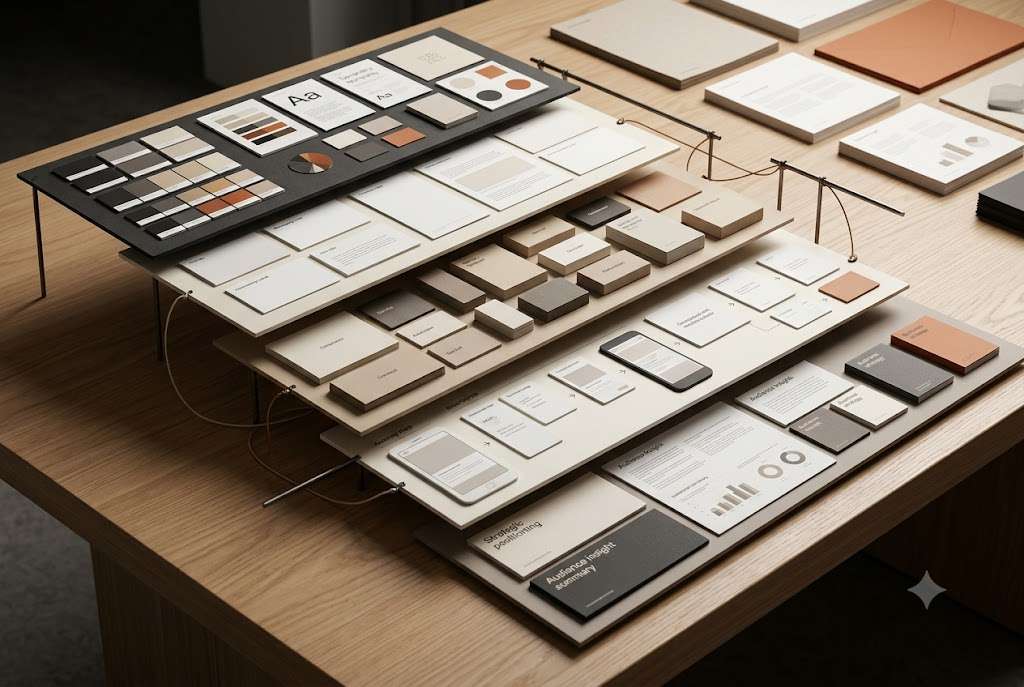
3. Offer Differentiation
Here the difference exists in what you actually sell.
Imagine two freelance designers.
One offers:
Logo Design — $500
Another offers:
Brand Starter System — logo, typography, color system, social templates, brand guidelines, and launch-ready assets.
The second has changed the offer itself.
This can create a stronger basis for differentiation because the difference is embedded in the customer’s experience rather than simply described in marketing.
4. Experience Differentiation
Sometimes the product is similar to competitors, but the experience is different.
Consider a small consulting business that:
- explains every recommendation
- provides clear project stages
- gives clients structured review points
- documents decisions
- supplies reusable resources after the project
The service category may be similar to competitors.
The experience is not.
This can become part of the brand’s identity.
5. Strategic Differentiation
The strongest differentiation often comes from a strategic choice about who you serve, what problem you solve, how you solve it, or what you refuse to do.
For example:
Instead of:
“We are a digital marketing agency.”
a business might build its entire model around:
“Marketing systems for independent professional firms that do not have an in-house marketing team.”
That decision affects the offer, content, expertise, website, examples, sales process, and customer experience.
Now the differentiation is not a slogan.
It is a business model.
How to Find Your Brand's Difference
You do not need to invent a completely new category.
Start with what already exists inside your business.
Step 1: Define Your Real Customer
Begin with your actual audience rather than “everyone who needs our service.”
Ask:
Who gets the most value from what we already do?
For example, a designer may discover that most of their strongest projects come from:
- consultants
- coaches
- small agencies
- SaaS founders
But perhaps consultants are the group that consistently values strategy, responds fastest, and gets the strongest outcome.
That observation may lead to a more focused positioning opportunity.
Your Ideal Customer Profile Guide 2026 can help you work through this stage.
Step 2: Identify the Problem Behind the Purchase
Customers rarely buy a service simply because the category exists.
They buy because something needs to change.
A business might hire a designer because:
“We need a new logo.”
But the deeper problem might be:
“Our company has grown, but our visual communication still looks like a one-person business.”
That is a much more useful strategic insight.
Ask:
What happened immediately before the customer started looking for a solution?
That situation often reveals a stronger differentiation opportunity.
Step 3: Study What Competitors Say
Look at competitor websites, social profiles, product pages, offers, and customer-facing language.
Do not only ask:
“Who is better?”
Instead ask:
“Where do these businesses sound exactly the same?”
Create a simple comparison.
| Competitor language | What it tells you |
|---|---|
| High-quality service | Common category claim |
| Customer-focused | Common category claim |
| Creative solutions | Broad and difficult to own |
| Affordable pricing | Price-based positioning |
| Fast turnaround | Potential operational differentiator |
| Industry-specific expertise | Potential specialization |
| Specific customer/problem combination | Stronger positioning territory |
The purpose is not to copy competitors.
It is to identify the language everyone is already using.
Step 4: Find Your Unusual Strength
Your differentiation does not have to come from an entirely new product.
It might come from something you already do unusually well.
Perhaps your company:
- understands a particular industry deeply
- serves a narrow audience
- combines two disciplines
- has a distinctive process
- simplifies a complicated problem
- provides unusually practical implementation
- offers a different customer experience
- has proprietary knowledge
- works with a particular business stage
Ask:
What do we do naturally that our competitors would struggle to replicate consistently?
That question is more useful than:
“What makes us unique?”
Almost every business can claim to be unique.
Fewer can explain why.
Step 5: Look for the Intersection
Strong differentiation often appears where four things overlap:
Customer need
Your strength
Market gap
Credible proof
For example:
A small branding studio notices that its target customers are tired of receiving beautiful brand files that they do not know how to use.
The studio is particularly good at creating practical templates and systems.
Competitors mainly sell identity design.
The studio has multiple examples showing clients using the systems after launch.
That creates a potential differentiation territory:
Strategic branding that is designed for implementation, not just presentation.
The important part is that the difference is supported by how the business actually operates.

A Real-World Example: IKEA
IKEA is useful because its differentiation is not simply “good furniture.”
Its model has long emphasized accessible design, self-service shopping, flat-pack products, and a customer experience built around those choices.
Its differentiation therefore comes from a combination of product design, pricing logic, distribution, customer participation, and experience.
That is more defensible than simply claiming:
“We make stylish furniture.”
The lesson for a smaller business is not to imitate IKEA.
It is to recognize that differentiation becomes stronger when several parts of the business reinforce the same strategic idea.
A 2026 Example: The Small Branding Studio
Consider a fictional branding studio called Northline Studio.
Its original positioning:
“We provide branding and graphic design services for businesses.”
There is nothing wrong with it.
But it gives prospects little reason to remember Northline.
The studio reviews its last 20 projects.
It discovers that most clients were established service businesses that had grown beyond their original DIY branding.
Those businesses had a similar problem:
Their logo was acceptable, but their website, presentations, social media, proposals, and sales materials all looked different.
Northline realizes its real strength is not simply logo design.
It is creating coherent visual systems for businesses that have outgrown inconsistent branding.
Its new strategic direction could therefore become:
Brand systems for growing service businesses that have outgrown DIY branding.
Now several things change.
The content can discuss brand inconsistency.
The portfolio can show before-and-after systems.
The service packages can focus on brand foundations and implementation.
The website can speak directly to businesses at that stage.
The differentiation becomes visible throughout the customer journey.
That is what strategic differentiation looks like.
7 Common Brand Differentiation Mistakes
You do not need to invent a completely new category.
Start with what already exists inside your business.
Saying "Quality" Is Your Difference
Almost every business wants to claim quality.
Quality can matter, but it becomes a differentiator only when you can define what makes your quality different and provide evidence for it.
Trying to Appeal to Everyone
A statement such as:
“We help businesses of all sizes achieve their goals.”
creates a huge potential audience.
But it creates very little recognition.
Specificity can make a smaller brand easier to understand.
Differentiating Through Design Alone
A purple logo does not create a differentiated brand.
Neither does a minimalist website.
Visual identity should express strategy rather than replace it.
Copying a Competitor's Differentiator
If another company has already established a meaningful association, simply repeating the same claim rarely creates a strong position.
Study competitors to understand the market—not to reproduce their language.
Choosing a Difference Customers Do Not Care About
You may consider something unique.
Your customers may consider it irrelevant.
A useful differentiator must matter to the people you want to attract.
Choosing a Difference You Cannot Prove
Suppose you claim:
“We are the fastest branding studio.”
Can you consistently deliver that experience?
If not, the differentiation becomes a marketing claim rather than a strategic advantage.
Changing Your Differentiation Every Month
A brand needs enough consistency for people to associate it with something.
If your January message is:
“Affordable branding.”
February:
“Premium branding.”
March:
“AI-powered branding.”
and April:
“Branding for everyone.”
your audience receives four different signals.
Differentiation requires commitment.
How to Turn Differentiation Into Your Brand
Finding a difference is only the beginning.
Your differentiation should influence the entire brand system.
Positioning
Explain who you serve and why your approach matters.
Messaging
Repeat the central idea in different forms across your content.
Visual Identity
Create a visual language that reinforces the brand’s strategic personality.
Content
Teach the problems and perspectives associated with your area of expertise.
Offer
Design services or products that support your positioning.
The Brand Differentiation Test
Before committing to a differentiator, put it through five questions.
Is it relevant?
Does the target audience care?
Is it specific?
Can someone understand the difference without interpreting vague marketing language?
Is it credible?
Can you demonstrate or prove it?
Is it defensible?
Would competitors struggle to reproduce it immediately?
Is it sustainable?
Can you continue delivering it as the business grows?
If the answer is yes across these areas, you may have a useful strategic direction.
From Differentiation to Positioning
Once you have identified a credible difference, the next step is deciding how that difference should shape your market position.
For example:
Differentiation:
We specialize in helping service businesses turn inconsistent DIY branding into practical brand systems.
Positioning:
We are a branding studio for growing service businesses that have outgrown DIY branding.
Messaging:
Your business has grown. Your brand should catch up.
The three statements are connected, but they perform different jobs.
This is why differentiation should be developed alongside positioning rather than treated as an isolated marketing exercise.
If you have not already worked through your positioning, continue with the Brand Positioning Guide 2026.
Final Takeaway
Brand differentiation is not about making your brand look strange.
It is about making your brand meaningfully recognizable.
A strong differentiator can come from your audience, problem, expertise, process, offer, experience, philosophy, or business model.
But it has to matter to the customer and be supported by what your business actually does.
In 2026, when AI and digital tools make polished content and design increasingly accessible, this becomes even more important.
Your competitor can copy your color palette.
They can copy your content format.
They can generate similar headlines.
They can imitate your visual style.
What becomes harder to copy is a deeply integrated strategic position built around a specific audience, meaningful problem, distinctive approach, and credible experience.
So instead of asking:
“How can we look different?”
ask:
“What meaningful difference can our brand consistently own?”
That is where real brand differentiation begins.
Frequently Asked Questions
What is brand differentiation?
Brand differentiation is the process of establishing meaningful characteristics that distinguish your brand from competing alternatives in ways that matter to your target audience.
What is an example of brand differentiation?
A generic design studio might say it provides creative branding services. A differentiated studio might specialize in helping growing service businesses turn inconsistent DIY branding into a practical brand system. The second approach creates a clearer audience, problem, and reason to choose the business.
What is the difference between brand differentiation and brand positioning?
Brand positioning defines the place a brand aims to occupy in the customer’s mind. Brand differentiation identifies the meaningful characteristics or advantages that distinguish the brand from alternatives and help support that position.
How do I differentiate my small business?
Start by identifying your strongest customer group, the specific problem they have, what competitors commonly offer, what your business does unusually well, and what evidence supports that difference. Then incorporate the difference into your positioning, messaging, offer, visual identity, content, and customer experience.
Does a brand need a completely unique product to differentiate?
No. Differentiation can come from the audience you serve, your specialization, process, experience, offer structure, expertise, customer service, business model, or the way you solve an existing problem.
Can AI help with brand differentiation?
Yes. AI can help analyze competitor messaging, customer research, reviews, and existing content to identify patterns and possible differentiation opportunities. However, AI-generated ideas should be validated against real customers, competitors, business capabilities, and evidence before becoming part of the brand strategy.
Is having a unique logo enough to differentiate a brand?
No. A logo can contribute to visual recognition, but meaningful differentiation usually requires a broader strategic difference. The logo, visual identity, messaging, offer, and customer experience should reinforce the same positioning.
How often should a brand change its differentiation?
A brand should not change its core differentiation simply because a new marketing trend appears. Revisit it when there is meaningful evidence that the audience, market, competitors, business model, or strategic direction has changed.
1 Comment