You have a logo. You have a website. You post consistent content. Your work is professional.
So why does your brand still feel… incomplete?
Like something’s missing, even though you can’t quite name it?
This happens to talented people all the time. And I see the same pattern over and over again.
The problem isn’t what you think it is.
The Real Reason Your Brand Feels Fragmented
Most people assume their brand problem is one of these:
- Your website needs better design
- Your content needs more engagement
- Your visual identity needs refinement
- You need better graphics or templates
But here’s what I’ve discovered after working with dozens of founders, creators, and small business owners:
Your brand doesn’t feel incomplete because of design or content.
Your brand feels incomplete because you don’t have a system.
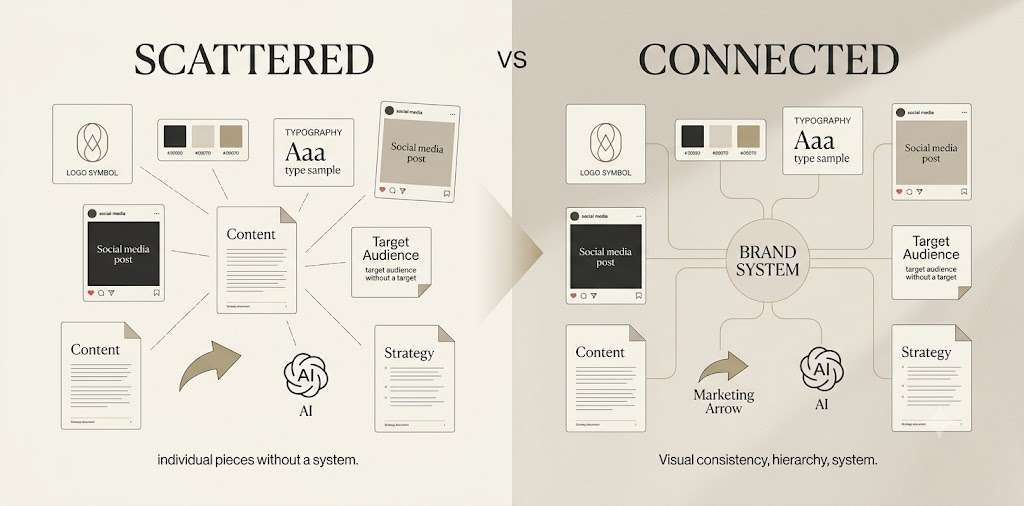
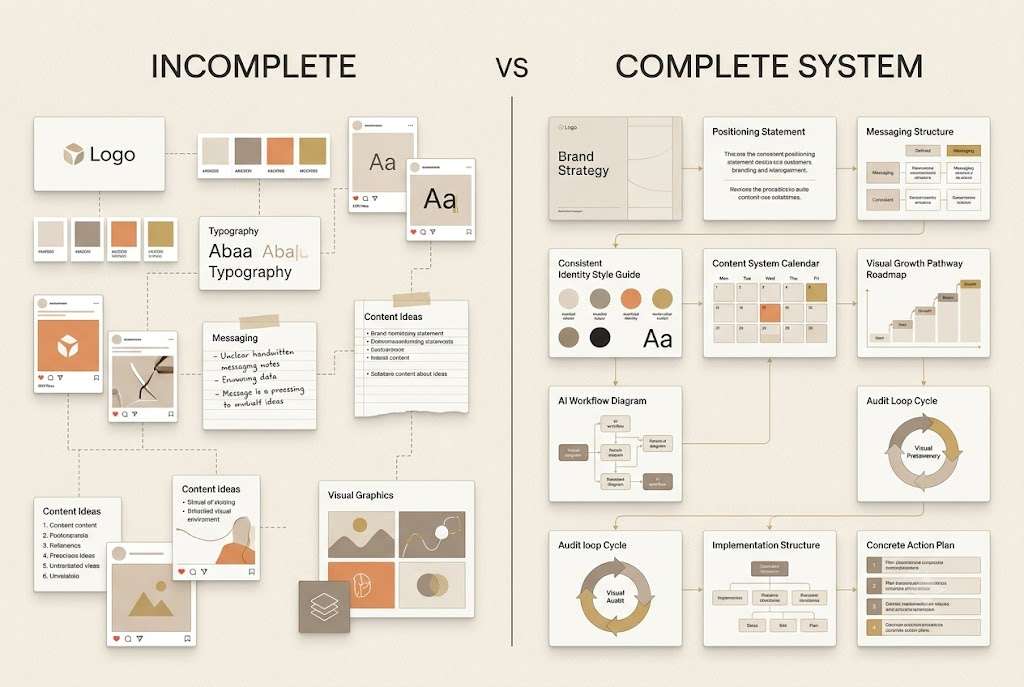
You have pieces. But the pieces don’t connect.
Your logo is beautiful. But it doesn’t connect to your positioning.
Your website is professional. But your messaging is unclear.
Your content is consistent. But it doesn’t prove what you stand for.
You’re building your brand like a checklist instead of like a system.
And that’s why nothing feels connected.
The Difference Between Pieces and Systems
Here’s the distinction that changes everything:
Pieces: Individual elements that exist separately
- Logo ✓
- Website ✓
- Content ✓
- Color palette ✓
- Brand guidelines ✓
System: All pieces working together with purpose
- Clear positioning
- Consistent messaging connected to positioning
- Visual identity that supports positioning
- Content strategy tied to positioning
- Growth strategy based on positioning
When you have pieces without a system, everything feels random.
Even if each piece is well-designed.
When you have a system, everything aligns.
And alignment is what creates clarity.
What You'll Learn
ToggleThe 10-Piece Brand System That Actually Works
Here’s what I’ve learned: Every successful brand operates using the same 10-piece system.
Sometimes they stumbled into it. Sometimes they built it intentionally.
But the pattern is always there.
Piece 1: Clarity
You know what you do. But do you know why it matters? Who specifically it’s for?
This is where most brands get fuzzy.
They try to serve everyone. Which means they feel generic to everyone.
Piece 2: Positioning
This is what makes you different.
Not your price. Not your delivery method.
Your actual point of view.
What do you believe about your industry that’s different?
Most brands skip this. They jump straight to visual design. That’s why they feel like every other brand.
Piece 3: Messaging
This is how you translate positioning into words.
Your key messages. Your brand voice. How you explain your offer.
Without consistent messaging, people can’t explain your brand to others.
Piece 4: Visual Identity
Now you can design with purpose.
Colors that communicate what you stand for. Typography that reinforces your voice. Imagery that aligns with positioning.
When visual identity comes after positioning, it actually works.
Piece 5: Content Strategy
What should you post about?
If you don’t know your positioning, you’re just posting topics that seem relevant.
With a system, every piece of content proves your positioning.
Piece 6: Brand Growth Strategy
How does someone find you?
Where is your audience? What message converts them?
Without a system, growth is random.
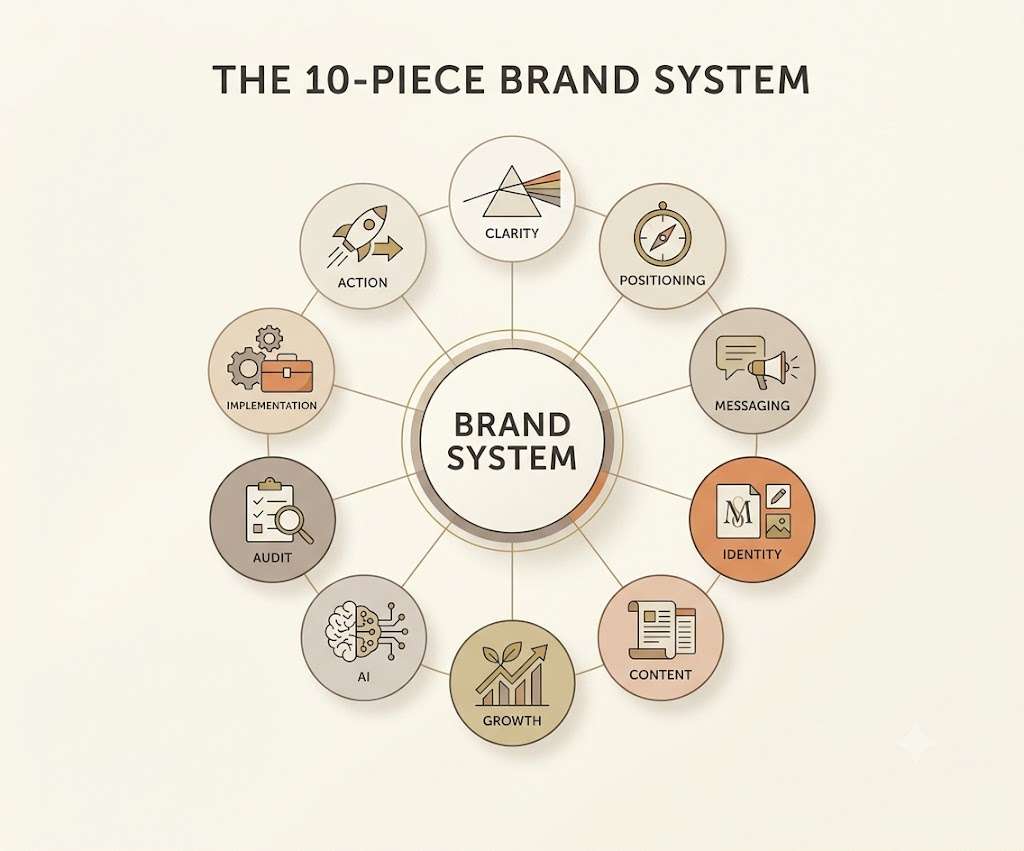
Piece 7: AI Prompt System
How do you use AI Tools without losing your voice?
Most people use AI wrong. They get faster content that sounds generic.
With a system, AI helps you scale while staying on-brand.
Piece 8: Brand Audit
Is your system actually working?
Can people explain what you stand for? Do they remember you?
Without auditing, you don’t know if you’re off track.
Piece 9: Implementation
You have strategy. Now what?
Step-by-step execution. Templates. Tools. Resources.
Most people have strategy but no execution plan.
Piece 10: Action System
What do you work on next?
Without a priority framework, you try to fix everything at once.
With a system, you know exactly what matters most.
Why Most Brands Miss These Pieces
I talk to talented founders all the time who have pieces 1, 4, 5 (and kind of 8).
But they’re missing 2, 3, 6, 7, 9, 10.
So their brand feels incomplete.
Here’s why this happens:
Nobody teaches the complete system
You learn design. You learn content creation. You learn marketing.
But nobody connects all 10 pieces.
You do it piece-by-piece
You design a logo. Then realize you need a website. Then you start posting content.
Each piece was necessary. But none connected to the others.
You confuse "finished" with "working"
You think: “I have a logo, website, and content. I’m done.”
But finished ≠ working.
A system that works means all pieces connect.
You chase trends instead of building strategy
You see what’s trending and post it. You redesign your visual identity because you like new aesthetic.
But you’re not building toward anything. You’re just reacting.
The Consequence of Not Having a System
If you don’t build a complete brand system, here’s what happens:
Your positioning keeps changing
Because you haven’t locked it in, you’re constantly tweaking it.
Your messaging sounds generic
Because you didn’t work through the messaging framework, your offer sounds like everyone else’s.
Your content feels random
Because it’s not tied to positioning, you’re just posting topics that interest you.
People can’t explain your brand
After seeing your content, can they articulate what you stand for? Most people can’t.
Your visual identity feels disconnected
Your logo is pretty. But it doesn’t communicate what you actually stand for.
You redesign your brand constantly
Every quarter, something feels off. So you tweak. Then redesign. Then change again.
Sales stay random
Even with good engagement, conversions don’t feel predictable.
You feel behind
You compare yourself to people who seem to have it figured out. But the difference isn’t talent.
It’s system.
How to Know If Your Brand System Is Incomplete
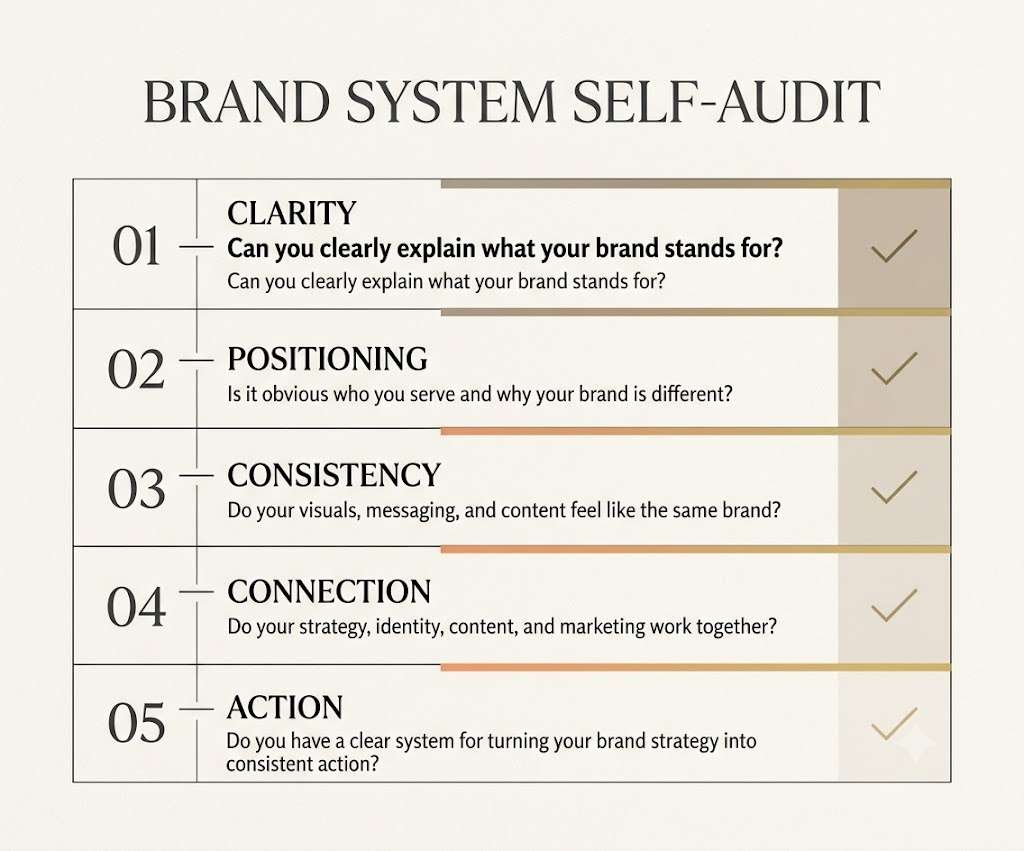
Here’s a quick self-audit:
Question 1: Can you explain your positioning in one sentence?
Not “what you do.” What you stand for.
Question 2: Can you describe your specific approach in one paragraph?
Not what’s common in your industry. What’s specific to you.
Question 3: Can you name your exact target person?
Not a demographic. An actual person with a specific problem.
Question 4: Does your visual identity support your positioning?
Or does your aesthetic look like it could belong to anyone?
Question 5: When you create content, do you have a strategy?
Or are you posting things that seem relevant?
If you answered “no” to any of these, your brand system is incomplete.
And that’s why it feels that way.
The Fix: Building Your Complete Brand System
Here’s the good news: This is completely fixable.
It doesn’t require redesigning your logo. It doesn’t require starting from scratch.
It requires building a system.
The best way to do this is to work through all 10 pieces in order:
Start with clarity and positioning. Get crystal clear on what you stand for and who you serve.
Then develop messaging. Create the key messages that explain your positioning.
Then design with purpose. Your visual identity now supports your positioning instead of existing randomly.
Then build content strategy. Your content now proves your positioning instead of being random topics.
Then develop growth strategy. You now know how to reach people who care about your positioning.
Then integrate AI. You can now use AI strategically without losing your brand voice.
Then audit. You know if your system is actually working.
Then implement. You have a step-by-step execution plan.
Then plan ongoing. You know what to work on every month.
When you build all 10 pieces in order, something remarkable happens:
Everything connects.
Your brand stops feeling fragmented and starts feeling intentional.
Your message becomes clear. Your visual identity becomes purposeful. Your content becomes strategic.
And people finally understand what you stand for.
Getting Started: Your Next Step
The question isn’t whether you have talent.
You clearly do.
The question is whether you have a system.
If your brand feels incomplete, the issue isn’t talent.
It’s system.
And systems are learnable.
The challenge is that nobody teaches complete brand systems. They teach individual pieces.
Positioning workshops. Content strategy classes. Design training.
But nobody connects all 10 pieces.
That’s what makes brands feel incomplete.
They’re missing the connections.
If you’re ready to build a complete brand system instead of continuing to build piece by piece, I’ve created a comprehensive system that walks you through all 10 pieces.
It’s not a course. It’s not vague theory.
It’s a practical, step-by-step system for building a complete brand that actually works.
You’ll work through clarity, positioning, messaging, identity, content, growth, AI, audit, implementation, and action planning.
By the end, you don’t just have resources.
You have an actual, working brand system.
Does Your Brand Have These Problems?
Professional audit against design standards (same checklist designers use). Takes 10 minutes. Reveals everything your brand needs.