A business can have a website, an Instagram account, a Google Business Profile, social media content, email campaigns, advertisements, and hundreds of pieces of content—and still have a weak digital brand.
The problem is not necessarily a lack of marketing.
It is often a lack of digital branding.
Digital branding is the way a business builds, expresses, and reinforces its brand across digital environments. It connects strategy, positioning, visual identity, messaging, content, customer experience, and digital touchpoints into one recognizable brand experience.
This matters even more in 2026 because people no longer discover businesses through one predictable path.
Someone might discover a brand through an Instagram Reel, search for it on Google, read its website, see it mentioned by a creator, ask an AI system about alternatives, receive a WhatsApp message, and finally purchase through an online store or physical location.
The customer journey has become fragmented, but the brand still needs to feel coherent.
Current data illustrates the scale of India’s digital environment. DataReportal’s Digital 2026 India report recorded approximately 1.03 billion internet users and 500 million social-media user identities in late 2025. It also reported 481 million Instagram users and 500 million YouTube users based on platform advertising data.
At the same time, current 2026 industry research in India points toward AI-powered discovery, short-form video, creators, messaging, and omnichannel shopping becoming increasingly connected.
So digital branding is no longer simply about “being online.”
It is about creating a recognizable and trustworthy brand wherever people encounter your business.
What You'll Learn
ToggleWhat Is Digital Branding?
Digital branding is the process of building and managing a brand across digital channels and experiences.
It includes much more than a logo or social media profile.
Your digital brand can be expressed through:
- your website
- search results
- social media profiles
- content
- digital advertising
- online communities
- videos
- creator collaborations
- messaging platforms
- ecommerce experiences
- AI-powered discovery
- customer support
- digital products and services
The important distinction is that digital branding is not simply a collection of channels.
It is the system connecting those channels.
For example, imagine a consulting business whose website communicates expertise and clarity, but whose Instagram content uses completely different messaging and whose sales emails sound overly promotional.
Each individual channel may work reasonably well.
Together, however, they create an inconsistent brand.
Digital branding asks a broader question:
Does the customer experience the same underlying brand wherever they encounter it?
That does not mean every platform should look identical.
It means the underlying strategy, positioning, personality, and promise remain recognizable.

Digital Branding vs Digital Marketing
These terms are often used interchangeably, but they are not the same.
Digital marketing focuses primarily on attracting, engaging, converting, and retaining customers through digital channels.
Digital branding focuses on how the business is perceived and remembered throughout those digital interactions.
A simple way to understand the difference is:
Digital marketing asks:
“How do we reach and convert this audience?”
Digital branding asks:
“What should this audience understand, feel, and remember about us?”
The two work together.
A paid advertisement can generate a click.
Branding influences what the person thinks after that click.
A social post can generate views.
Branding influences whether those views contribute to recognition and trust.
SEO can bring someone to a website.
Branding influences whether the visitor understands why the business is different.
This is why strong digital marketing without strong branding can become expensive.
You may continuously pay to acquire attention without building enough memory, trust, or differentiation.
Why Digital Branding Matters More in 2026
Digital audiences are not simply getting larger. They are becoming more fragmented.
There are more platforms, more formats, more creators, more brands, and more content competing for attention.
AI is adding another layer.
People can increasingly use AI systems to research products, compare options, summarize information, and discover businesses. At the same time, social platforms are becoming discovery and commerce environments rather than places used only for publishing updates.
In India, Meta reported in February 2026 that social media influenced 77% of retail purchase decisions in its study, while short-form video and creators were increasingly influencing discovery and trust. The same research highlighted WhatsApp’s growing role in connecting discovery, purchase, and post-purchase interactions.
That creates a significant branding challenge.
Your brand does not control every environment where people encounter it.
Your content might be reshared.
Your products might be discussed by creators.
Your brand might appear in an AI-generated answer.
Your website might be viewed on a phone.
Your customer might communicate with you through WhatsApp.
Your advertisement might appear next to dozens of competing messages.
A strong digital brand gives all these encounters a common strategic foundation.
The 7 Core Elements of Digital Branding
Digital branding is easier to manage when you stop thinking about individual platforms and start thinking about the components underneath them.
1. Brand Strategy
Everything begins with strategy.
Before deciding what to post, you need to understand:
- who the brand serves
- what problem it solves
- what it believes
- what makes it different
- what category it operates in
- what position it wants to occupy
Your digital channels should express this strategy rather than create it randomly.
This is why digital branding should connect directly to your broader brand strategy.
If the strategy is unclear, adding more content rarely fixes the underlying problem.
2. Brand Positioning
Positioning determines the place your brand wants to occupy in the customer’s mind.
Suppose three design studios all say:
“We create beautiful brands.”
That statement does little to distinguish them.
A stronger digital brand might position itself around strategic branding for early-stage businesses, premium visual identities for established companies, or practical branding systems for founders building in-house teams.
The positioning changes what content the brand creates, what examples it uses, what services it promotes, and how it communicates.
This is why your brand positioning should come before your digital content strategy.
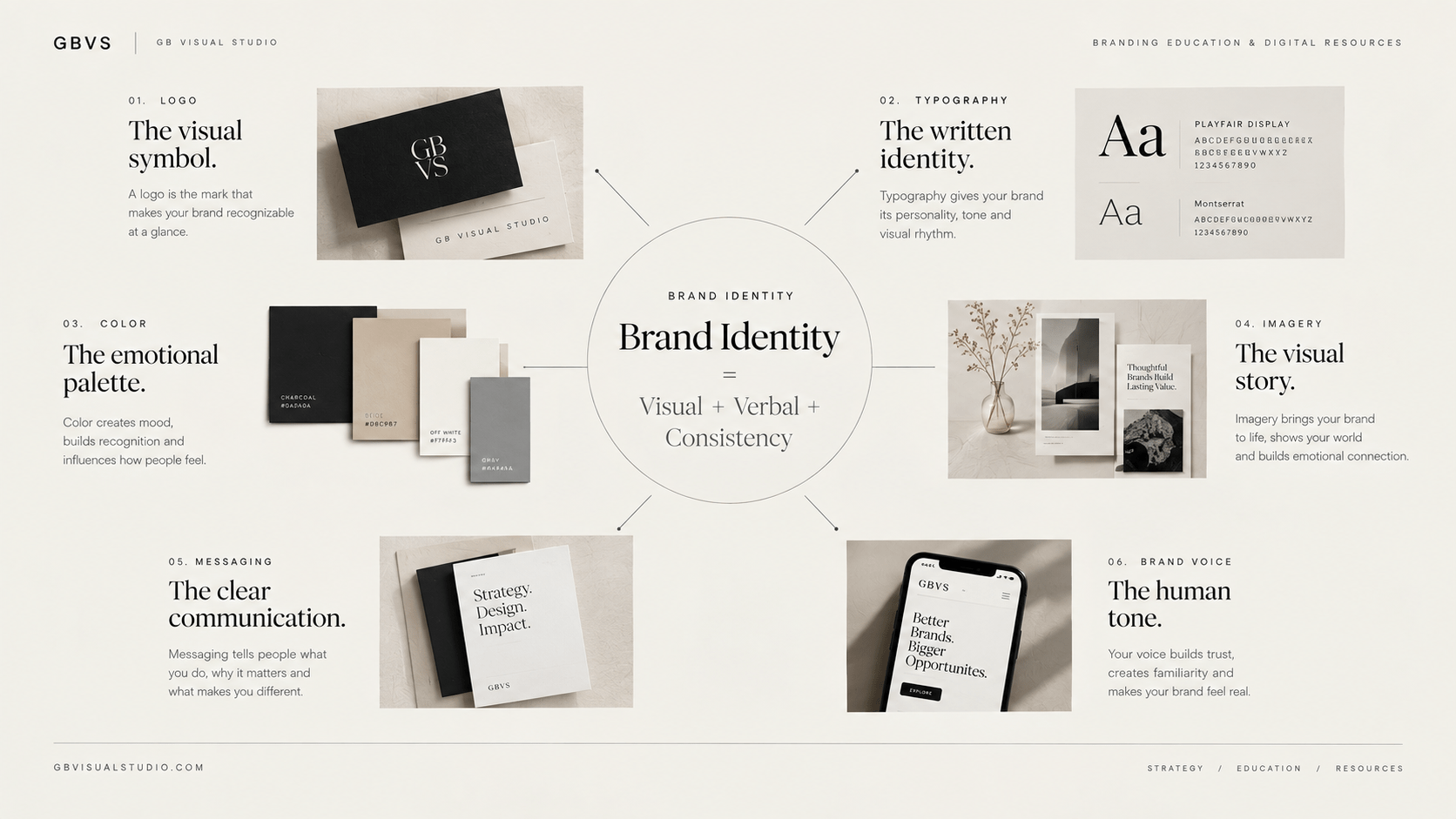
3. Visual Identity
Digital audiences encounter your visual identity repeatedly.
Think about:
- logo usage
- typography
- colors
- photography
- illustrations
- graphic elements
- layouts
- social templates
- website design
- presentation design
A strong visual identity does not mean every post looks identical.
It means the audience can recognize the underlying visual language.
This becomes increasingly important when businesses publish across multiple platforms.
Your Instagram may use a different layout from your website.
Your YouTube thumbnail may have different dimensions from your Pinterest graphic.
Your email may have a different structure from your social post.
The visual system can change by format while still remaining recognizably yours.

4. Brand Voice and Messaging
Visual consistency is only half of digital branding.
Your brand also needs a recognizable verbal identity.
Consider how your business sounds when it:
- writes a website headline
- publishes an Instagram caption
- answers a comment
- sends an email
- publishes a blog article
- creates a product description
- responds to a customer
- uses AI to generate content
If every channel sounds like a different company, your visual identity cannot compensate for the inconsistency.
Your brand voice should define characteristics such as:
Tone → vocabulary → sentence style → level of expertise → personality → communication boundaries
Then your messaging should communicate the ideas that matter most to your positioning.
5. Content
Content is one of the most visible expressions of a digital brand.
But content should not be treated as an endless production requirement.
The objective is not:
“How can we publish more?”
The better question is:
“What should our audience repeatedly associate with us?”
For a branding studio, that might mean consistently teaching people about positioning, visual identity, brand strategy, design systems, and creative business.
Over time, those subjects become associated with the brand.
That is the difference between random content production and brand-led content marketing.
6. Digital Customer Experience
Branding does not stop when someone clicks “buy.”
The experience after the click also communicates the brand.
Consider a digital product business.
A potential customer might encounter:
Instagram → website → product page → checkout → confirmation email → download page → support → follow-up email
Every step creates an impression.
If the Instagram experience feels premium but the checkout experience feels confusing, the inconsistency affects the brand.
Digital branding therefore includes the experience surrounding the transaction, not simply the promotional content before it.
7. Digital Brand Recognition
The long-term objective is not merely visibility.
It is recognition.
You want someone to encounter your:
- visual style
- phrase
- content format
- website
- product
- voice
- idea
and understand:
“I know this brand.”
That recognition becomes increasingly valuable as customers encounter brands across more environments.
Your digital branding system should therefore make repeated recognition possible without requiring every piece of content to look exactly the same.
How to Build a Digital Brand
A digital brand should be built from the inside out.
Step 1: Define the Brand Foundation
Start with your purpose, audience, problem, values, positioning, and difference.
If these are unclear, document them before investing heavily in digital content.
Your digital presence cannot consistently communicate something the business itself has not clearly defined.
Step 2: Define Your Position
Write down the specific space you want to occupy.
Ask:
Who are we for?
What problem do we solve?
What category do customers place us in?
What makes our approach different?
Why should someone choose us instead of an alternative?
This gives your digital channels a strategic direction.
Step 3: Build Your Digital Identity
Translate the strategy into a visual and verbal system.
This includes your:
- logo system
- colors
- typography
- imagery
- layouts
- graphic elements
- voice
- messaging principles
A brand design system becomes particularly useful once the number of digital touchpoints increases.
Step 4: Choose the Right Digital Channels
Do not automatically join every platform.
Choose channels based on audience behavior and your ability to maintain them.
For example:
A B2B consultancy may prioritize LinkedIn, its website, email, and YouTube.
A visual consumer brand may prioritize Instagram, Pinterest, YouTube, and ecommerce.
A local service business may prioritize Google, Instagram, WhatsApp, and its website.
The goal is not maximum platform presence.
The goal is strategic presence.
Step 5: Create a Content System
Your content should have recognizable themes.
A useful structure might be:
Education → Perspective → Proof → Story → Product/Service
This gives your audience different reasons to engage without making every post promotional.
For example, a branding studio could publish:
An educational article about positioning.
A short video explaining a common branding mistake.
A case study showing how a positioning change affects messaging.
A founder story about building a brand.
A product explaining how the reader can work through the same problem.
The content is different, but the strategic territory remains connected.
Step 6: Connect Your Channels
Your digital channels should not operate as isolated islands.
Your website can become the knowledge hub.
Social media can distribute ideas.
Pinterest can create visual discovery.
YouTube can build deeper authority.
Email can nurture relationships.
Digital products can convert knowledge into resources.
Search can bring people into the ecosystem.
This creates a system rather than a collection of accounts.
Digital Branding in the Age of AI
AI is changing digital branding in two different ways.
The first is how brands produce content.
The second is how people discover brands.
The first is already visible.
Brands can use AI to accelerate research, generate initial drafts, analyze large datasets, personalize communications, explore creative concepts, and support content production.
But there is an important limitation.
If every business uses the same AI systems with generic instructions, their output can start to converge.
That creates a new branding problem:
AI can increase production speed while decreasing distinctiveness.
The answer is not to avoid AI.
It is to give AI a stronger strategic foundation.
Your brand strategy, positioning, voice, visual rules, audience understanding, examples, and content principles should inform the AI workflow.
In other words:
AI should operate inside the brand system—not replace the brand system.
This will become an important part of the next GBVS content cluster on AI in Digital Branding.

Digital Branding and AI Search
There is another change businesses need to understand.
Search is becoming more conversational and increasingly influenced by AI-generated answers.
This means a potential customer may not always discover a business by clicking a traditional search result.
They may ask an AI system:
“What are some good branding studios for a small business?”
or:
“What should a startup consider when developing its brand identity?”
The brand visibility challenge therefore extends beyond traditional rankings.
Businesses need useful, authoritative, well-structured information that clearly establishes what they know and what they represent.
That makes digital branding and search strategy increasingly connected.
A brand with unclear positioning is harder to understand.
A brand with inconsistent information is harder to interpret.
A brand with shallow content has less opportunity to demonstrate expertise.
A brand with strong strategic content, clear entities, consistent messaging, and useful resources has more opportunities to be understood across digital discovery environments.
This is one reason GBVS will treat AI search visibility as a dedicated future content cluster rather than simply adding “AI SEO” to a generic SEO article.
Digital Branding in India: What Is Changing?
India’s digital environment is particularly interesting because the market is not defined by one audience or one platform.
The scale itself is significant. DataReportal’s 2026 India report records more than one billion internet users and 500 million social-media user identities based on late-2025 data.
But the more important change is how discovery happens.
Current Indian commerce research points toward a combination of social discovery, short-form video, creators, messaging, AI, and online/offline journeys.
Meta’s June 2026 India research also reported very high daily engagement with short-form video across both urban and rural audiences and described Reels as increasingly connected to product discovery.
For brands, this means the digital presence cannot be designed around only one format.
A brand may need:
Searchable content + social content + video + messaging + website experience + creator relationships + consistent visual identity
The exact mix depends on the business.
But the underlying brand should remain recognizable.
What Digital Branding Looks Like for a Small Business
You do not need a large marketing department to build a digital brand.
A small business can begin with a simple ecosystem.
For example:
Website
The central source of information and credibility.
For discovery, visual communication, and relationship building.
Google/Search
For people actively looking for solutions.
For developing an owned audience.
One long-form content channel
Such as a blog or YouTube.
One conversion mechanism
Such as a service inquiry, consultation, digital product, ecommerce checkout, or lead magnet.
The mistake is trying to maintain ten channels before building a system for two or three.
Consistency is more valuable than platform quantity.
Common Digital Branding Mistakes
Treating digital branding as social media management
Social media is one part of digital branding.
Your website, search presence, emails, customer experience, and digital products matter too.
Changing your brand for every trend
A trend can influence execution.
It should not constantly change your strategic identity.
Publishing without positioning
If every post targets a different audience and topic, the audience has little reason to associate the content with a particular expertise.
Using AI without brand direction
AI can accelerate generic content just as efficiently as useful content.
The strategic input still matters.
Making every platform identical
Consistency does not mean duplication.
A website, Reel, YouTube video, and Pinterest pin have different jobs.
Your system should adapt to the medium while preserving the underlying brand.
Focusing only on visibility
Views, impressions, and reach can be useful measurements.
But digital branding ultimately needs to build understanding, trust, recognition, and meaningful business action.
A Simple Digital Branding Framework
You can think about your digital brand as six connected layers:
Strategy
What does the brand stand for?
↓
Positioning
What should it be known for?
↓
Identity
How should it look and sound?
↓
Content
What should it repeatedly teach, communicate, and demonstrate?
↓
Experience
What does the customer experience at every digital touchpoint?
↓
Recognition
What should people remember and associate with the brand?
If one layer is weak, the rest becomes harder to manage.
For example, strong visual identity without positioning can produce attractive but interchangeable content.
Strong positioning without consistent identity can make the brand difficult to recognize.
Strong content without a good customer experience can generate attention without conversion.
Digital branding works best when these layers reinforce one another.
How Digital Branding Connects to Brand Strategy
Digital branding should not exist separately from the branding work you have already done.
Think of the relationship as:
Brand Strategy
defines the direction.
↓
Brand Positioning
defines the place you want to occupy.
↓
Brand Differentiation
defines what makes you meaningfully different.
↓
Brand Identity
makes the strategy visible.
↓
Brand Voice & Messaging
makes the strategy communicable.
↓
Digital Branding
translates the system into digital environments.
↓
Brand Experience
turns those interactions into customer perception.
↓
Brand Recognition & Equity
develop over time.
This is why digital branding should be treated as an extension of the brand rather than a separate marketing activity.
The Future of Digital Branding
Digital branding is moving toward a more connected environment.
The future is unlikely to be defined by one platform replacing another.
Instead, people will continue moving between:
Search → social → video → creators → websites → messaging → AI → commerce
The important question for brands is therefore not:
“Which platform will win?”
It is:
“Can our brand remain recognizable and useful as people move between these environments?”
AI will accelerate content production.
Creators will influence discovery.
Video will continue to compete for attention.
Messaging will increasingly connect brands and customers.
Search will become more conversational.
Personalization will become more sophisticated.
But the fundamental branding problem remains remarkably familiar:
What do you stand for, who is it for, why should people care, and how will they recognize you?
The technology changes.
The strategic foundation still matters.
Final Takeaway
Digital branding is the system that connects your brand strategy to the digital world.
It is not simply your logo on Instagram.
It is not your website design.
It is not your social media content.
It is the combined experience created by your positioning, identity, messaging, content, customer experience, and digital touchpoints.
In 2026, that system is becoming even more important because customers are discovering businesses through increasingly fragmented paths involving search, social platforms, video, creators, messaging, commerce, and AI.
The brands that adapt successfully will not necessarily be the ones that publish the most.
They will be the ones that can remain clear, distinctive, recognizable, and useful across changing digital environments.
And that is the real purpose of digital branding.
Frequently Asked Questions
What is digital branding?
Digital branding is the process of building and expressing a brand across digital channels such as websites, search, social media, email, video, advertising, messaging platforms, ecommerce, and AI-driven discovery.
What is the difference between digital branding and digital marketing?
Digital marketing focuses primarily on attracting, engaging, converting, and retaining customers through digital channels. Digital branding focuses on how the business is positioned, perceived, recognized, and remembered throughout those interactions.
Why is digital branding important in 2026?
Digital discovery is increasingly fragmented across search, social media, video, creators, messaging, ecommerce, and AI-powered experiences. A consistent digital brand helps businesses remain recognizable across these environments.
How can a small business start digital branding?
Start with a clear brand strategy and positioning, then establish a consistent visual identity, brand voice, website, one or two relevant social channels, useful content, and a clear customer journey.
How does AI affect digital branding?
AI can accelerate research, content creation, personalization, analysis, and creative production. However, businesses still need human-led strategy, differentiation, brand voice, and creative direction to prevent their output from becoming generic.
Is social media part of digital branding?
Yes. Social media is an important digital branding channel, but it is only one part of the broader system. Websites, search, email, video, messaging, digital products, advertising, and customer experience can also contribute to digital branding.
What is the future of digital branding?
Digital branding is likely to become increasingly connected to AI-powered discovery, personalized experiences, video, creators, conversational commerce, messaging, and omnichannel customer journeys. Brands will need to maintain a consistent strategic identity across these changing environments.