A founder sits across from you. They’ve been running their business for three years. Revenue is flat. They’re frustrated. When you suggest strengthening their brand, their first reaction is: “We can’t afford that right now. We need to invest in ads, hiring, product development.”
It’s a reasonable objection.
It’s also one of the most expensive mistakes a business can make.
Here’s the uncomfortable truth: you can’t afford to ignore the cost of weak branding. The cost of weak branding is often far higher than the cost of building a clear, strategic brand.
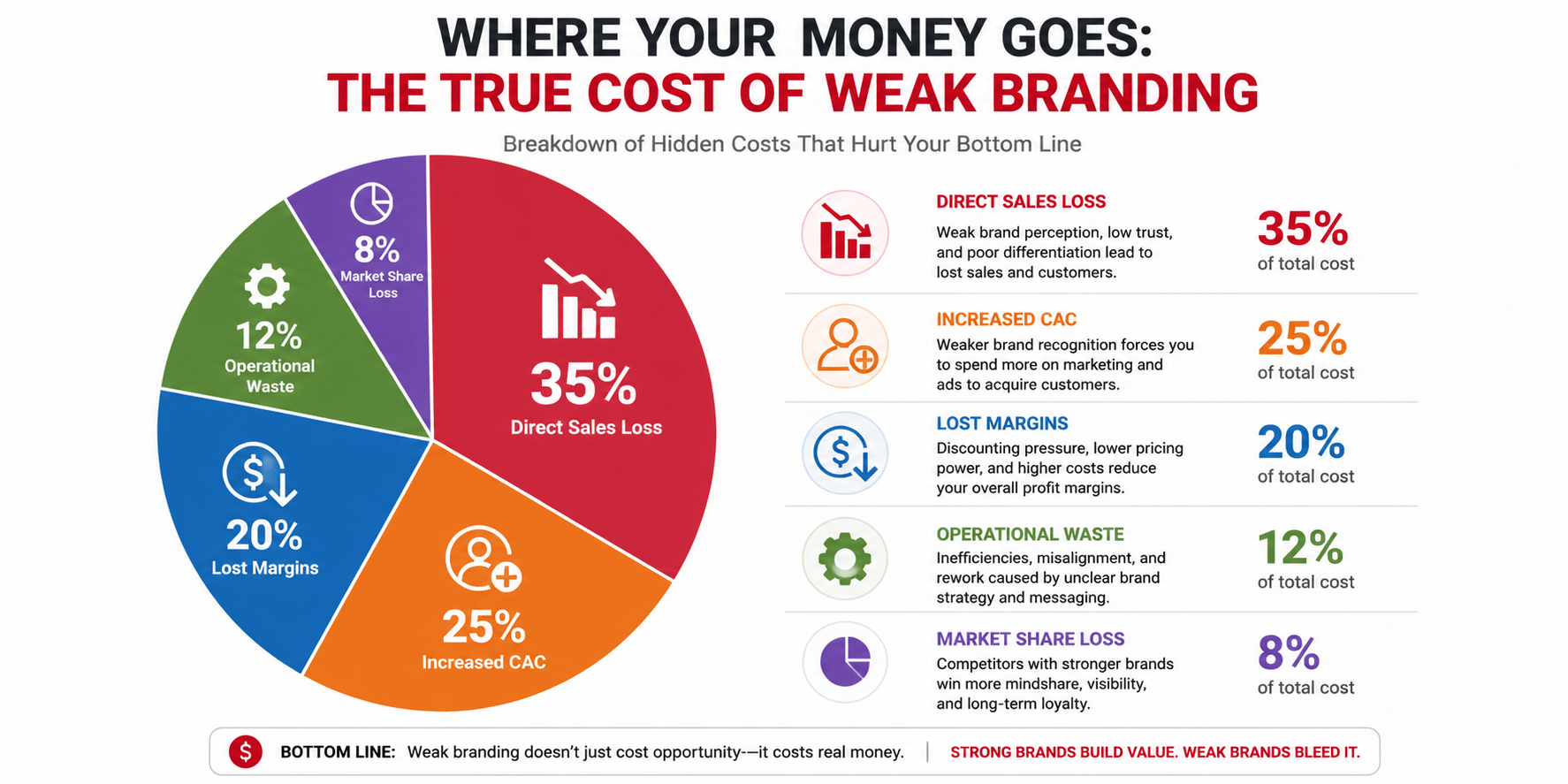
Most business owners don’t realize this because the costs are hidden. They show up as lost sales, higher customer acquisition costs, inability to charge premium prices, missed market opportunities, and wasted internal time.
They’re not a single invoice.
They’re a slow financial leak that can compound over years.
In this article, we’ll look at the real financial impact of weak branding through research, real-world rebranding failures, and a 5-year financial model.
By the end, you’ll understand why businesses that skip strategic branding can end up spending more not less.
What You'll Learn
ToggleWhat Is the Cost of Weak Branding?
Weak branding isn’t simply a visual problem.
It can create several interconnected business costs:
- Lost sales from customer confusion
- Higher customer acquisition costs
- Lower conversion efficiency
- Difficulty communicating premium value
- Commodity positioning
- Operational inefficiency
- Market-share loss
- Expensive corrective work
- Missed growth opportunities
The exact cost of weak branding will vary from business to business.
But the underlying principle is simple:
If customers don’t understand your value, your marketing has to work harder to compensate.
And when your marketing has to work harder, growth becomes more expensive.
The Immediate Cost: Lost Sales and Confused Customers
The first consequence of poor branding is one of the most obvious and one of the most underestimated.
Weak branding creates confusion, and confused customers have less reason to choose you.
When customers encounter your business and can’t quickly understand who you are, what you offer, or why you’re different, uncertainty enters the buying decision.
They may postpone the purchase.
They may search for another option.
Or they may choose a competitor whose positioning is easier to understand.
Research into brand confusion has long examined how similarities and unclear brand signals can affect consumer perception and decision-making.
This is why the brand confusion cost isn’t simply visual.
It can become a revenue problem.
Consider Hillary’s House, a dog-boarding business. The owner faced a situation where several competitors used extremely similar logos, colors, and messaging. Potential customers struggled to distinguish between the businesses, creating confusion about which company they were actually choosing.
That’s brand confusion at its most damaging.
For a small business generating $300,000 in annual revenue, even a hypothetical 22% decline would represent $66,000 in lost revenue. The exact impact will vary by company, industry, and situation.
The important point is that unclear branding can affect the customer’s ability to recognize, understand, and choose your business.
The Hidden Cost: Increased Customer Acquisition Expense
Here’s one of the hidden costs of weak branding that businesses can feel for years:
You may have to work harder and spend more to acquire customers.
When your positioning, messaging, and visual identity are clear and consistent, your marketing doesn’t have to repeatedly explain who you are before it can communicate what you sell.
But when branding is weak or inconsistent, every campaign may need to overcome additional uncertainty.
You need more explanation.
More touchpoints.
More repetition.
More convincing.
That can contribute to higher customer acquisition costs (CAC), lower conversion efficiency, and longer sales cycles. Strong brand consistency can help create recognition and reduce friction across customer touchpoints.
Weak Brand vs. Strong Brand
| Business Metric | Weak Brand | Strong Brand |
|---|---|---|
| Brand positioning | Generic and difficult to differentiate | Clear, specific, and differentiated |
| Customer understanding | Customers need more explanation | Value is understood faster |
| Trust | Takes longer to establish | Built through consistent presentation |
| Conversion | More hesitation and friction | Greater confidence in the buying decision |
| CAC | Potentially higher acquisition cost | Potentially more efficient acquisition |
| Messaging | Different messages across channels | Consistent core message |
| Visual identity | Inconsistent or forgettable | Recognizable and consistent |
| Pricing power | More pressure to compete on price | Greater ability to communicate premium value |
| Marketing efficiency | Each campaign may need to start from zero | Campaigns reinforce existing brand recognition |
| Customer recall | Easy to forget or confuse with competitors | Easier to recognize and remember |
The difference isn’t simply the marketing budget.
It’s the efficiency of the system behind the marketing.
For example, consider this illustrative model:
- Weak brand: $150 CAC, 1.5% conversion, $400 customer lifetime value
- Strong brand: $50 CAC, 5% conversion, $1,200 customer lifetime value
Over 10,000 annual website visitors:
- Weak brand: 150 customers acquired at $150 CAC = $22,500 spend
- Strong brand: 500 customers acquired at $50 CAC = $25,000 spend
The important point is not that every strong brand will achieve these exact numbers. These are illustrative assumptions showing how differences in positioning, trust, and conversion efficiency can produce dramatically different commercial outcomes.
For small businesses especially, this matters because every inefficient acquisition dollar reduces the money available for growth.
The Growth-Killer: Losing Premium Positioning
Another major weak branding impact on business is the inability to clearly communicate why your offer deserves a premium.
When customers can’t easily differentiate your business from competitors, price can become the easiest comparison point.
You become a commodity.
And once you’re competing primarily on price, margins become harder to protect.
Strong positioning helps businesses communicate a specific value rather than simply saying, “We do what everyone else does.”
Let’s say you’re a web design agency.
Weak Branding vs. Strong Branding: A Pricing Example
| Option A: Weak Branding | Option B: Strong Branding | |
|---|---|---|
| Positioning | “We design websites” | “We design conversion-focused B2B websites for SaaS companies” |
| Market position | Generic | Specialist |
| Customer perception | Commodity service | Specialized expertise |
| Project price | $5,000 | $12,000 |
| Margin after expenses | 30% | 60% |
| Profit per project | $1,500 | $7,200 |
| Differentiation | Low | High |
| Pricing pressure | High | Lower |
| Primary selling point | Service/features | Specific business value |
| Annual projects | 12 | 12 |
| Illustrative annual profit | $18,000 | $86,400 |
| Difference | — | +$68,400 |
Same fundamental service.
Very different perceived value.
In this illustrative example, the difference is $68,400 in annual profit.
That’s why poor branding and lost sales aren’t the only concern.
Weak branding can also limit how effectively you position and price what you already sell.
The lesson isn’t that changing your branding automatically lets you charge 2.4× more.
The lesson is that clear positioning gives customers a stronger reason to choose you based on value instead of simply comparing prices.
The Rebranding Trap: Why Fixing It Later Gets Expensive
Now we get to one of the most visible examples of the cost of weak branding:
having to fix a brand after years of confusion or a poorly executed rebrand.
The problem isn’t that every rebrand fails.
The problem is that changing a brand without protecting existing recognition, understanding customers, and validating the strategic reason for the change can create unnecessary costs.
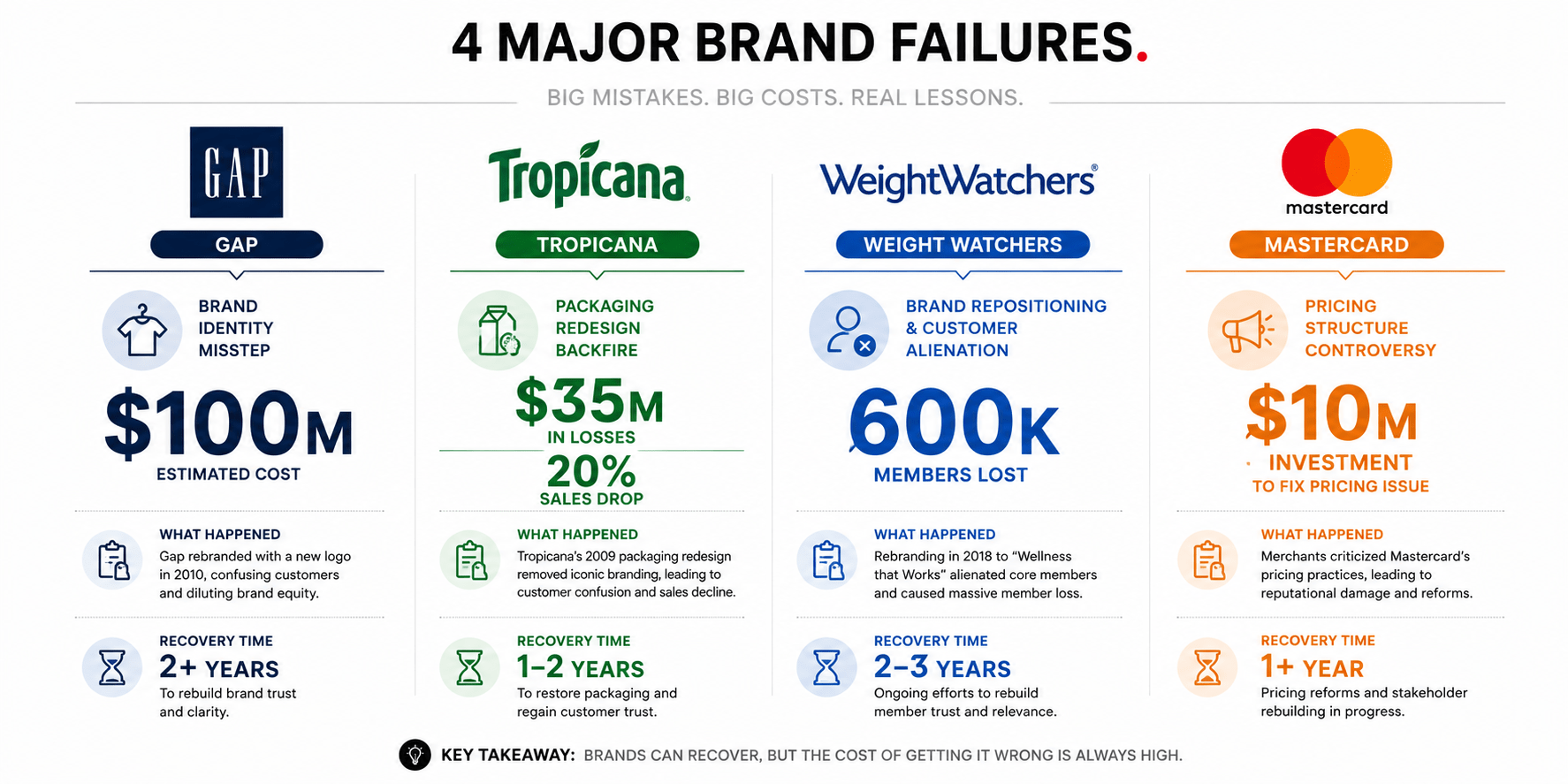
Recent analysis of major rebranding failures repeatedly highlights the same patterns: insufficient customer research, destroying existing brand equity, and changing visual identity without solving the underlying business problem.
Gap's 2010 Rebrand
Gap introduced a new logo and faced immediate public backlash before reverting to the previous identity six days later.
The episode is widely cited as a classic rebranding failure because the company changed a highly recognizable asset without sufficiently protecting the brand meaning customers already associated with it. Academic research has also examined the Gap case as an example of how brand meaning is negotiated among consumers and other stakeholders during rebranding.
Tropicana's 2009 Rebrand
Tropicana redesigned its packaging and removed recognizable elements from the previous identity. The redesign was followed by a significant sales decline, and the company reverted to its previous packaging.
The case remains one of the most frequently discussed examples of the cost of rebranding failures, particularly the danger of removing recognition cues customers use at the point of purchase.
Weight Watchers / WW
Weight Watchers changed its name to WW in an attempt to reposition the brand. The change became another example frequently discussed in the context of brand recognition, consumer confusion, and the difficulty of moving away from established brand equity.
Mastercard
Mastercard’s visual identity evolution is also frequently discussed in rebranding case studies, particularly around the difference between refreshing a recognizable identity and unnecessarily disrupting established recognition.
The pattern is clear:
A rebrand should solve a strategic problem not create a new one.
And the longer a weak brand problem continues, the more touchpoints eventually need to be corrected.
The Operational Drain: Internal Misalignment Costs
The consequences of poor branding aren’t limited to customers.
Weak branding can also confuse your own team.
When your brand isn’t clearly defined, marketing may communicate one message while sales communicates another. Customer service may interpret the brand differently. Designers may create inconsistent assets.
Everyone starts making decisions individually.
That creates operational waste:
- Marketing materials need to be recreated.
- Teams spend time clarifying basic brand decisions.
- Different departments communicate different messages.
- Campaigns become inconsistent.
- Employees have less clarity around what the company represents.
- Brand decisions become slower and more subjective.
The result is an operational drain.
Instead of using a clear brand system to make decisions faster, the business repeatedly solves the same problems from scratch.
This is one reason brand consistency matters beyond aesthetics.
The Market-Share Loss: Competitors Gain While You Stagnate
Finally, there’s the opportunity cost.
While your business struggles to communicate its value, competitors with clearer positioning can become easier for customers to understand and remember.
Consider Blockbuster and Netflix.
The broader lesson isn’t simply that one company adopted streaming faster.
It’s that businesses need clear strategic positioning to make decisive choices about where they’re going, who they serve, and what they want to be known for.
A brand that lacks clarity can make those decisions harder.
And when competitors move faster, the opportunity cost becomes significant.
The market doesn’t wait while a business figures out what it stands for.
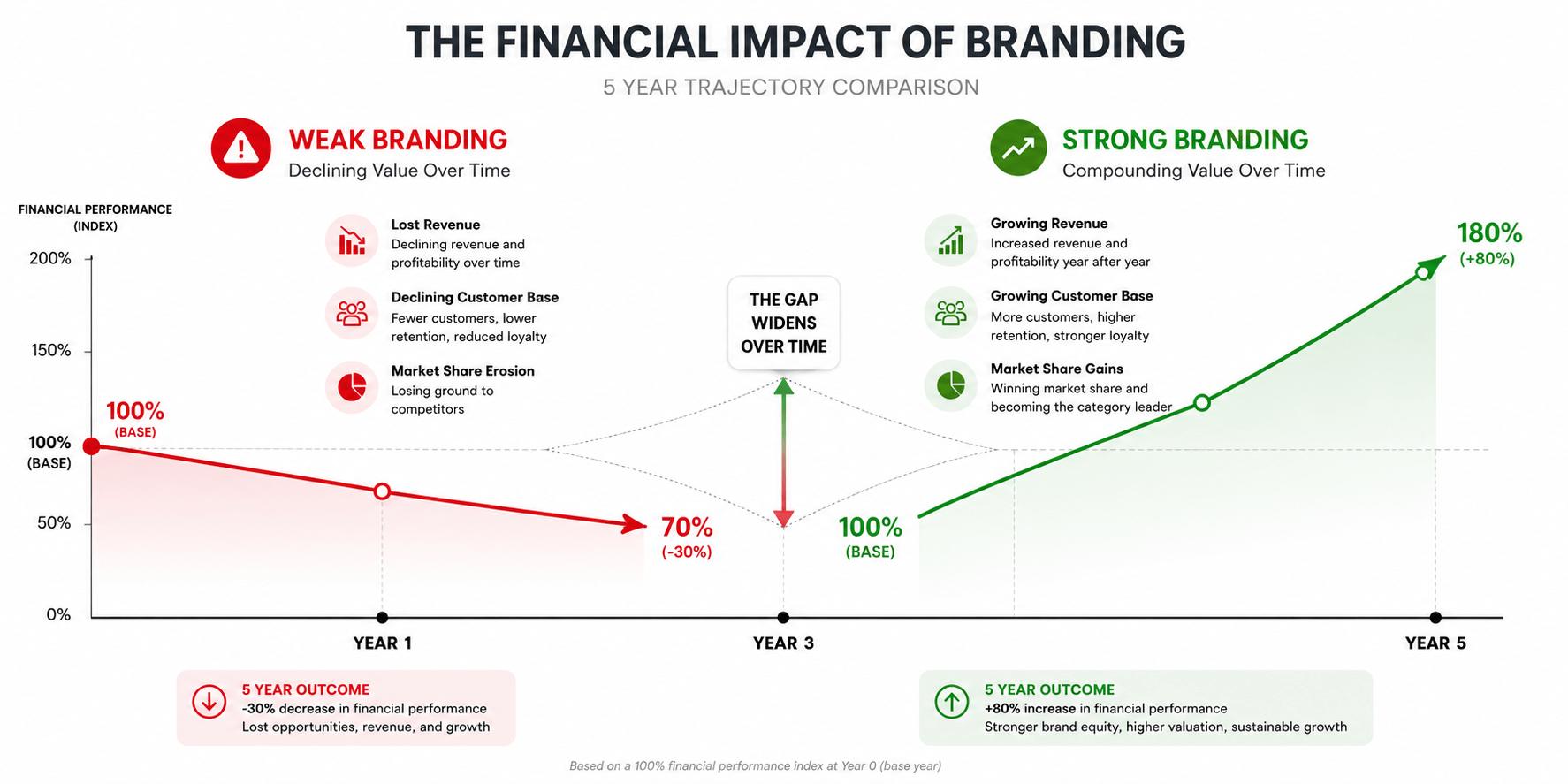
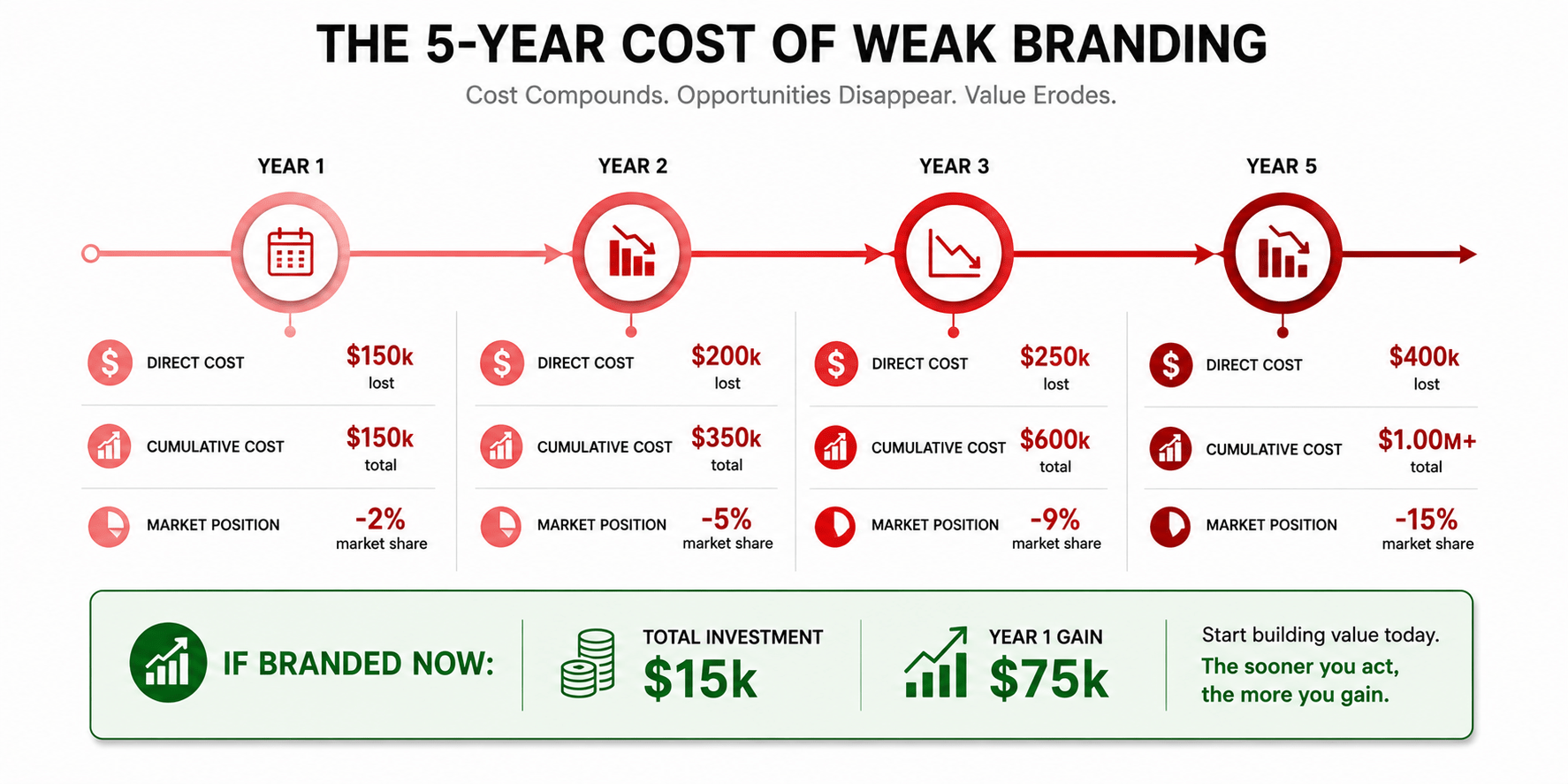
The Real Cost: A 5-Year Financial Model
Let’s put the idea together with an illustrative 5-year model.
The purpose of this model isn’t to claim that branding alone produces a specific revenue outcome.
Instead, it demonstrates how differences in customer acquisition efficiency, conversion, margins, positioning, and market share can compound over time.
Company A vs. Company B
| Metric | Company A — Weak/No Brand Strategy | Company B — Invests in Branding |
|---|---|---|
| Initial branding investment | $0 | $15,000 |
| Year 1 revenue | $500,000 | $500,000 |
| Year 1 CAC | $150 | $120 |
| Year 1 conversion | 1.5% | 3% |
| Year 1 margin | 30% | 32% |
| Year 2 revenue | $520,000 | $650,000 |
| Year 2 CAC | $165 | $100 |
| Year 2 conversion | 1.5% | 4% |
| Year 2 margin | 28% | 38% |
| Year 3 revenue | $520,000 | $850,000 |
| Year 3 CAC | $180 | $80 |
| Year 3 conversion | 1.5% | 5% |
| Year 3 margin | 26% | 40% |
| Year 4 revenue | — | — |
| Year 5 revenue | $480,000 | $1,200,000 |
| Year 5 market position | -15% market share | +30% market share |
| Overall direction | Stagnating/declining | Growing |
| Profitability | Negative | Strong |
Year-by-Year Comparison
| Year | Company A — Weak/No Brand Strategy | Company B — Stronger Brand Strategy |
|---|---|---|
| Year 1 | $500K revenue; $150 CAC; 1.5% conversion; 30% margin | $500K revenue; $120 CAC; 3% conversion; 32% margin; $15K branding investment |
| Year 2 | $520K revenue; $165 CAC; 1.5% conversion; 28% margin | $650K revenue; $100 CAC; 4% conversion; 38% margin |
| Year 3 | $520K revenue; $180 CAC; 1.5% conversion; 26% margin; competitors gaining ground | $850K revenue; $80 CAC; 5% conversion; 40% margin; stronger positioning |
| Year 4 | Brand weakness continues to create acquisition, positioning, and market-share pressure | Brand system continues supporting clearer positioning, recognition, and marketing consistency |
| Year 5 | $480K revenue; -15% market-share position; declining profitability | $1.2M revenue; +30% market-share position; strong profitability |
The Difference
| Company A | Company B | |
|---|---|---|
| Year 5 Revenue | $480,000 | $1,200,000 |
| Annual Revenue Difference | — | $720,000 |
| 5-Year Direction | Declining | Growing |
| Market Position | Losing ground | Gaining ground |
| Brand Positioning | Weak/unclear | Clear/specialized |
| Pricing Power | Limited | Stronger |
| Acquisition Efficiency | Higher CAC | Lower CAC in the model |
| Overall Outcome | Stagnation and decline | Sustainable growth |
In the original illustrative model, Company B generates approximately $2.4 million more revenue over five years than Company A against a $15,000 initial branding investment.
That figure should be treated as a scenario model, not a guaranteed branding ROI.
Brand strategy doesn’t automatically produce a specific revenue increase. Its commercial impact depends on factors including the quality of the offer, market demand, positioning, execution, marketing, customer experience, and competitive environment.
The point of the model is simpler:
Small differences in acquisition efficiency, conversion, pricing power, and market position can compound into a very large business difference over time.
Recent brand-ROI research similarly recommends measuring brand strategy through commercial indicators such as CAC, win rate, sales-cycle length, pricing power, and team productivity rather than treating branding as an intangible expense.
Conclusion
Weak branding isn’t just an aesthetic or reputational problem.
It’s a business problem.
Lost sales from confusion. Higher customer acquisition costs. Commodity pricing. Operational inefficiency. Market-share loss. Missed opportunities.
The businesses that postpone branding often believe they’re saving money.
But the real question isn’t:
“Can we afford to invest in branding?”
It’s:
“What is our current lack of brand clarity already costing us?”
If you understand the case for branding, the next step is building it.
Read our strategic branding investment → Branding Complete Beginner’s Guide for the tactical steps to build a stronger brand strategy.