
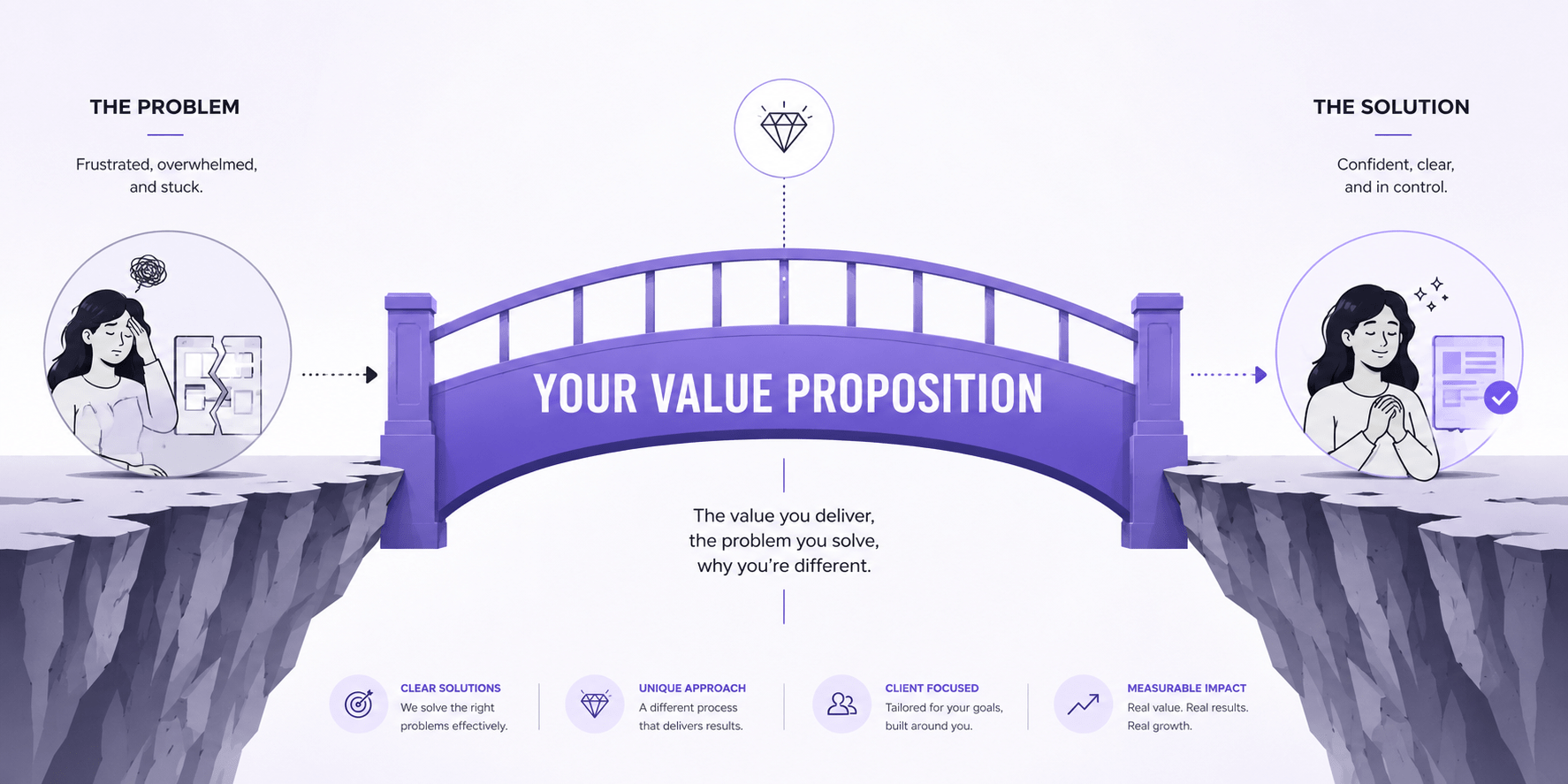
A founder describes her design service on her website: “We provide branding solutions for businesses.”
A competitor describes theirs: “We help purpose-driven founders build brands that attract ideal customers, communicate their values, and command premium positioning in 4 weeks, not 4 months.”
Both offer branding services. One is forgettable. The other is irresistible.
The difference isn’t the service. It’s the value proposition the clear articulation of who they serve, what problem they solve, and why customers should choose them.
Most businesses have a vague idea of the value they deliver. Few can articulate it clearly. Fewer still use it consistently across every customer touchpoint.
This article shows you how to do all three: understand what a value proposition is, build one that’s genuine to your business, and articulate it so clearly that customers immediately understand why they should choose you over alternatives.
What You'll Learn
ToggleWhat Is a Value Proposition? (And What It's Not)
A value proposition is a clear statement of the tangible results customers get from using your products or services.
It answers the customer’s core question: “Why should I choose you?”
Not “What do you do?” (that’s a tagline). Not “What is your mission?” (that’s brand purpose). Not “How do you operate?” (that’s your business model).
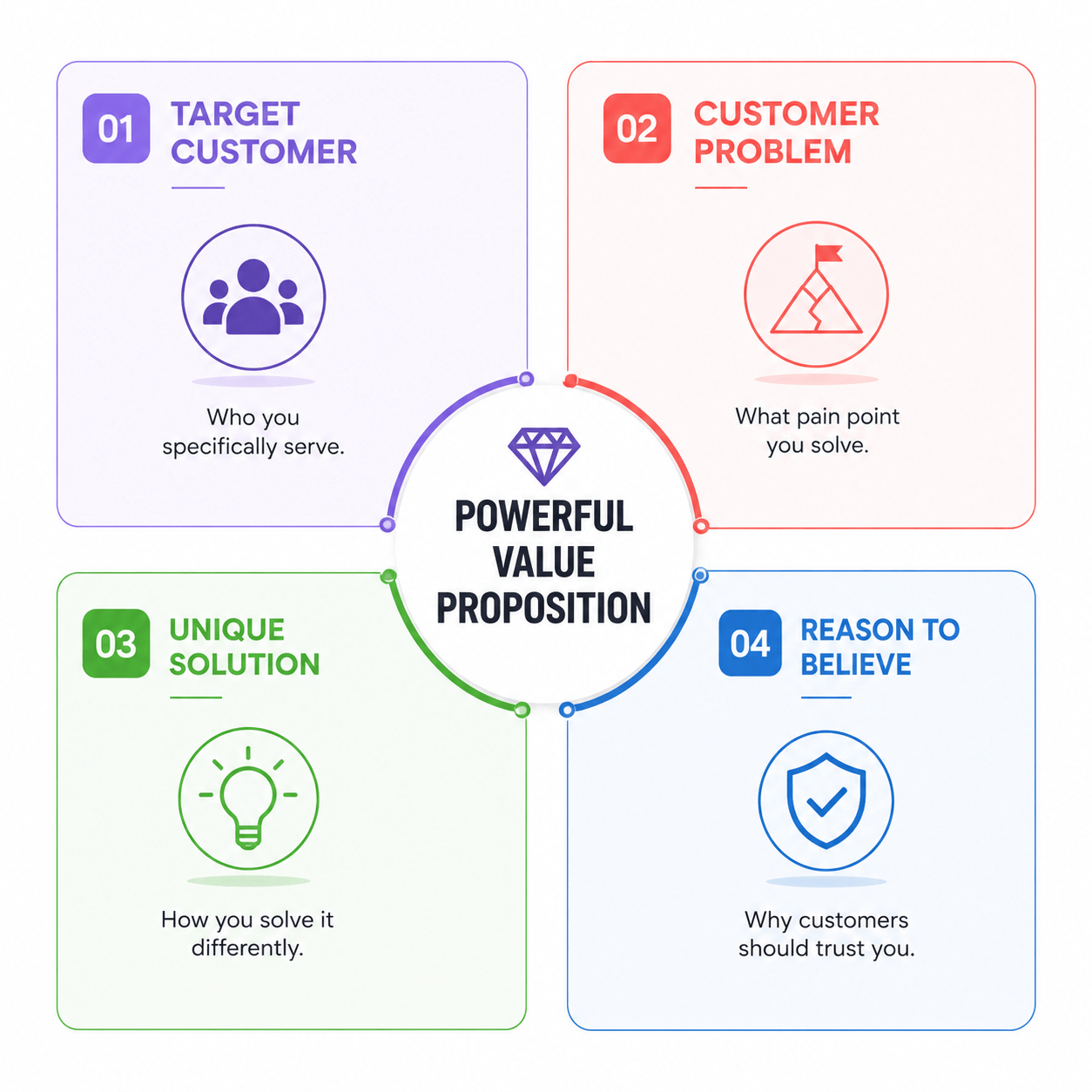
A value proposition specifically articulates:
- Who you serve (your target customer)
- What problem you solve (the customer's pain point)
- How you solve it uniquely (your differentiation)
- Why they should believe you (proof or credibility)
Example: Warby Parker’s value proposition isn’t “We sell eyeglasses.” It’s “Designer eyeglasses at 1/3 the price of traditional optometrists, with a home try-on program and a social mission.”
Notice what’s included:
- Who: People who need quality eyeglasses
- Problem: Eyeglasses are expensive
- Solution: Affordable designer frames + home try-on
- Reason to believe: Direct-to-consumer model + established reputation
A strong value proposition is specific, customer-focused, and differentiated. It’s not about your company. It’s about what your customer gets.
Value Proposition vs. Mission vs. Positioning
Before going further, let’s clarify how value proposition relates to other concepts you’ve likely heard.
Value Proposition is different from Brand Mission.
Your mission explains how you operate. Your value proposition explains what customers get.
Mission (internal): “We design affordable, high-quality eyewear and distribute it directly to consumers.”
Value Proposition (customer-facing): “Get designer eyeglasses for 1/3 the price.”
Value Proposition is different from Brand Positioning.
Positioning is how you want to be perceived in the market relative to competitors. Value proposition is why customers should buy from you specifically.
Positioning: “The affordable luxury eyewear brand”
Value Proposition: “Quality designer frames at 1/3 the cost, with zero eye exams or insurance hassles.”
Value Proposition connects Purpose and Messaging.
Remember our previous guide, Purpose is why your company exists. Value proposition is what value flows from that purpose to customers. Messaging is how you communicate that value.
Purpose → Value Proposition → Messaging → Customer Action
The Four Components of a Strong Value Proposition
1. Clear Target Customer (Specificity Matters)
Don’t say “businesses” or “entrepreneurs.” Say “B2B SaaS founders who’ve reached $1M ARR and need brand clarity to raise Series A.”
The more specific you are about who, the more compelling your value proposition becomes to the right people.
Why? Because specific customers feel seen. Generic language makes them feel like you’re trying to sell to everyone (which means you’re selling to no one effectively).
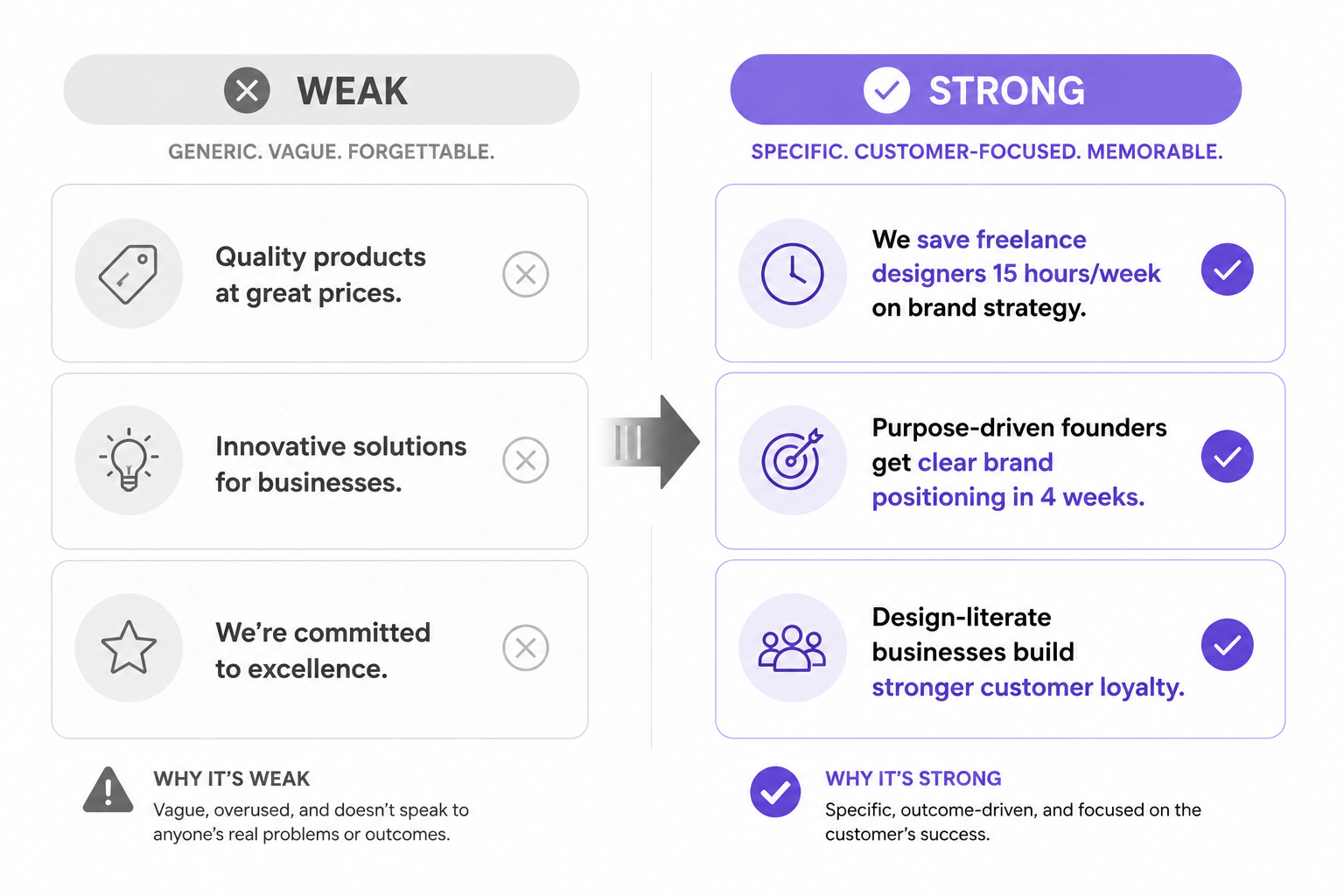
Weak: “For small business owners”
Strong: “For freelance designers who want to stop competing on price and start commanding premium rates”
2. Specific Customer Problem (Not Feature, Problem)
Don’t focus on what your product is. Focus on what problem your customer has.
Weak problem statement: “People need software to manage their projects”
Strong problem statement: “Project managers waste 2–3 hours daily context-switching between email, Slack, and spreadsheets, losing visibility into what’s actually happening”
The stronger you articulate the pain, the more compelling your solution becomes.
This is where research matters. What keeps your target customer up at night? What frustrates them? What opportunity are they missing? That’s the problem your value proposition should address.
3. Your Unique Solution (Differentiation)
This is where you show how you solve the problem differently than competitors.
It’s not enough to say “We have better customer service” or “Our product is easier to use.” Every competitor claims that.
Your differentiation should be specific to your approach, your team, your business model, or your unique insight.
Example differentiations:
- “We use AI to automate 80% of repetitive work” (technology differentiation)
- “We offer human support within 5 minutes, 24/7” (service differentiation)
- “We only work with B2B SaaS companies, so we understand your specific challenges” (expertise differentiation)
- “We offer a money-back guarantee if you’re not satisfied in 30 days” (risk reversal differentiation)
- “Our pricing is 40% lower because we eliminated sales commissions” (business model differentiation)
What makes your solution genuinely different? That’s your differentiation.
4. Reason to Believe (Proof)
Customers are skeptical. You need to give them a reason to believe your claims.
This could be:
- Social proof: “500+ companies use our platform”
- Expert credibility: “Built by the former VP of Product at [known company]”
- Track record: “Increase conversion by average 23% (certified results from independent audit)”
- Transparency: “Try free for 30 days, no credit card required”
- Specificity: “Businesses reduce onboarding time from 6 weeks to 1 week”
Without a reason to believe, your value proposition is just marketing fluff.
- Who: People who need quality eyeglasses
- Problem: Eyeglasses are expensive
- Solution: Affordable designer frames + home try-on
- Reason to believe: Direct-to-consumer model + established reputation
How to Build Your Value Proposition: A Framework
Step 1: Define Your Target Customer
Not “businesses” or “entrepreneurs.” Get specific.
- Who specifically do you serve?
- What industry or role?
- What company size?
- What characteristics define them?
Write it as a detailed customer profile. The more specific, the better.
Step 2: Identify Their Core Problem
Interview 5–10 customers or prospects. Ask:
- What’s your biggest frustration right now?
- What have you tried that didn’t work?
- How is this problem costing you (time/money/opportunity)?
- What would change if this problem was solved?
Don’t assume you know the problem. Customers will often reveal a problem you didn’t expect.
Step 3: Define Your Unique Solution
How do you solve this problem?
- What’s your approach?
- What makes it different from competitors?
- What are you specifically good at that others aren’t?
Be honest. If you’re not differentiated, acknowledge it and find a way to differentiate (or reconsider the market).
Step 4: Gather Proof Points
What evidence supports your claim?
- Customer testimonials
- Case studies with quantified results
- Your track record
- Third-party validation
- Risk reversal guarantees
Step 5: Draft and Refine
Write your value proposition in 1–3 sentences that include all four components.
Test it with target customers. Does it resonate? Do they immediately understand why they should choose you?
Refine until it’s crystal clear.
- Who: People who need quality eyeglasses
- Problem: Eyeglasses are expensive
- Solution: Affordable designer frames + home try-on
- Reason to believe: Direct-to-consumer model + established reputation
Value Proposition Examples Across Industries
SaaS (Project Management):
“Asana gives teams the clarity they need to stay focused on results, even as work changes. With Asana, teams coordinate across silos, accelerate project delivery, and reduce repetitive questions saving each team member 2+ hours weekly.”
Notice: Target (teams), Problem (coordination/wasted time), Solution (clear visibility/coordination), Proof (2+ hours saved).
Freelance Services (Brand Strategy):
“GB Visual Studio helps purpose-driven founders build brands that attract ideal customers and command premium positioning without hiring a full creative agency. Skip 6 months of DIY mistakes. Launch a brand that works in 4 weeks.”
Notice: Target (purpose-driven founders), Problem (slow branding/DIY mistakes), Solution (fast, expert-led, affordable), Proof (4-week timeline/no agency cost).
E-commerce (Eyeglasses):
“Warby Parker makes fashion-forward, affordable eyeglasses that don’t sacrifice quality. Shop online, try on at home, and get them delivered in days. Same-day frames made with high-quality materials, backed by our risk-free guarantee.”
Notice: Target (fashion-conscious, price-sensitive), Problem (expensive eyeglasses), Solution (affordable + home try-on + fast delivery), Proof (quality materials + guarantee).
- Who: People who need quality eyeglasses
- Problem: Eyeglasses are expensive
- Solution: Affordable designer frames + home try-on
- Reason to believe: Direct-to-consumer model + established reputation
Common Mistakes in Value Proposition
Mistake 1: Making It About You, Not the Customer
Weak: “We’re a leading brand strategy firm with 15 years of experience.”
Strong: “Brands we’ve worked with see 35% average revenue growth within 18 months.”
The first is about you. The second is about customer benefit.
Mistake 2: Being Too Generic
Weak: “We provide quality products at great prices.”
Strong: “Sustainable outdoor gear that’s 40% cheaper than legacy brands because we sell direct, and 100% of profits fund environmental conservation.”
The first could apply to anyone. The second is specific and differentiated.
Mistake 3: Focusing on Features Instead of Benefits
Weak: “Our software has AI-powered analytics.”
Strong: “Reduce time analyzing reports from 4 hours to 10 minutes, so you can make faster decisions.”
Features are what you do. Benefits are what customers get.
Mistake 4: Lacking Proof
Weak: “We’ll improve your efficiency significantly.”
Strong: “Average client reduces manual work by 80%, saving $50k+ annually.”
One is vague promise. The other is verifiable claim.
Using Your Value Proposition Across Touchpoints
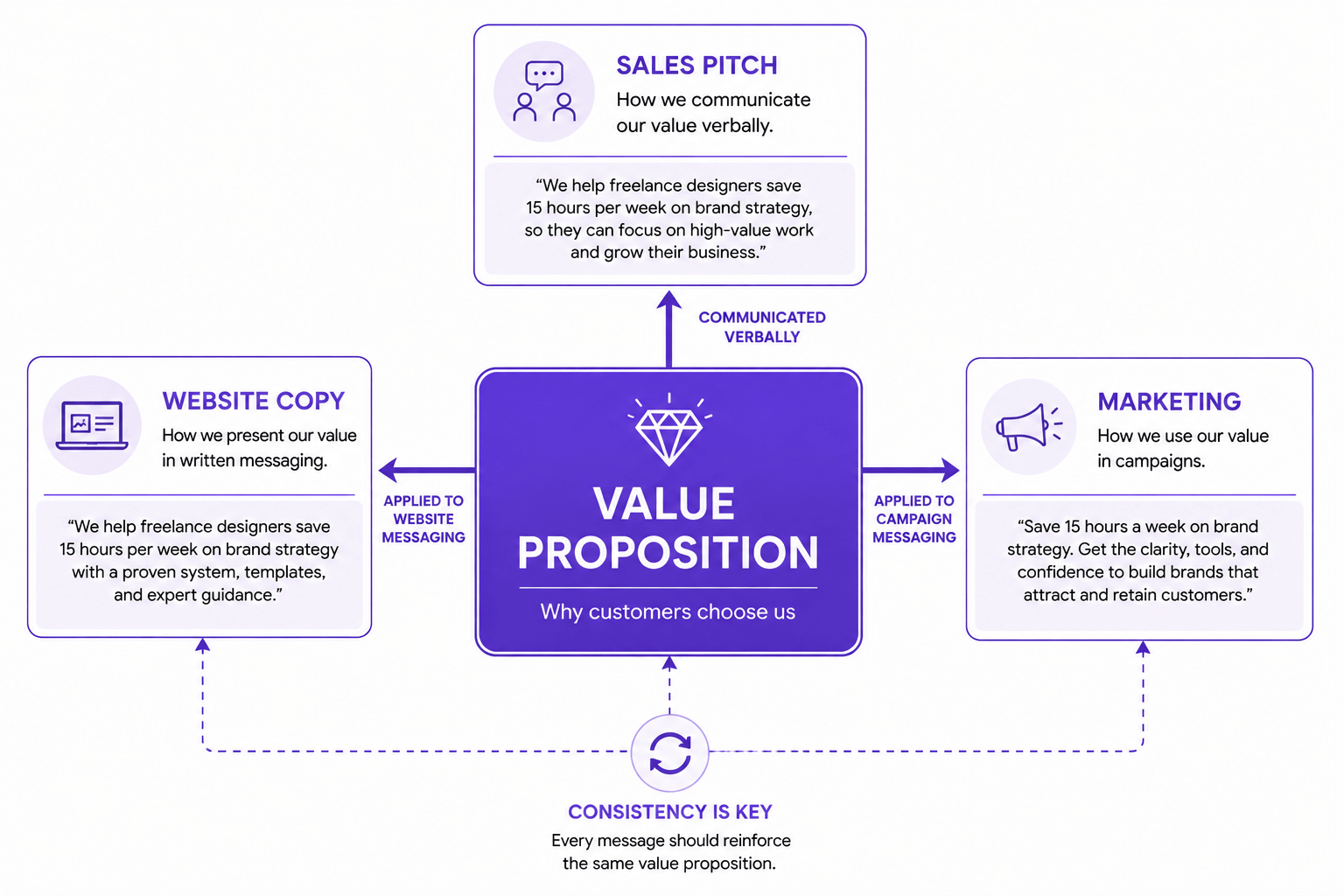
Once you’ve articulated it, your value proposition should appear consistently:
On Your Website: Your homepage headline, about section, and service descriptions should all reinforce your value proposition.
In Sales Conversations: Your pitch, proposals, and sales emails should articulate the same value proposition.
In Marketing: Your content, ads, emails, and social posts should consistently communicate your value proposition.
In Customer Onboarding: Your onboarding should deliver on what your value proposition promises.
The most powerful brands have a value proposition that’s so clear and consistent that customers can articulate it themselves.
Conclusion
Your value proposition is the bridge between your business strategy and customer perception.
It’s not about what your company is. It’s about what your customer gets. When you articulate that clearly targeting a specific customer, solving a specific problem, offering a unique solution with proof everything else becomes easier.
Your marketing is clearer. Your sales conversations are more compelling. Your positioning is stronger. Your customers understand instantly why they should choose you.
The companies winning right now aren’t the ones with the most features. They’re the ones with the clearest value proposition.
Once you’ve articulated your value proposition, the next challenge is communicating it consistently across every customer touchpoint. That’s where brand messaging strategy comes in.
Or explore how your value proposition flows from your brand purpose, mission, and vision.
1 Comment
[…] For a deeper exploration of this subject, see Value Proposition: How to Articulate What Makes Your Brand Valuable. […]