A founder is rewriting her company’s brand strategy. She’s gathered her team to define three things: purpose, mission, and vision.
Within 10 minutes, the room is confused.
“Isn’t mission the same as vision?”
“Wait, so purpose IS the mission?”
“I thought we already defined all of this.”
The problem: These three concepts are related deeply related but they’re not the same. Most companies conflate them. Most people use the terms interchangeably. But they shouldn’t.
Understanding the difference between purpose, mission, and vision isn’t semantic nitpicking. It’s strategic clarity. When you understand what each one does and how they connect suddenly everything else in your branding strategy becomes easier.
This article breaks down the differences clearly. By the end, you’ll understand what each concept is, how they relate to each other, and why the distinction matters for your business.
What You'll Learn
ToggleWhat Is Brand Purpose?
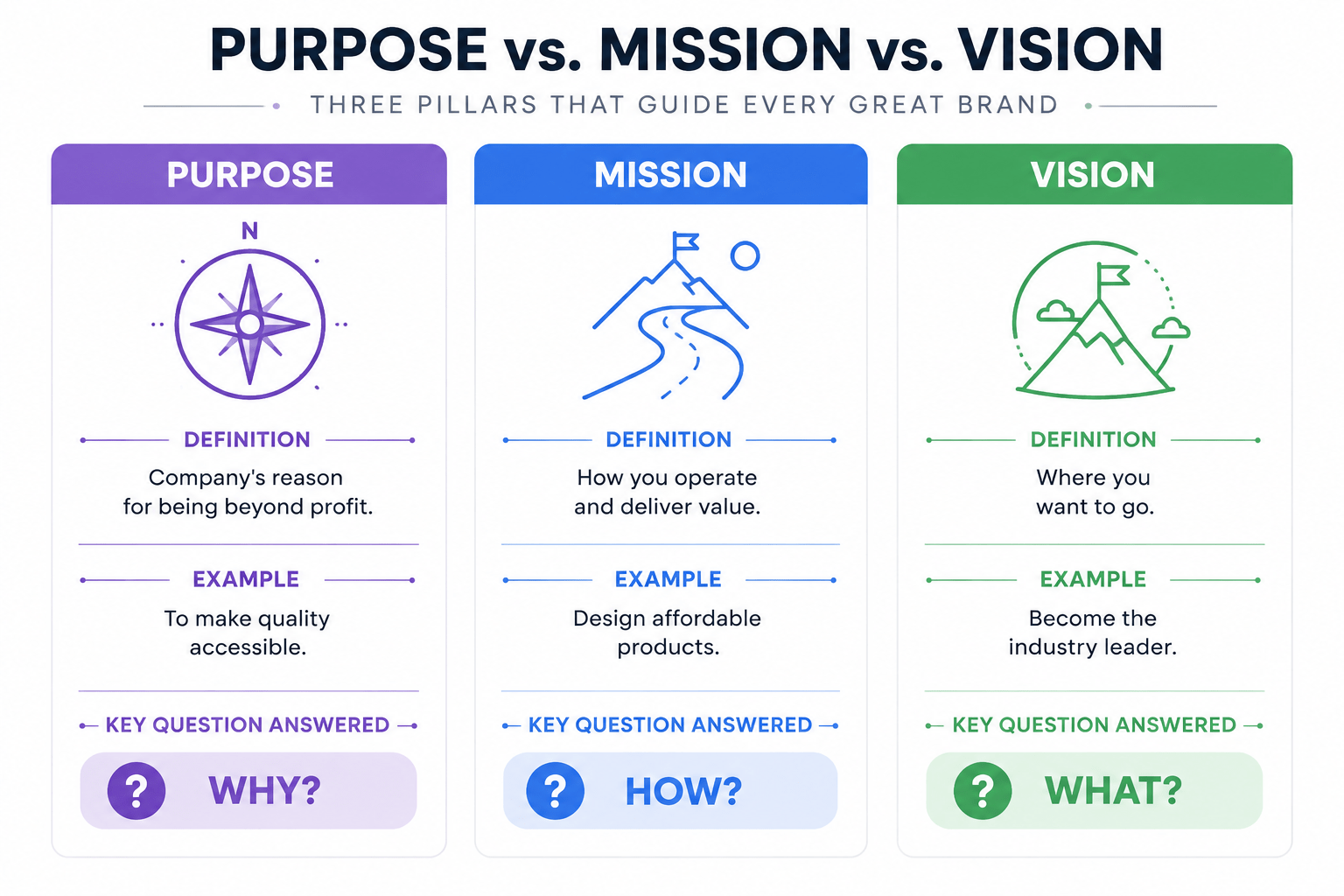
Brand purpose is your company’s reason for existing beyond making profit.
It answers the question: “Why do we exist?” Not “What do we sell?” or “Where do we want to be?” But fundamentally, why does this company exist?
Purpose is foundational. It’s the deepest layer. According to Simon Sinek’s “Start With Why” framework, people don’t buy what you do; they buy why you do it. Creativepool
Purpose is often connected to creating positive change solving a problem, meeting a need, or improving something in the world. It goes beyond commercial success.
Examples of clear brand purpose:
- Patagonia: To protect the environment
- Tesla: To accelerate sustainable energy
- TOMS: To improve lives through business
- Warby Parker: To make quality eyewear accessible
Notice: None of these are about the product itself. They’re about the impact the company is here to create.
Purpose is stable. It shouldn’t change based on market trends. It’s the North Star that guides everything else.
What Is Brand Mission?
Brand mission is how you execute your purpose. It’s the method, the approach, the specific action you take.
Mission answers: “How do we fulfill our purpose?”
Your mission describes what you actually do—the work you do every day to make your purpose real. It’s more specific than purpose but still strategic.
A strong mission statement often includes:
- What you do
- Who you serve
- How you deliver value
- What makes your approach distinctive
Examples:
- Patagonia’s mission: Build the best outdoor products while minimizing environmental damage
- Tesla’s mission: Design and manufacture electric vehicles that are desirable, affordable, and performance-leading
- TOMS’s mission: Produce quality merchandise and distribute shoes, eyewear, and clean water to those in need
- Warby Parker’s mission: Offer designer eyewear at a revolutionary price while leading the way for socially conscious businesses
Notice: These are more specific than the purpose. They describe the actual business model and approach.
Mission can evolve as your business evolves. Your purpose stays the same, but how you pursue it might shift as markets and capabilities change.
What Is Brand Vision?
Brand vision is where you want to go. It’s the destination, the future state you’re building toward.
Vision answers: “Where are we headed?” or “What future are we creating?”
A strong vision is ambitious, aspirational, and concrete enough to guide decisions. It paints a picture of what success looks like.
Examples:
- Patagonia’s vision: A world where protecting the environment is a core business practice
- Tesla’s vision: To accelerate the world’s transition to sustainable energy
- TOMS’s vision: A world where business is a force for good
- Warby Parker’s vision: To create a world where everyone has access to quality eyewear
Notice: These are future-oriented. They describe the world or situation the company is trying to create or reach.
Vision often includes a timeframe (“by 2030”) and specific, measurable outcomes. It’s ambitious enough to inspire but grounded enough to be believable.
Vision should evolve as you achieve milestones. When you reach one vision, you set a new one.
How They Connect: The Golden Circle Framework
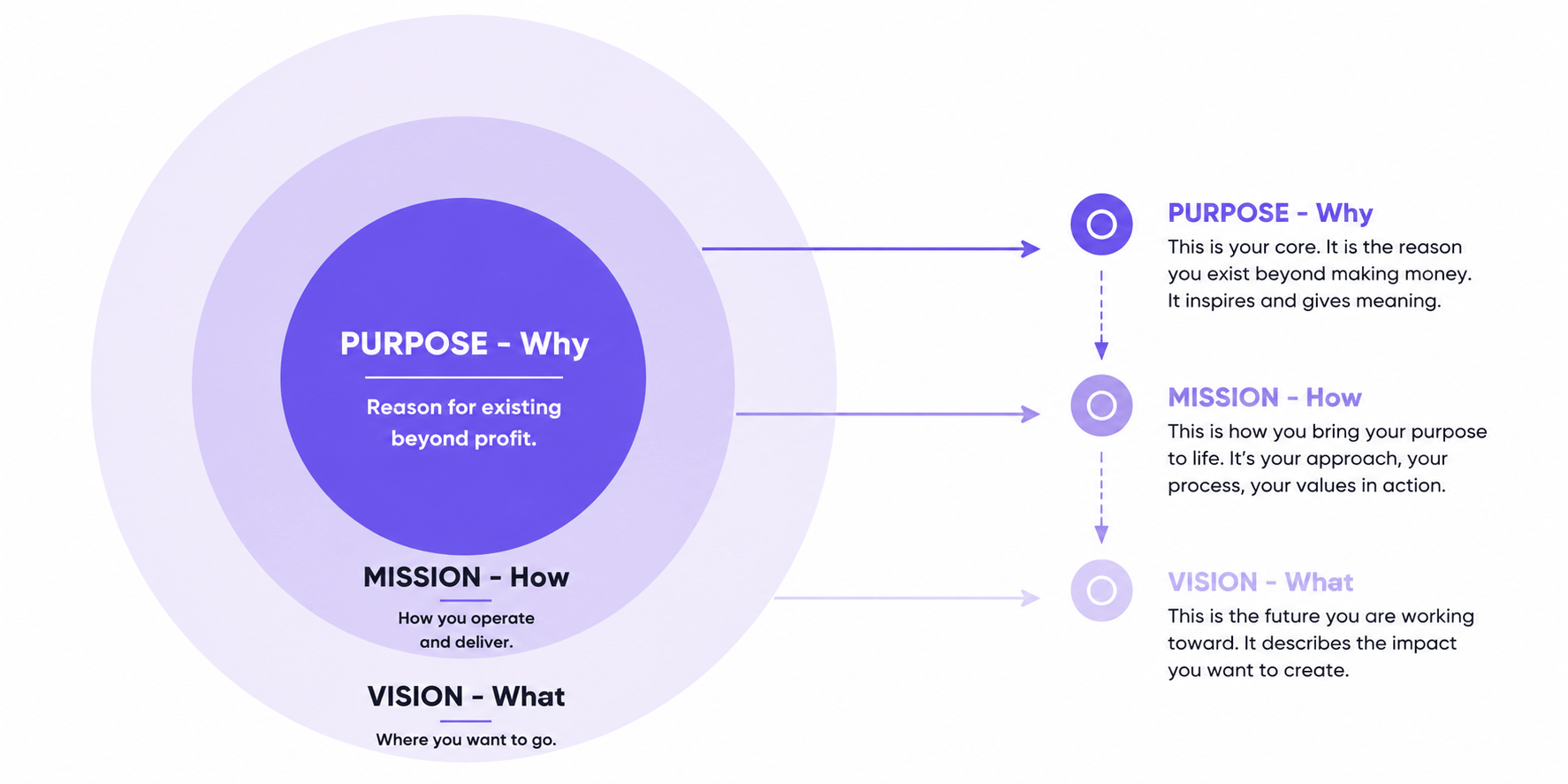
Simon Sinek’s golden circle provides the clearest framework: “Why” (purpose) at the center, “How” (mission) in the middle ring, and “What” (vision) on the outer ring. Qualtrics
Here’s how they work together:
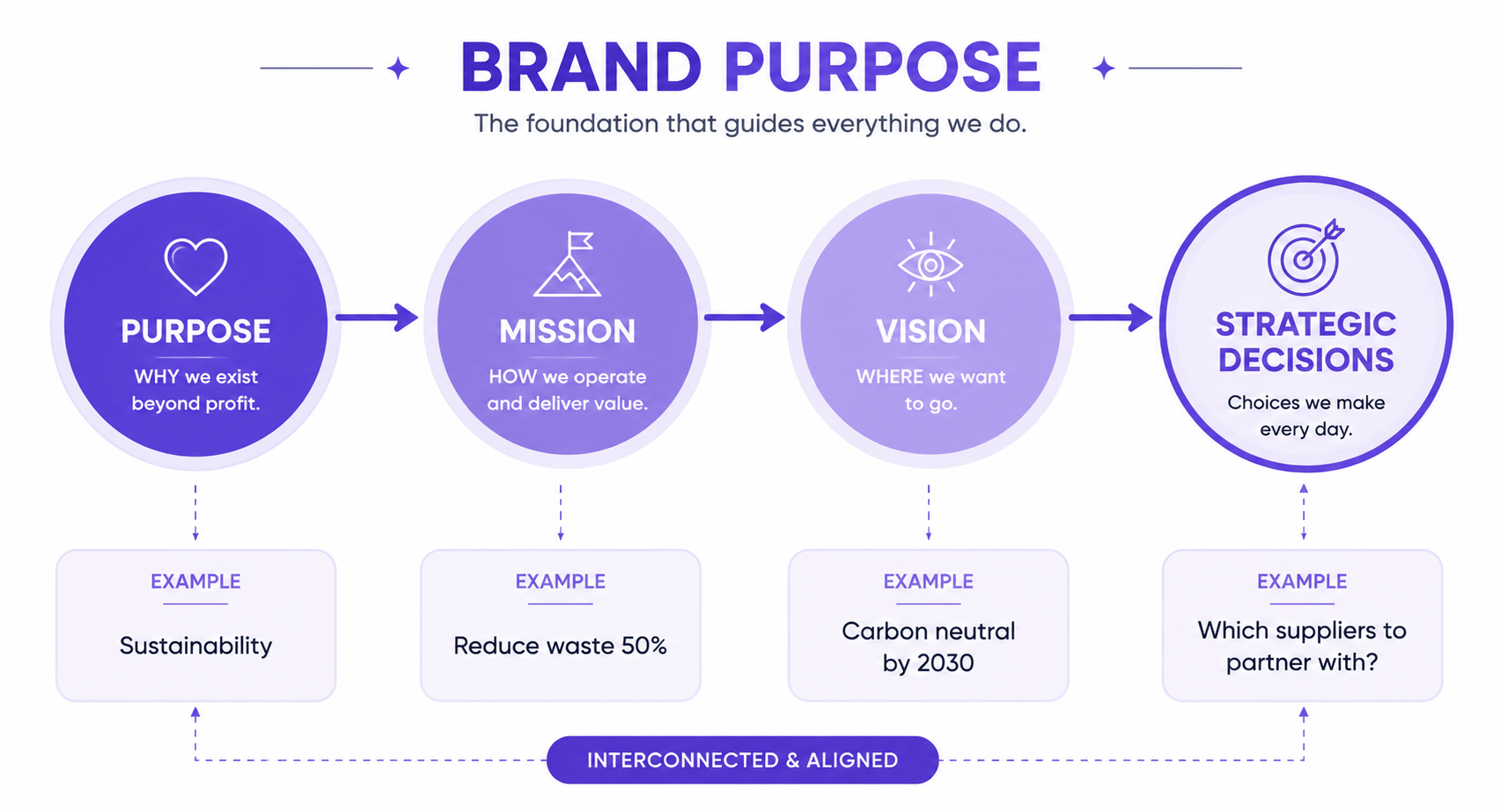
Purpose (Why) is foundational. It’s the reason the company exists. It guides everything else. If you don’t have clarity on your purpose, your mission and vision will lack coherence.
Mission (How) flows from purpose. Once you know why you exist, your mission describes how you operationalize that purpose. Your mission is the specific work you do to fulfill your why.
Vision (What) flows from mission. Once you know how you’re going to pursue your purpose, your vision describes where that approach will take you—the future state you’re building toward.
Example:
- Purpose: Make sustainable products accessible (Why)
- Mission: Design affordable, high-quality sustainable products and distribute them globally (How)
- Vision: A world where sustainable living is the default, not the luxury (Where)
When all three are aligned, every business decision becomes easier. You evaluate opportunities against your purpose. You execute through your mission. You measure progress toward your vision.
When they’re misaligned or unclear, everything is harder. You waste energy debating strategy because the foundation isn’t solid.
Common Mistakes: When Companies Get These Wrong
Mistake 1: Confusing Purpose with Marketing
Many companies create a “purpose” that sounds good but doesn’t actually reflect why they exist. It’s marketing language designed to appeal to consumers, not a genuine reason for being.
Real purpose isn’t designed for marketing. It’s designed for operations. It guides hiring, product decisions, partnerships, investments. If your stated purpose doesn’t influence your actual decisions, it’s not your real purpose it’s a slogan.
Mistake 2: Making Mission Too Vague
“Our mission is to create value for all stakeholders” is so generic it’s meaningless. It could apply to any company.
A strong mission is specific: What exactly do you do? Who exactly do you serve? How exactly do you serve them differently?
Warby Parker’s mission is specific: “Offer designer eyewear at a revolutionary price while leading the way for socially conscious businesses.” You understand exactly what they do and why their approach is distinctive.
Mistake 3: Setting Vision Too Ambitiously
Vision should be inspirational but believable. “We will dominate the entire industry” is vague. “We will capture 30% market share in women’s eyewear by 2030” is too tactical (that’s a goal, not a vision).
Good vision paints a picture of a future state that’s ambitious enough to inspire but grounded enough to guide strategy.
Mistake 4: Not Connecting the Three
Many companies have separate statements a mission, a vision but they don’t connect clearly to purpose. They feel disconnected. That’s because they were probably created in separate meetings without a coherent framework.
The strongest brands have clear lines of connection: Purpose → Mission → Vision. Each one builds on the previous one.
How to Use Purpose, Mission, and Vision in Strategy
Now that you understand the distinctions, here’s how to use them:
Purpose should guide culture and values. What do you hire for? What do you celebrate? What do you fire people for? These should flow from your purpose. If your stated purpose doesn’t influence your culture, it’s not real.
Mission should guide product and operations. What products do you build? What services do you offer? What processes do you implement? These should flow from your mission. A change in mission (how you operate) might lead to new products, new markets, new partnerships.
Vision should guide goals and strategy. Where are you investing? What initiatives are you funding? What partnerships are you pursuing? These should flow from your vision of the future you’re building.
When all three are clear and connected, every team member understands why they’re doing what they’re doing. Marketing isn’t just selling features. Product development isn’t just chasing trends. Operations aren’t just following process. Everything connects to a larger purpose and vision.
Conclusion
Purpose, mission, and vision are three distinct concepts that work together to create strategic clarity.
- Purpose is your reason for existing (Why)
- Mission is how you operate (How)
- Vision is where you’re going (What)
When all three are clear and connected, your strategy becomes coherent. Decisions become easier. Teams become aligned. Customers understand what you stand for.
The companies winning right now don’t just have better products. They have clarity on their purpose, a distinctive mission, and an inspiring vision. Everything flows from that foundation.
Ready to build these into your complete branding strategy? Or dive deeper into how to articulate your value proposition once you’ve defined your purpose, mission, and vision.