A founder has just completed the hard work: she’s defined her brand purpose, clarified her mission and vision, and articulated a compelling value proposition.
Now comes the question that trips up most brands: “How do we actually talk about this?”
She’s tempted to just start creating content. Write some web copy. Post on social media. Send an email campaign. But there’s a problem: without a framework, every piece of communication will sound different. One page says one thing, social media says something else, sales is saying a third thing.
Customers get confused. The brand feels incoherent. The strategic work purpose, value prop, positioning gets diluted or lost.
This is where a brand messaging framework comes in. It’s the bridge between strategy (what you’ve defined) and execution (how you actually communicate).
A messaging framework doesn’t write your copy for you. It provides the structure and guardrails so that every person on your team from social media manager to sales rep to content writer can communicate your brand consistently.
This article shows you how to build one.
What You'll Learn
ToggleWhat Is a Brand Messaging Framework? (And Why You Need One)
A brand messaging framework is the organized system that translates your brand strategy into consistent, channel-specific communication.
It answers three questions:
- What are we saying? (Core messages)
- How are we saying it? (Tone, voice, style)
- Where are we saying it? (Channel-specific adaptations)
Without a framework, messaging is chaotic. With one, messaging is consistent—even when different people are communicating on different channels.
Why this matters:
Consistency builds trust. When customers encounter the same core message on your website, in your email, in your sales conversation, and in your social media, they perceive your brand as coherent and trustworthy.
Without consistency, customers get confused. They might not realize that different messages are coming from the same brand.
A messaging framework ensures that whether a customer encounters your brand on LinkedIn, your website, your sales pitch, or a piece of content, they hear the same core narrative with consistent tone and values.
The Core Components of a Messaging Framework
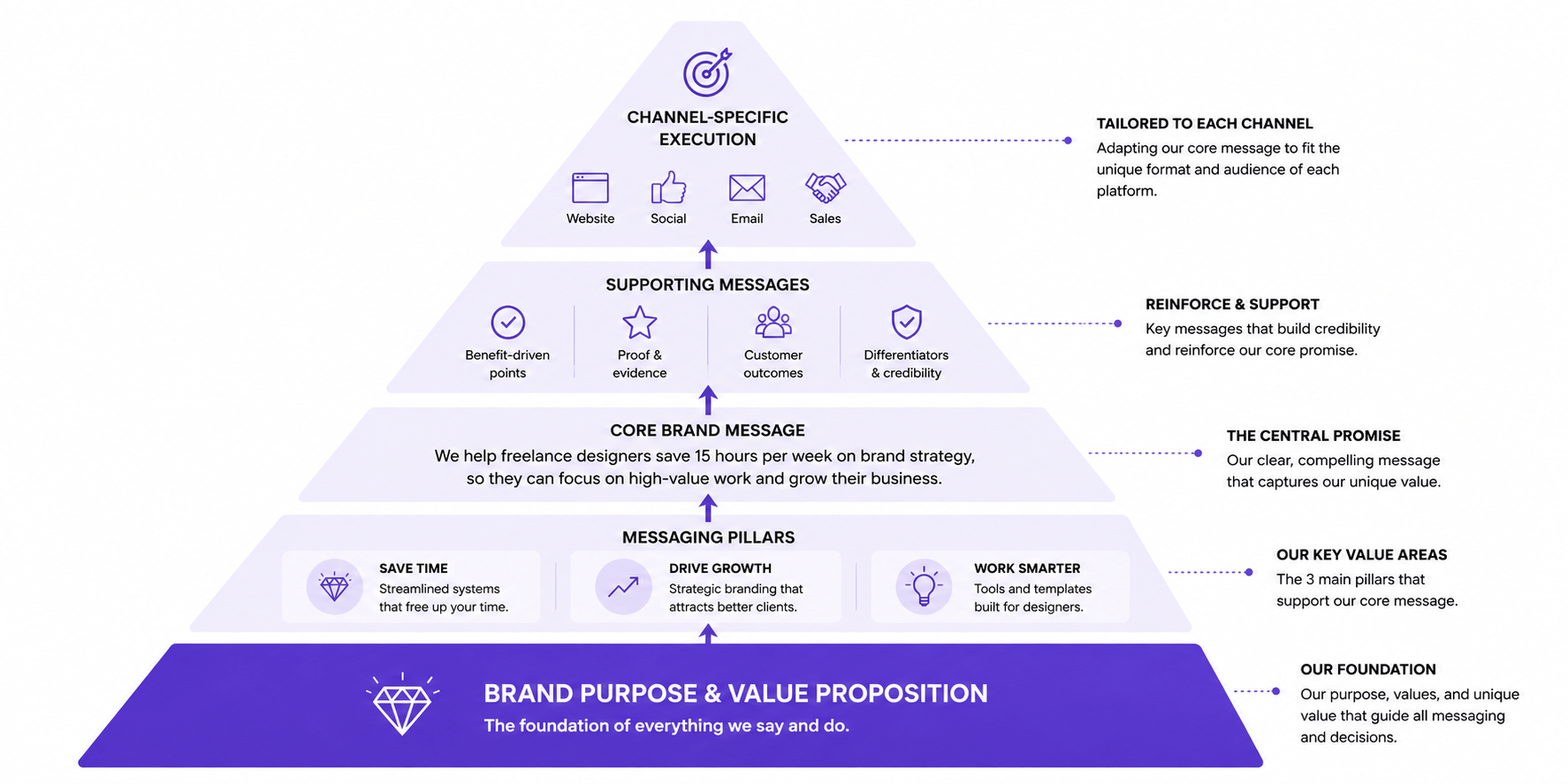
A complete messaging framework has several layers. Let’s break them down:
1. Core Brand Message (The North Star)
This is your single, most important message. It should capture your value proposition in one memorable statement.
It’s not a tagline. It’s the essence of what you want your brand to be known for.
Examples:
- GB Visual Studio: “We help purpose-driven founders build brands that attract ideal customers and command premium positioning.”
- Patagonia: “We’re in business to save our home planet.”
- Warby Parker: “Affordable, designer-quality eyewear for everyone.”
Your core message should:
- Be specific enough to be memorable
- Focus on customer benefit (not company feature)
- Be defensible (you actually deliver this)
- Remain consistent across all communication
This message should appear (in some form) in your website headline, your elevator pitch, your social bio, your email signature. It’s your North Star.
2. Messaging Pillars (3–5 Supporting Messages)
Your core message is powerful, but it needs support. Messaging pillars are 3–5 core themes that reinforce your main message.
Example: Warby Parker’s possible messaging pillars:
- Pillar 1 (Quality): Premium, designer-quality eyewear
- Pillar 2 (Affordability): Dramatically lower prices through direct-to-consumer model
- Pillar 3 (Social Impact): Every purchase funds eyewear for someone in need
- Pillar 4 (Accessibility): Easy home try-on, no eye exams required
Each pillar is a distinct reason customers should care about your brand.
Why three to five? Fewer and you’re not providing enough reasons to believe. More and customers forget. Three to five is memorable.
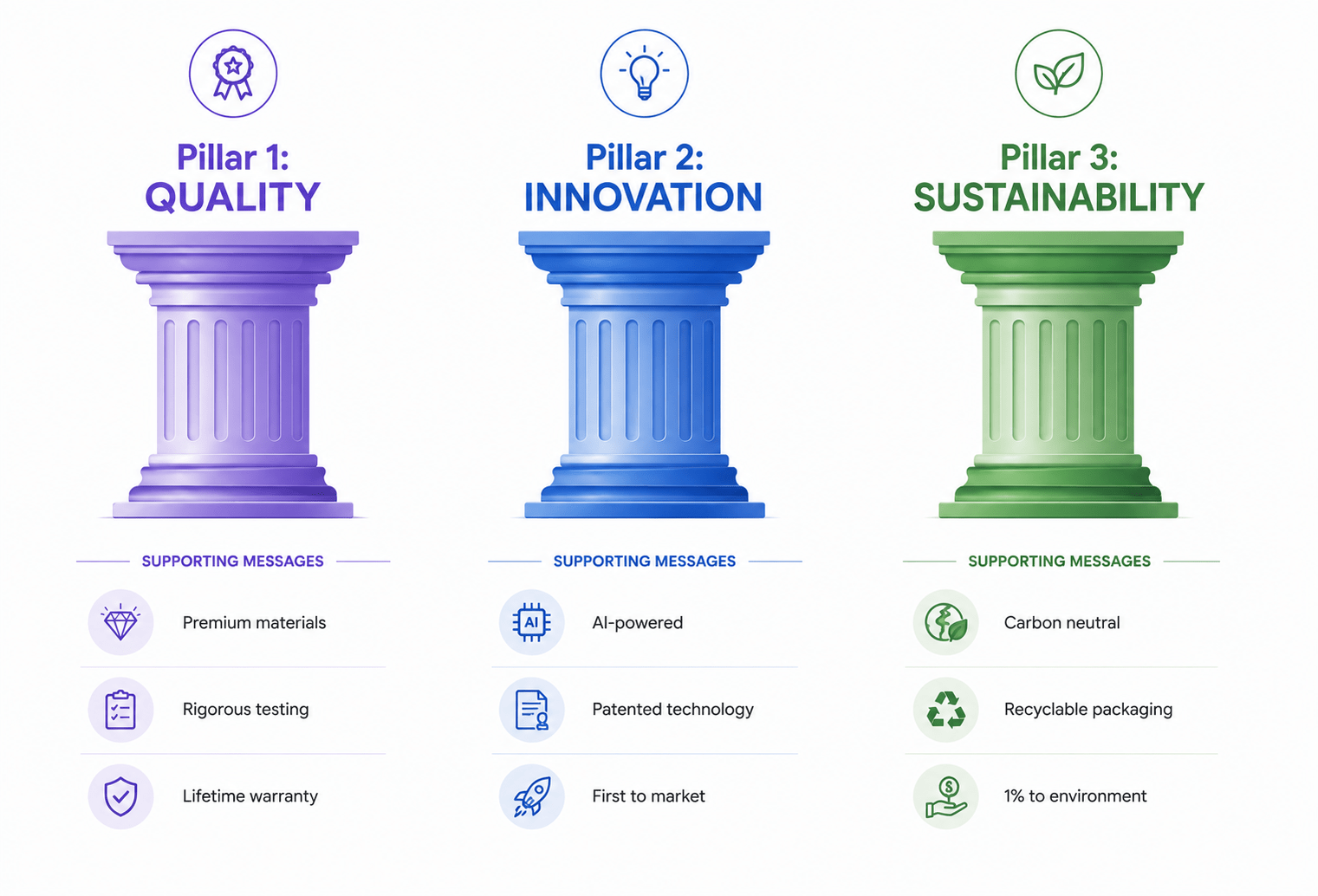
3. Supporting Messages (Details Under Each Pillar)
Under each pillar, you need 2–4 supporting messages that provide proof or detail.
Example: Under “Quality” pillar:
- Supporting message 1: “Sourced from Italian manufacturers with 40+ years of eyewear expertise”
- Supporting message 2: “Every frame undergoes rigorous quality testing”
- Supporting message 3: “Blue-light filtering and scratch-resistant coating standard”
These supporting messages give customers specific reasons to believe the pillar claim.
4. Brand Voice & Tone Guidelines
How do you sound? Your voice is your personality. Your tone is how that personality adapts to context.
Brand Voice (consistent across all communication):
- Knowledgeable but not arrogant
- Direct and clear
- Human and conversational
- Optimistic but honest
Tone Variations (adapted by context/channel):
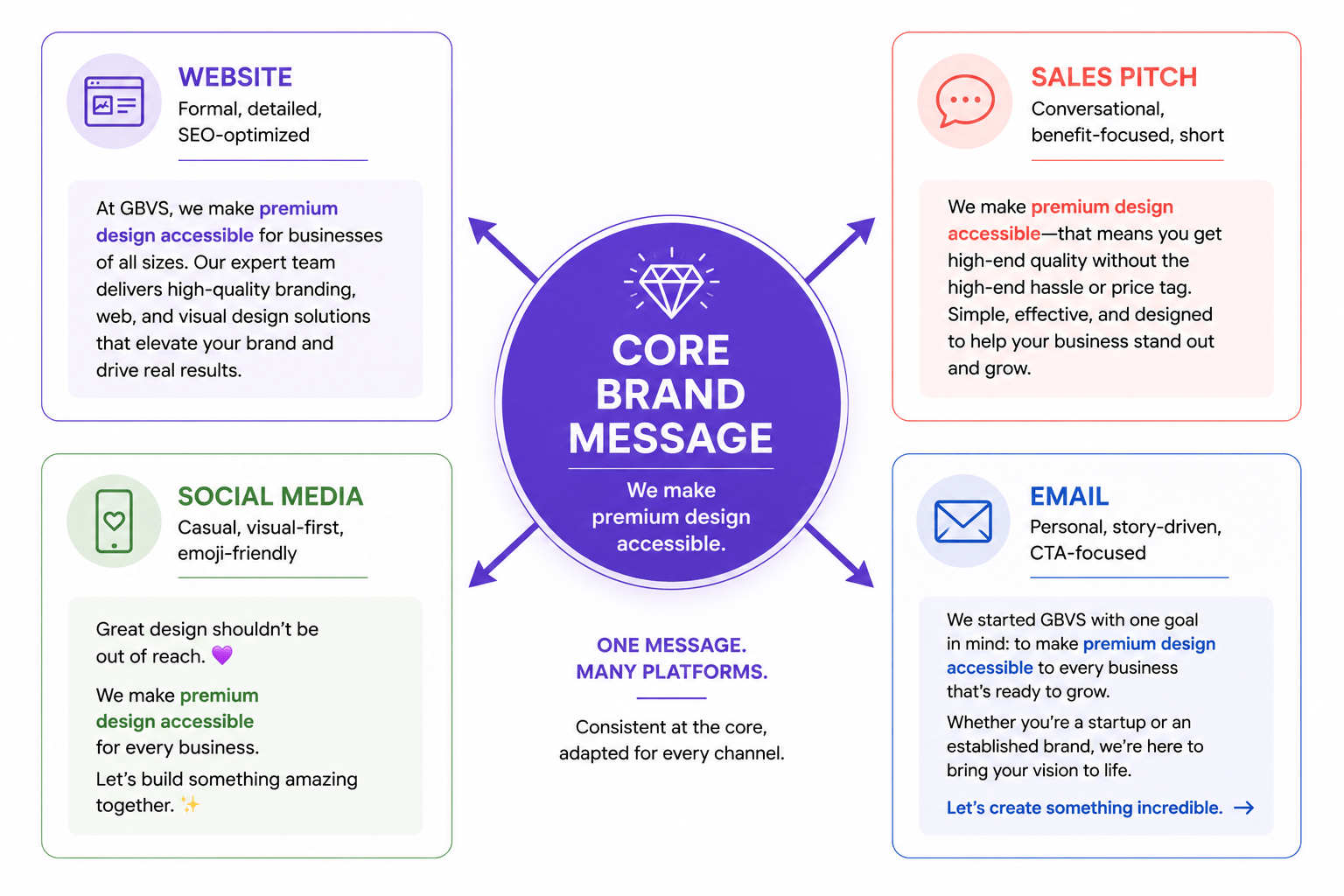
- Website: Professional, authoritative, detailed
- Social media: Casual, witty, conversational
- Email: Personal, intimate, story-driven
- Sales pitch: Enthusiastic, benefit-focused, interactive
- Customer support: Empathetic, patient, helpful
Define your voice once. Then adapt the tone by channel.
5. Channel-Specific Messaging (How It Appears in Each Place)
The same core message sounds different in different places because context matters.
Your website homepage needs context, credibility, details.
Your social media bio needs to be short and catchy.
Your sales pitch needs to be benefit-focused and conversational.
Your email subject line needs to stop the scroll.
A messaging framework acknowledges this. It says: “Your core message is X. On the website, emphasize Y. On social, focus on Z. In email, lead with story.”
How to Build Your Brand Messaging Framework
Step 1: Start with Your Strategy
You should already have this from Brand Purpose & Purpose vs Mission vs Vision:
- Brand purpose (why you exist)
- Brand mission (how you operate)
- Brand vision (where you’re going)
- Value proposition (what customers get)
Your messaging framework builds on this foundation. Don’t start messaging before you’ve clarified strategy.
Step 2: Define Your Core Brand Message
In one sentence, what do you want to be known for?
This should be customer-focused (what they get), specific (not generic), and defensible (you actually deliver it).
Test it: Can you imagine this showing up in your website headline? Can you imagine a customer saying this about your brand?
Step 3: Identify 3–5 Messaging Pillars
Think about your value proposition. What are the distinct benefits? What themes show up repeatedly in customer conversations?
Example pillars might be:
- Speed/efficiency
- Quality/premium
- Affordability/value
- Expertise/authority
- Impact/values
Choose pillars that are distinct from each other and supported by your business reality.
Step 4: Create Supporting Messages
For each pillar, write 2–4 supporting messages that provide proof, detail, or elaboration.
These can include:
- Specific features or capabilities
- Customer results or outcomes
- Proof points or credentials
- Comparative advantages
- Examples or case studies
Step 5: Define Your Voice & Tone
How should your brand sound?
Describe your brand voice in 3–5 personality traits:
- Knowledgeable / Approachable
- Serious / Playful
- Traditional / Innovative
- Formal / Casual
Then describe how tone shifts by channel:
- Website: [description]
- Social: [description]
- Email: [description]
- Sales: [description]
- Support: [description]
Step 6: Create Channel-Specific Guidance
For each major channel (website, social, email, sales, content), write specific guidelines:
- Primary message focus (which pillar?)
- Tone (how to sound)
- Length (word count)
- Format (text, visual, video?)
- Call to action (what should readers do?)
Step 7: Document & Share
Create a document or guide your whole team can reference. It might include:
- Core message (large and prominent)
- Messaging pillars with supporting messages
- Voice & tone guidelines
- Channel-specific guidance
- Examples of good/bad messaging
- Approved templates
Messaging Framework in Practice: Real Examples
Tech SaaS Company Example:
Core Message: “We help remote teams stay connected and productive, no matter where they are.”
Messaging Pillars:
- Connection: Unified platform for all team communication
- Productivity: Reduce context-switching, increase focus time
- Flexibility: Works wherever your team is
- Integration: Connects seamlessly with tools you already use
Supporting Messages (under “Connection” pillar):
- “Centralize chat, video, file sharing, and project management in one place”
- “Reduce app-switching by 80%”
- “Find information instantly instead of scrolling through threads”
Website messaging: Detailed, feature-focused, benefit-driven
Social messaging: Casual, relatable, problem-oriented (“Remote teams, does this sound familiar?”)
Email messaging: Personal storytelling about team productivity
Sales messaging: ROI-focused, competitive advantage-driven
Personal Brand Example (Freelancer):
Core Message: “I help freelance designers build personal brands that attract premium clients and command 2–3x higher rates.”
Messaging Pillars:
- Strategy: Design-literate brand strategy specific to freelancers
- Speed: Build your brand in 4 weeks, not 4 months
- Affordability: Premium strategy without premium agency costs
- Results: Clients command higher rates and work with better clients
Supporting Messages (under “Results” pillar):
- “Average client increases rates by 40% within 6 months”
- “Qualified leads increase by 3x”
- “Time spent on sales calls decreases by 60%”
Common Messaging Framework Mistakes
Mistake 1: Core Message Is Too Generic
Weak: “We provide quality solutions for businesses.”
Strong: “We help B2B SaaS companies go from confusing to crystal clear clarifying positioning, messaging, and brand identity so they can raise capital and attract talent.”
Generic sounds like everyone. Specific sounds like you.
Mistake 2: Pillars Aren't Distinct
Weak pillars:
- Quality
- Excellence
- High standards
- Premium
These are all saying the same thing. Create distinct pillars.
Strong pillars:
- Speed (we’re faster than everyone)
- Quality (we don’t compromise on quality)
- Affordability (we’re cheaper than alternatives)
- Expertise (we know this space better than anyone)
Each pillar should be a different reason to choose you.
Mistake 3: No Voice Guidelines
Without voice guidelines, every person on your team communicates differently. One person sounds corporate. Another sounds casual. Another sounds like an industry expert.
Define your voice. Document it. Make everyone reference it.
Mistake 4: Ignoring Channel Differences
The same message works differently on Twitter vs. your website vs. a sales call. Your framework should acknowledge this.
Same core message. Different channel adaptations.
Mistake 5: Messages Don't Connect to Strategy
Your messaging framework should flow directly from your purpose, mission, and value proposition. If it doesn’t, something’s misaligned.
Check: Does our core message reflect our value proposition? Do our pillars support our mission? Does our voice reflect our values?
Maintaining Messaging Consistency Across Teams
Once you’ve built your framework, the real work is maintaining consistency.
Create a Brand Messaging Guide
Write a one-page to three-page guide your whole team references:
- Core message (large, prominent)
- Messaging pillars + supporting messages
- Voice & tone guidelines
- Channel-specific guidance
- Examples and non-examples
- FAQ
Train Your Team
Don’t just share the guide and hope people read it. Run a 30-minute training:
- Why messaging matters
- What each component means
- How to use the guide
- Examples of applying it
- Q&A
Audit Regularly
Every quarter, audit your communication:
- Website copy (does it reflect the framework?)
- Social posts (consistent voice and message?)
- Emails (aligned with pillars?)
- Sales materials (supporting the core message?)
Where are you off-brand? Adjust.
Give Permission to Adapt
Channel adaptation isn’t inconsistency it’s required. Your social voice should be different from your website voice. Your email should sound different from your sales pitch.
Make this explicit: “Our core message never changes. But how we express it adapts by channel.”
Conclusion
A brand messaging framework ties your strategy to your execution.
It ensures that whether a customer encounters your brand on your website, social media, in your sales pitch, or in your content, they hear the same core message with consistent voice and values.
The companies winning right now aren’t the ones with the best individual campaigns. They’re the ones with the most consistent, recognizable brand voice across all touchpoints.
A framework makes consistency possible and it makes it easy for every person on your team to communicate your brand authentically.
Start with your strategy. Define your core message. Build your pillars. Document your voice. Adapt by channel. Share with your team.
That’s how strategy becomes communication.