
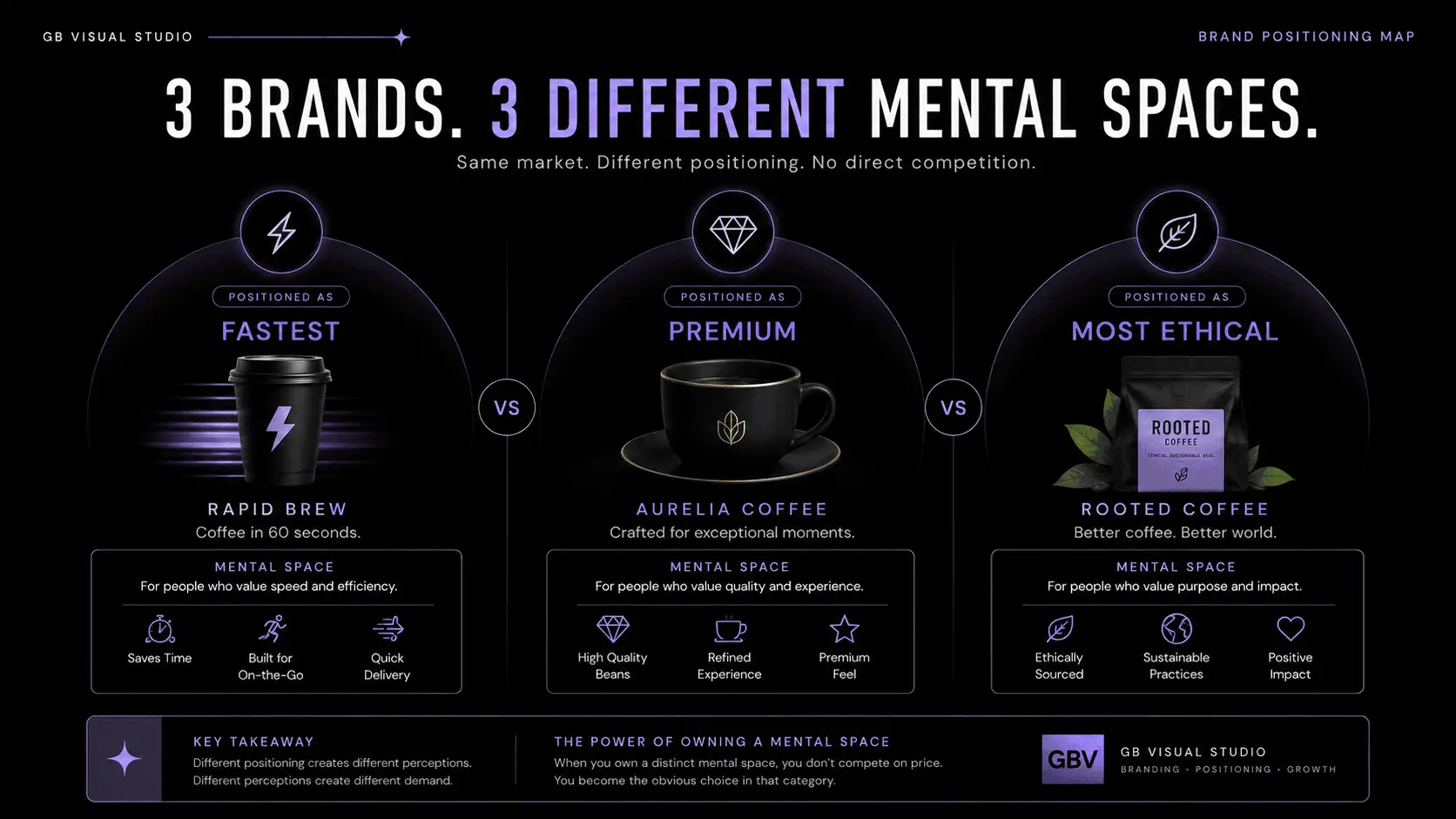
Imagine that someone asks a potential customer:
“What comes to mind when you think about this brand?”
The answer is not its logo.
It isn’t necessarily its color palette.
And it isn’t simply a list of products or services.
It is the place the brand occupies in that person’s mind compared with the alternatives they know.
That is the basic idea behind brand positioning.
Brand positioning is the strategic process of defining how your brand should be understood by a specific audience and how it is meaningfully different from competing alternatives.
Shopify describes positioning as establishing a unique place for a business within its industry, while its brand-positioning guidance emphasizes the connection between audience needs, differentiation, and the way a brand is perceived.
This distinction matters because a business can have excellent design and still have weak positioning.
It can have a professional website, attractive Instagram feed, carefully designed logo, and polished content—but if customers cannot quickly understand who it is for, what it offers, and why it is different, the brand remains difficult to categorize.
Positioning solves that strategic problem.
What You'll Learn
ToggleWhy Brand Positioning Matters
Most markets contain alternatives.
A customer rarely asks only:
“Is this product good?”
They are also deciding:
“Why this one?”
That second question is where positioning becomes important.
A clear position helps connect several parts of your brand strategy:
Audience → Problem → Category → Value → Differentiation → Proof → Perception
When those elements support one another, your marketing becomes easier to organize because you are not trying to communicate everything about the business at once.
Strong positioning can also make competitive differences easier for customers to understand. Shopify’s current positioning guidance identifies competitive analysis, target audience, value proposition, brand identity, messaging, and ongoing review as parts of developing a positioning strategy.
Positioning therefore isn’t merely a marketing slogan.
It is a strategic decision about where your brand belongs and what you want it to be known for.
Brand Positioning vs. Branding vs. Brand Identity
These terms are often mixed together.
They are related, but they aren’t the same.
Brand positioning defines the strategic place your brand aims to occupy relative to its audience and alternatives.
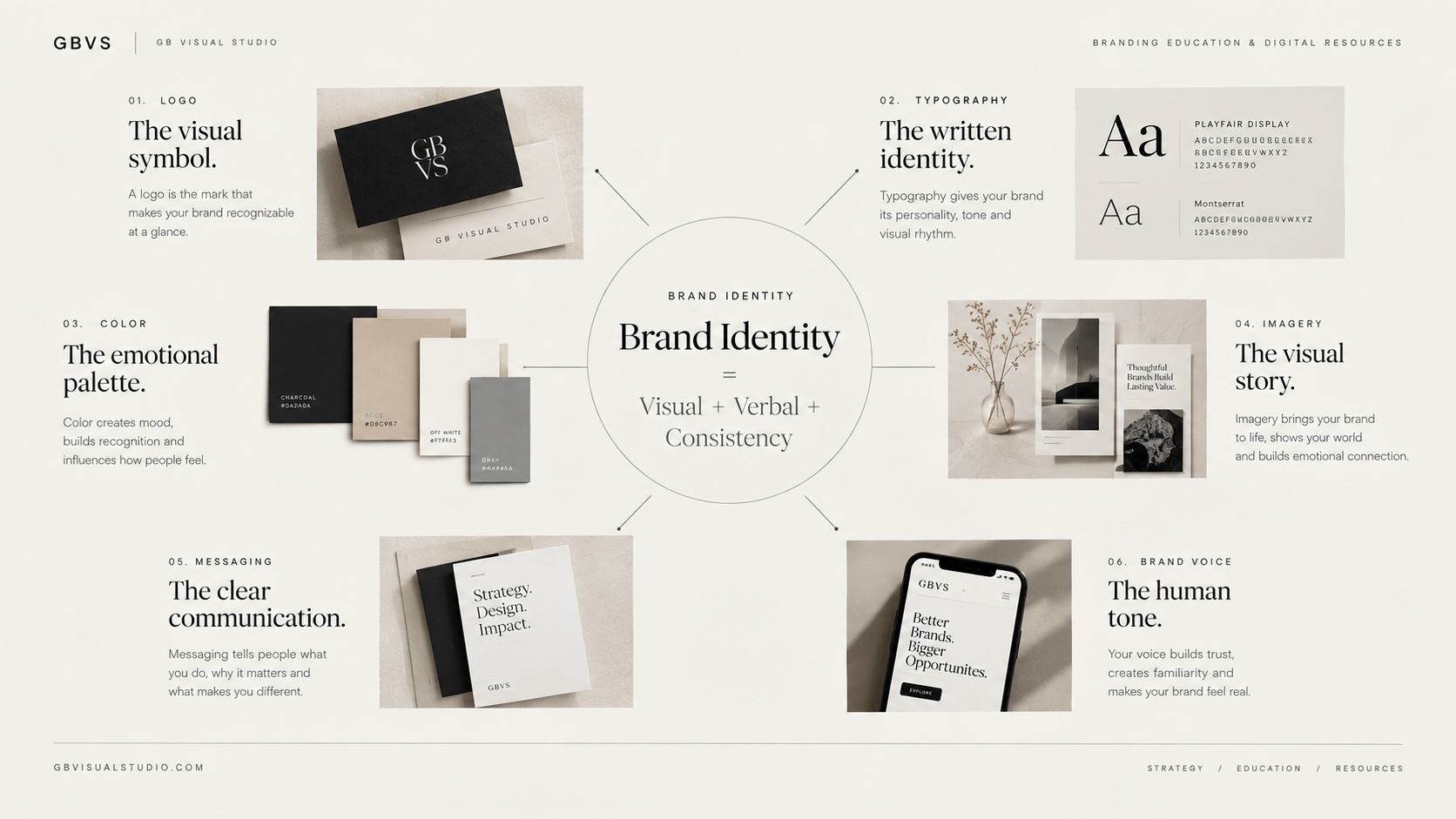
Brand identity is the collection of visual and verbal elements your business creates to express that strategy.
Branding is the broader ongoing process of shaping how the business is perceived through its identity, communication, experiences, and actions.
For example, a strategy might position a design studio as:
A practical branding partner for small businesses that need strategic clarity without agency-level complexity.
Its identity might then use a restrained visual system, editorial typography, straightforward messaging, and educational content.
The positioning comes first.
The identity helps express it.
This is why positioning should not be reduced to choosing a color, font, or logo.
For more context, see What Is Brand Strategy? A Beginner’s Guide.
The Foundation of Strong Brand Positioning
A useful way to think about positioning is through five connected questions:
1. Who are you serving?
You need a defined audience.
Not necessarily a tiny demographic description, but a meaningful group with a shared problem, need, context, or motivation.
2. What problem are you solving?
What does this audience need help with?
The problem might be functional, emotional, financial, strategic, or a combination.
3. What category are you competing in?
Customers need a mental category for your offer.
Are you a branding studio?
A business education platform?
A productivity tool?
A premium skincare company?
A financial service?
Without category clarity, differentiation becomes harder to understand.
4. What makes you meaningfully different?
Your difference needs to matter to the audience.
Being different for the sake of being different isn’t enough.
5. Why should people believe you?
A positioning claim needs support.
That support might come from expertise, process, product design, evidence, experience, specialization, methodology, results, or another credible reason.
HubSpot’s positioning-statement guidance similarly centers on the target market, customer need, differentiated value, and reason to believe.
Step 1: Define Your Target Audience
Positioning becomes weak when a brand tries to speak to everyone.
Start by identifying the audience that has the strongest reason to choose your offer.
Instead of:
“We help businesses with branding.”
Consider:
“We help early-stage founders and small businesses clarify their positioning and build a practical brand system.”
The second statement gives you more strategic direction.
It tells you something about the audience, their stage, and the problem.
You can then investigate:
What are they struggling with?
What alternatives are they considering?
What do they already believe?
What frustrates them about existing solutions?
What influences their purchase decisions?
What language do they use to describe their problem?
This research is important because positioning should be relevant to the audience, not simply interesting to the business.
Step 2: Understand the Competitive Landscape
You cannot define your position without understanding the positions already occupied around you.
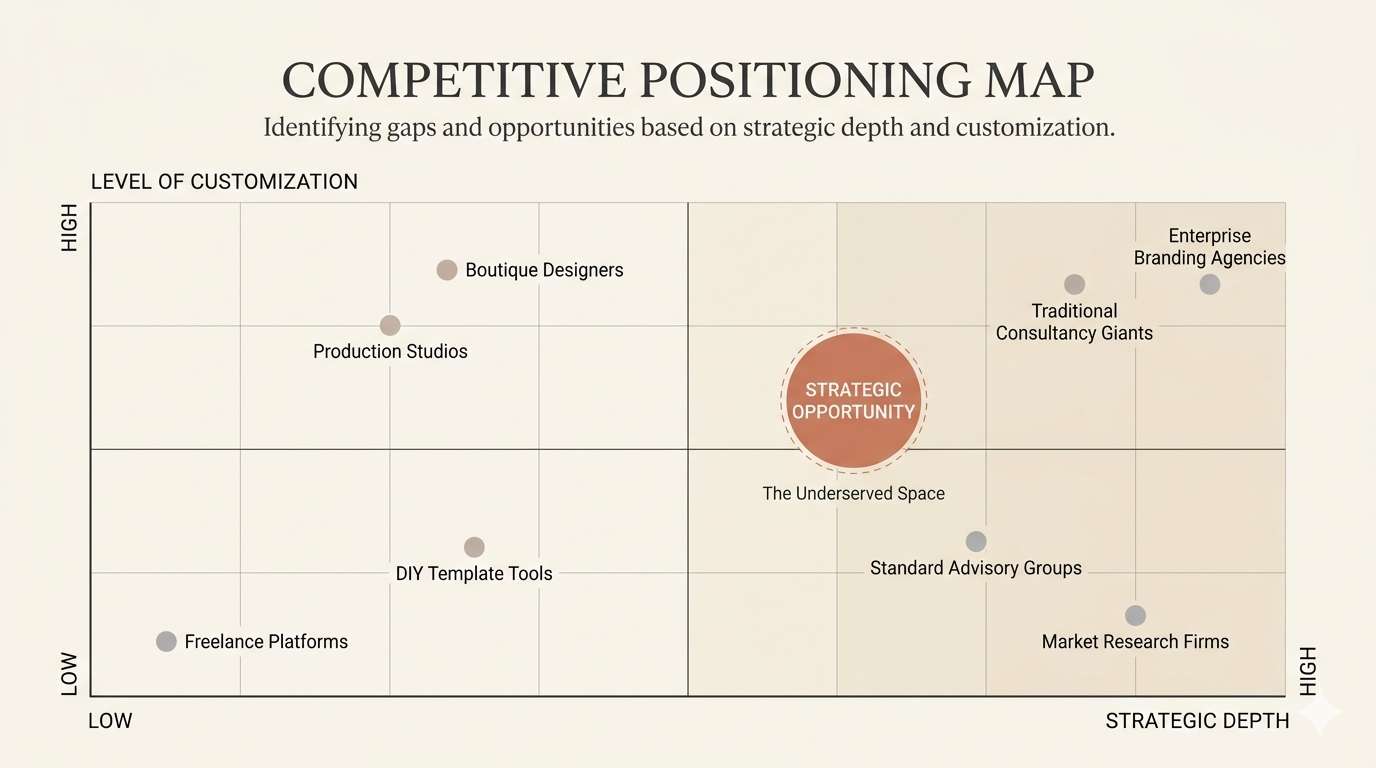
Create a simple competitive map.
Choose two attributes that matter to your audience.
For example:
Strategic depth
Low ←────────→ High
and
Level of customization
Low ←────────→ High
Place several competitors on the map.
The objective isn’t to prove that your business is better.
It is to understand the market.
You may discover that competitors cluster around similar combinations.
You may discover an underserved audience.
Or you may realize that your supposed differentiator is already common.
Competitive research is therefore not about copying competitors.
It is about finding the context in which your difference will actually mean something.
Shopify’s 2026 market-positioning guidance specifically recommends competitive analysis as a way to understand where a brand can distinguish itself and identify potential market gaps
Step 3: Identify Your Real Differentiators
Now list everything that makes your business different.
Don’t immediately call all of these differentiators.
Separate them into three categories:
What we do differently
What we do better or more effectively
What we specialize in
For example, a branding studio might have:
- a strategy-first process
- specialization in small businesses
- practical education alongside services
- template-based resources
- a specific visual style
- faster delivery
- a founder-led experience
But differentiation only becomes strategically useful when it matters to the intended audience.
Suppose ten competitors also claim “strategy-first.”
Then it is not a strong standalone differentiator.
Perhaps your real distinction is:
Strategy explained in practical language for founders who need to make branding decisions themselves.
That is more specific.
Difference + relevance = stronger positioning.
Step 4: Define Your Value Proposition
Your value proposition answers a closely related question:
What meaningful value does the customer receive from choosing you?
It shouldn’t simply describe features.
For example:
“We provide brand strategy, logo design, and social media templates.”
That explains the offer.
But:
“We help growing businesses turn unclear ideas into a consistent brand they can confidently communicate across their website, content, and customer touchpoints.”
communicates a larger outcome.
Your value proposition and positioning should support one another.
If your positioning says one thing while your value proposition communicates something completely different, the brand becomes harder to understand.
For a deeper exploration of this subject, see Value Proposition: How to Articulate What Makes Your Brand Valuable.
Step 5: Choose Your Positioning Angle
There are several ways a brand can establish a position.
The appropriate approach depends on the market and audience.
Price
The brand competes around affordability, accessibility, or value.
Quality
The brand emphasizes craftsmanship, performance, durability, or premium experience.
Specialization
The brand focuses strongly on a particular audience, industry, problem, or use case.
Experience
The differentiation comes from how the customer interacts with the business.
Methodology
The brand uses a distinctive process, framework, or way of solving a problem.
Convenience
The brand makes something significantly easier, faster, or more accessible.
Point of View
The brand is built around a distinctive philosophy or approach to the category.
These approaches can overlap.
A business might combine specialization with methodology, for example.
The important thing is not to select a positioning category because it sounds impressive.
Select the strategic angle that your business can actually support.
Step 6: Create Your Positioning Statement
Once you’ve done the strategic work, condense it.
A positioning statement is generally an internal strategic tool rather than a headline that must appear publicly on your homepage. HubSpot describes it as a concise description of the target market, need, differentiated value, and reason to believe.
A useful framework is:
For [target audience] who [need/problem], [brand] is a [category] that [primary value/difference] because [reason to believe].
For example:
For founders and small businesses that struggle to communicate what makes them different, GB Visual Studio is a branding and creative education studio that combines brand strategy, design, and practical resources to help businesses build clearer and more consistent brands.
This doesn’t need to become your homepage copy word-for-word.
Its primary purpose is to give your business an internal strategic reference point.
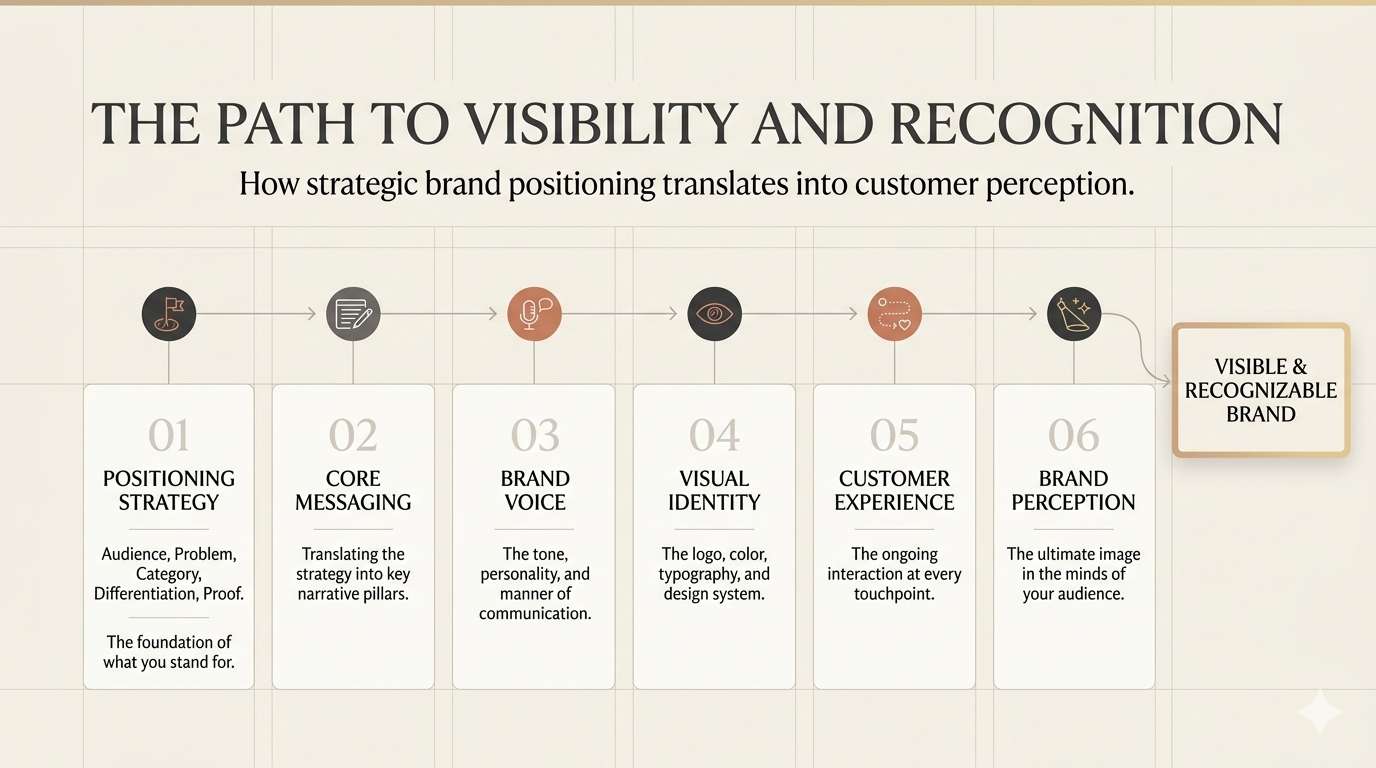
Step 7: Turn Positioning Into Messaging
Positioning tells you what should be true about the brand.
Messaging determines how you communicate it.
Suppose your position is built around making branding more practical for small businesses.
Your messaging might repeatedly communicate:
Branding doesn’t need to be complicated.
Strategy comes before decoration.
Small businesses need clarity, not just a logo.
A strong brand should be usable across real business situations.
Those messages reinforce the position.
Your homepage, social content, emails, product descriptions, sales pages, and advertisements should not all say the exact same sentence.
They should, however, reinforce the same strategic idea.
This is one reason positioning statements are useful as an internal reference: they can guide communication across different channels.
Step 8: Make Your Position Visible Through Brand Identity
Positioning is strategic.
Your identity is one of the ways that strategy becomes visible.
Suppose a business positions itself as a premium strategic consultancy.
A playful, inconsistent visual system could create tension with that position.
Likewise, a brand positioning itself around accessibility and simplicity may need an identity and website experience that are genuinely easy to navigate and understand.
This doesn’t mean every premium brand needs black-and-gold visuals or every approachable brand needs bright colors.
There is no universal visual formula.
The identity needs to express the strategic idea consistently.
For more on this relationship, read Brand Identity: A Beginner’s Guide to Building a Strong Visual Identity.
Step 9: Test Your Positioning
A positioning statement can sound excellent in a strategy document and still fail in the real world.
Test it.
Show your description to people who resemble your target audience and ask:
“What do you think this business does?”
Then ask:
“Who do you think it’s for?”
And:
“What seems different about it?”
Don’t explain your answer immediately.
Listen to their interpretation.
If your intended position and their interpretation are dramatically different, you have useful information.
You may need to change the strategy.
Or you may need to change the way the strategy is communicated.
Positioning is ultimately about perception, so the gap between what you intend to communicate and what people actually understand matters.
Brand Positioning Mistakes to Avoid
One common mistake is trying to appeal to everyone.
Another is choosing a differentiator that doesn’t matter to customers.
A third is confusing features with positioning.
For example, “we offer 24/7 support” is a feature.
It becomes strategically meaningful only when connected to a customer need and broader brand promise.
Another mistake is copying a competitor’s position.
Your competitor’s strategy was built around their audience, strengths, resources, and market context.
Copying the surface without understanding the underlying strategy rarely creates a meaningful position.
Finally, avoid changing your position every time a new trend appears.
Consistency matters.
A position should be stable enough to become recognizable while remaining flexible enough to evolve when the market, audience, or business genuinely changes.
How to Know Whether Your Positioning Is Strong
A useful positioning test is to ask five questions:
Is it clear?
Can someone understand what the business is and who it serves?
Is it relevant?
Does it address something the target audience actually cares about?
Is it differentiated?
Does it create meaningful contrast with alternatives?
Is it credible?
Can the business genuinely deliver what it promises?
Is it usable?
Can the positioning guide decisions about products, content, messaging, design, and customer experience?
If the answer is yes across these areas, your positioning has a stronger strategic foundation.
Positioning Is Not a One-Time Exercise
Markets change.
Customers change.
Competitors change.
Businesses change.
That doesn’t mean you should constantly reinvent your brand.
Instead, periodically examine whether your current position still reflects reality.
Ask:
Has our target audience changed?
Have customer needs changed?
Have new competitors entered the category?
Has our offer evolved?
Are customers describing us differently than before?
Are our strongest differentiators still relevant?
If the answers indicate a meaningful shift, repositioning may be appropriate.
If not, consistency may be more valuable than change.
How Brand Positioning Fits Into Your Brand Strategy
Think of your brand strategy as a connected system.
Purpose explains why the business exists.
Values explain what principles guide it.
Audience defines who you are trying to serve.
Positioning defines the distinctive place you want to occupy.
Value proposition explains the meaningful value you provide.
Messaging communicates that value.
Brand identity gives the strategy a recognizable visual and verbal expression.
These elements should reinforce one another.
That is why brand positioning shouldn’t be developed as an isolated marketing exercise.
It sits in the middle of the broader brand strategy.
Final Takeaway
A strong brand position isn’t about inventing a clever slogan.
It is about making a series of strategic decisions:
Who do we serve?
What problem do we solve?
What category do we belong to?
What makes us meaningfully different?
Why should customers believe us?
How should that difference shape the way we communicate and operate?
When those answers are clear, branding becomes easier to direct.
Your website becomes easier to structure.
Your content becomes easier to create.
Your visual identity has a stronger strategic foundation.
And customers have a clearer reason to understand where your brand fits.
The goal isn’t simply to be different.
The goal is to be meaningfully different to the right audience.
That is the foundation of effective brand positioning.
Frequently Asked Questions
What is brand positioning?
Brand positioning is the strategic process of defining how a brand should be understood by its target audience relative to competing alternatives. It connects audience needs, value, differentiation, and the reasons customers should believe the brand can deliver.
What is the difference between brand positioning and brand identity?
Brand positioning is strategic: it defines the place a brand aims to occupy in the market and in the minds of its target audience. Brand identity is the visual and verbal system used to express that strategy.
What are the 3 Cs of brand positioning?
A commonly used framework is Customer, Competitor, and Company. You examine what customers need, how competitors are positioned, and what your own business can credibly offer differently. Shopify also identifies these three areas as a useful way to think about positioning.
What makes a good positioning statement?
A useful positioning statement clearly identifies the target audience, customer need, category, differentiated value, and reason to believe. It should be concise enough to guide strategic and marketing decisions without becoming a long description of the business.
Is brand positioning the same as a unique selling proposition?
No. A USP generally focuses on a distinctive selling advantage or reason to choose an offering. Brand positioning is broader: it establishes how the brand should be understood relative to its audience, category, competitors, value, personality, and differentiation.
Can a small business have strong brand positioning?
Yes. Positioning isn’t limited to large companies. A small business can create a clear position by narrowing its audience, solving a specific problem, developing meaningful differentiation, and consistently communicating that distinction.
How often should a brand review its positioning?
There is no fixed schedule. Review it when there are meaningful changes in your audience, category, competitors, offer, business model, or customer perception. Regular research can help identify when the existing position no longer reflects the market.
4 Comments
[…] For the broader framework, read Brand Positioning Guide 2026. […]
[…] you haven’t read it yet, start with the Brand Positioning Guide 2026 for the strategic […]
[…] now, you can also explore Brand Positioning Guide 2026 when developing this part of your […]
[…] If you want a deeper understanding of positioning, read the Brand Positioning Guide 2026. […]