

A logo tells people who you are.
A brand identity shows them what you look like.
But brand strategy helps determine what you want your business to mean, who you want to matter to, and why people should choose you.
That distinction is important because many businesses start branding from the visible layer.
They design a logo.
Choose colors.
Create social media templates.
Build a website.
Then discover that the business still struggles to answer basic questions:
Who exactly are we for?
What makes us different?
What should customers remember about us?
Why should someone choose us instead of another option?
These are strategic questions.
Brand strategy exists to answer them.
“Brand strategy is the strategic direction that guides how a business is positioned, communicated, experienced, and developed over time.”
It connects the business’s goals with its audience, positioning, personality, messaging, and identity.
Your visual branding then has something meaningful to express.
What You'll Learn
ToggleBrand Strategy vs Branding vs Brand Identity
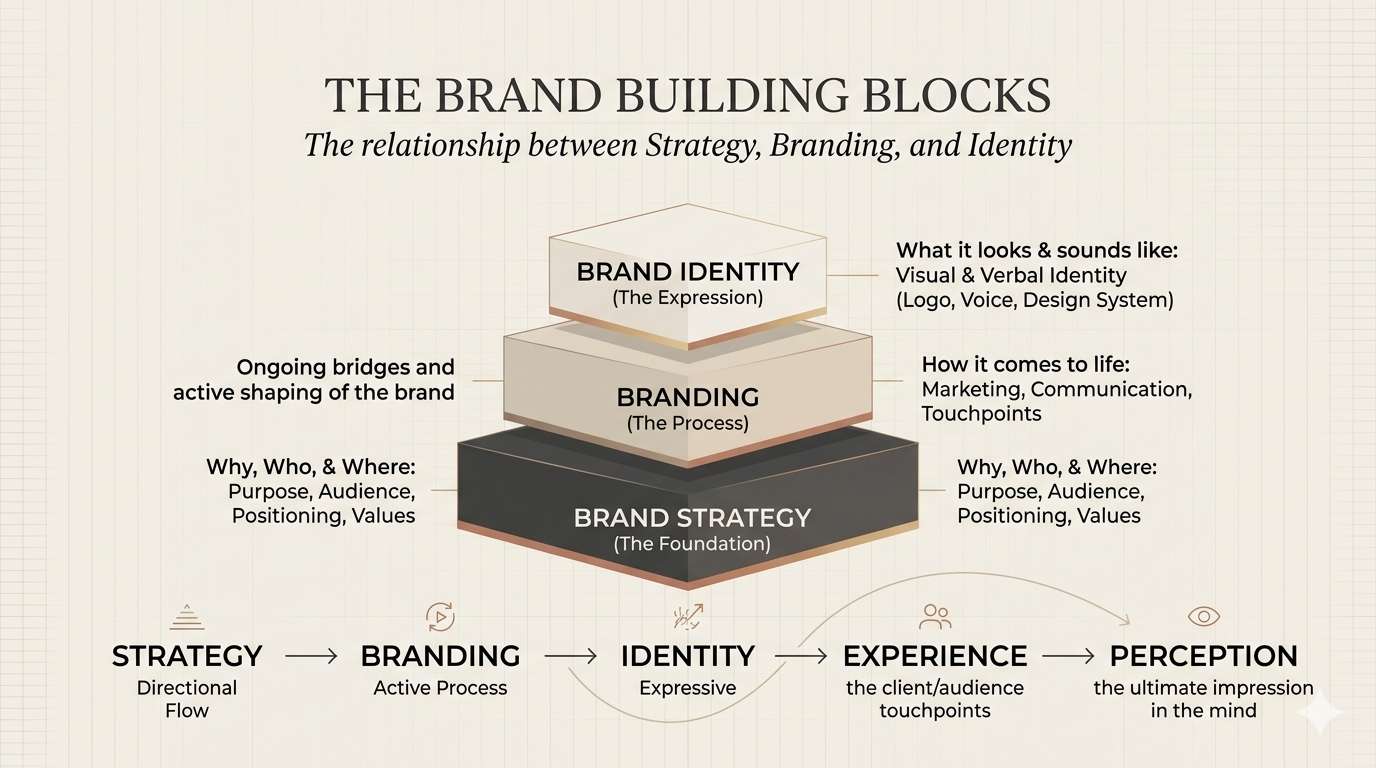
These terms are often used interchangeably, but separating them makes the entire subject easier to understand.
Brand Strategy
The direction.
It establishes what the brand is trying to achieve, who it serves, what it should stand for, and how it should differentiate itself.
Branding
The ongoing process.
Branding is how those strategic decisions are expressed and reinforced through communication, design, marketing, content, customer experience, and other touchpoints.
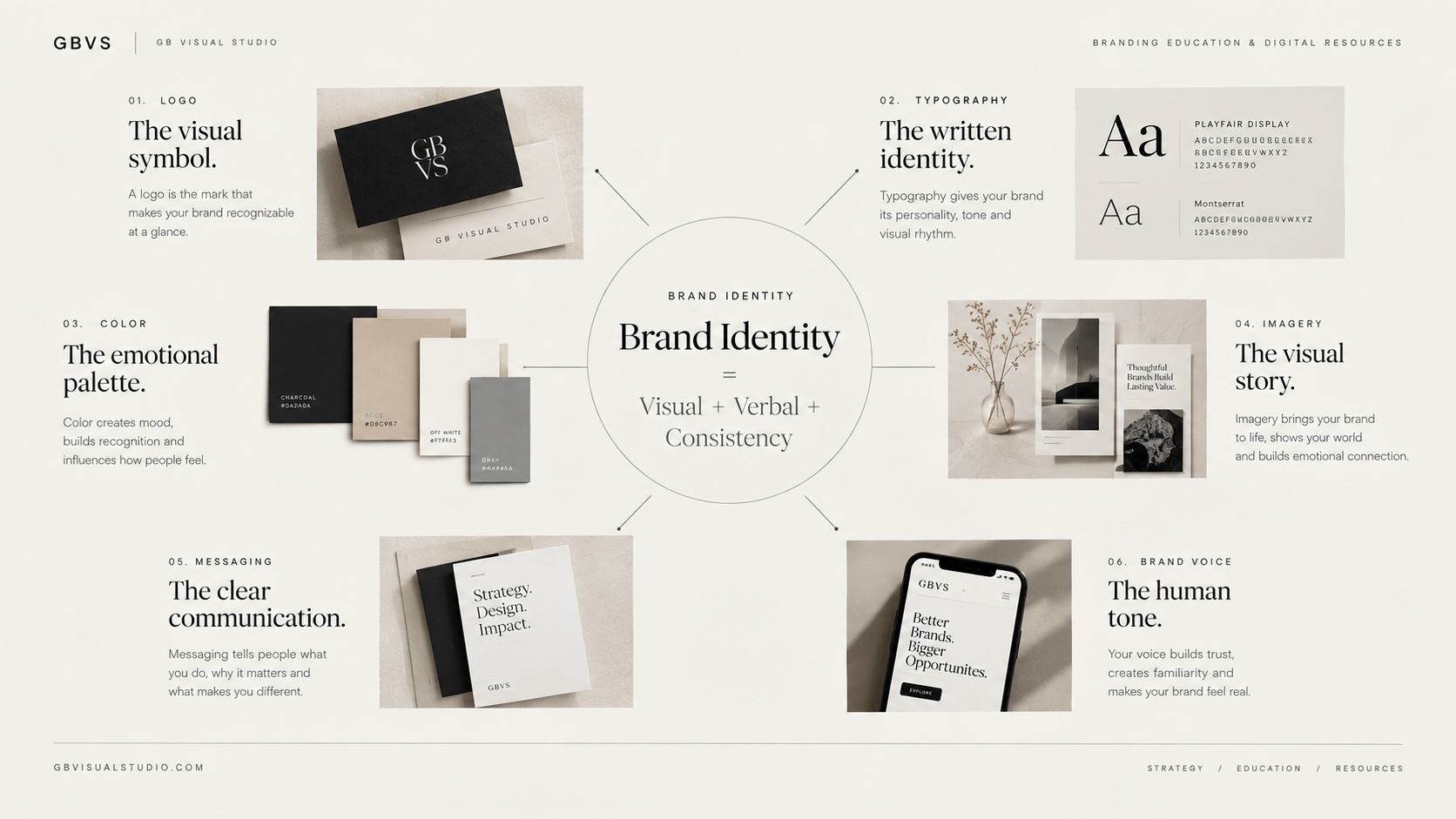
Brand Identity
The expression.
It includes the visual and verbal elements that represent the business—such as its logo, colors, typography, imagery, messaging, and voice.
You can think about the relationship like this:
Strategy → Branding → Identity → Experience → Perception
The exact terminology can vary across branding disciplines, but this framework is useful because it prevents a common mistake: expecting visual design to solve strategic problems.
If you want to understand the visual side first, read Brand Identity: A Beginner’s Guide to Building a Strong Visual Identity.
Why Does Brand Strategy Matter?
Imagine two businesses selling essentially similar services.
Both have professional websites.
Both have attractive logos.
Both publish regularly.
But one clearly communicates:
Who it serves, what it specializes in, why its approach is different, and what customers can expect.
The other says:
“We provide high-quality solutions for businesses looking to grow.”
The second statement isn’t necessarily wrong.
It’s simply difficult to own.
Brand strategy helps you move from general communication to deliberate positioning.
Instead of trying to appeal to everyone, you make decisions about where the brand belongs and what it should be associated with.
This can influence everything from your website headline to your product structure, content topics, design decisions, marketing campaigns, and customer experience.
Strategy doesn’t guarantee business success.
It gives your brand a clearer framework for making decisions.
The 7 Core Components of Brand Strategy
There isn’t one universal brand strategy template that every business must follow.
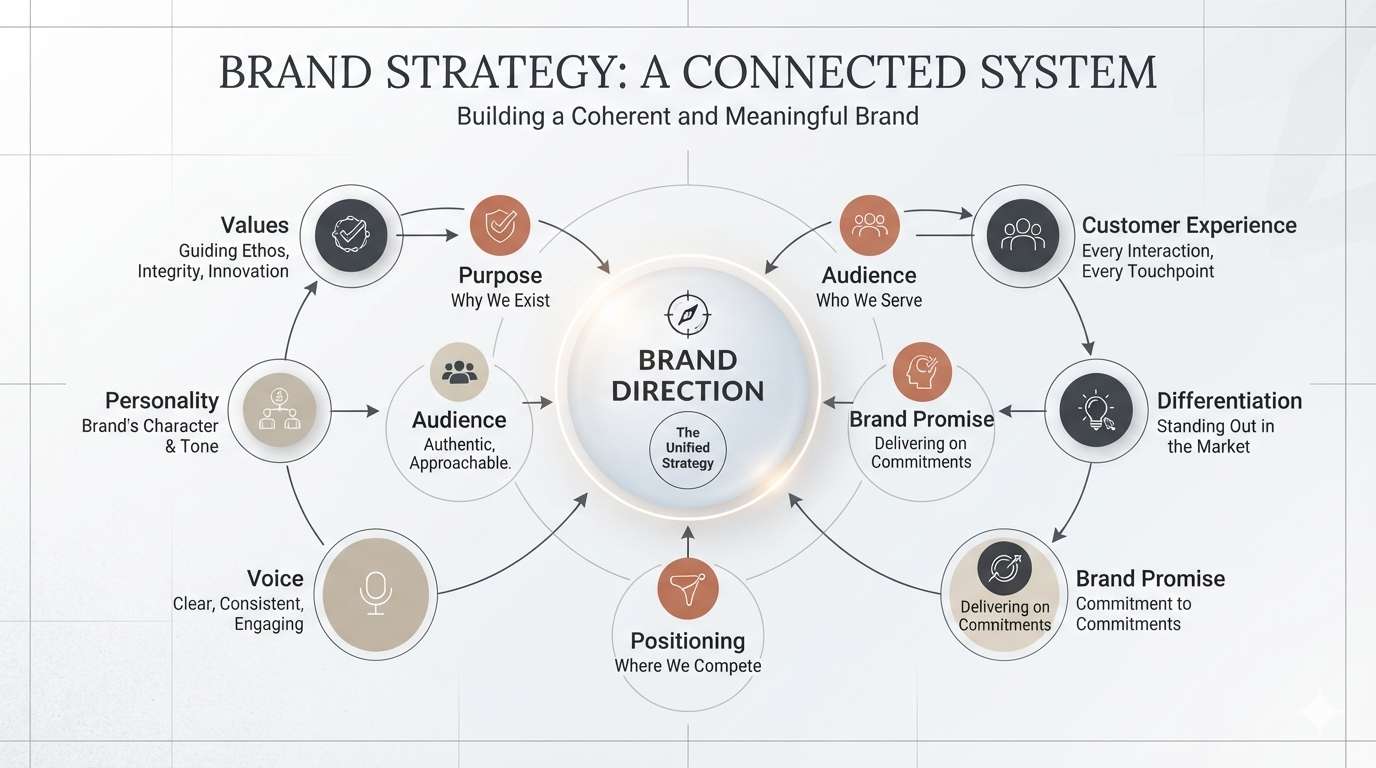
However, a practical strategy generally needs to answer several fundamental questions.
1. Purpose: Why Does the Brand Exist?
Purpose goes beyond simply describing what you sell.
A design studio might sell branding services.
A software company might sell project-management software.
A consultant might sell advisory services.
Those describe what the businesses do.
Purpose explores the deeper reason behind the business.
What change are you trying to create?
What problem do you care about solving?
What do you want to make easier, better, clearer, faster, safer, or more accessible?
Purpose doesn’t need to sound inspirational.
It needs to be meaningful and relevant to the business.
For example:
We help small businesses communicate their value clearly through practical brand strategy and design.
That gives the business a strategic direction beyond simply saying:
“We are a design studio.”
Your purpose can also help you decide which opportunities fit the brand and which don’t.
2. Audience: Who Is the Brand For?
One of the most important decisions in brand strategy is defining the audience.
Not:
“Everyone who needs branding.”
That’s too broad to guide meaningful decisions.
Instead, ask:
Who has the problem you solve?
Who is most likely to value your approach?
What situation are they currently in?
What are they trying to accomplish?
What alternatives are they currently using?
What makes them hesitate before purchasing?
You don’t need to create an imaginary character with a favorite coffee order and a detailed fictional biography.
You need useful customer understanding.
A good audience definition helps you decide what to say, how to say it, where to reach people, and what problems your content should address.
This is why Ideal Customer Profile work belongs inside brand strategy.
We’ll cover that in a dedicated supporting article later in this cluster.
3. Positioning: What Should You Be Known For?
Positioning is one of the most important parts of brand strategy.
It answers:
Where should this brand sit in the customer’s mind compared with alternatives?
Your positioning isn’t simply a slogan.
It is the strategic space you want to occupy.
Consider two fictional design businesses.
One says:
“We create beautiful designs for businesses.”
The other says:
“We help early-stage technology companies turn complex products into clear, credible visual brands.”
The second statement immediately creates more context.
It tells us something about:
- audience
- category
- problem
- specialization
- value
Strong positioning doesn’t necessarily mean being radically different from everyone else.
It means making your particular value easier to understand.
Your positioning will become a major topic in the next section of this cluster, where we’ll examine brand positioning in depth.
For now, you can also explore Brand Positioning Guide 2026 when developing this part of your strategy.
4. Differentiation: Why You?
Positioning and differentiation are closely connected.
Once you know where you want to compete, you need to understand why someone should choose you.
Differentiation doesn’t always mean inventing something nobody else offers.
It could come from:
Your specialization.
Your methodology.
Your experience.
Your product structure.
Your customer experience.
Your point of view.
Your speed.
Your simplicity.
Your depth.
Your audience focus.
Your combination of capabilities.
For example, “branding services” is a category.
“Brand strategy and visual identity specifically for independent consultants launching their first premium offer” is more differentiated.
The goal isn’t to manufacture a strange claim simply to sound unique.
It’s to identify something genuinely meaningful that your business can consistently deliver.
5. Brand Values: What Principles Guide the Business?
Brand values are often treated as decorative words placed on an About page.
That makes them almost useless.
If you claim that your brand values clarity, what does that mean in practice?
Maybe:
You avoid unnecessary jargon.
Your pricing is straightforward.
Your onboarding process is easy to understand.
Your content explains complex ideas simply.
Your products are organized logically.
Now the value has behavioral meaning.
Strong values can influence decision-making inside the business.
When evaluating a partnership, product, campaign, hire, or communication style, you can ask:
Does this fit the principles we’ve decided matter?
We’ll explore how to define meaningful brand values step by step in a dedicated supporting article.
6. Brand Personality and Voice
If strategy defines what the brand should stand for, personality helps determine how it behaves and communicates.
Imagine two brands offering the same service.
One communicates:
Precise. Formal. Analytical. Reserved.
The other communicates:
Direct. Friendly. Practical. Conversational.
Neither is automatically better.
The appropriate personality depends on the audience, category, positioning, and business.
Your brand voice then translates those characteristics into communication.
For example:
Personality: confident, practical, intelligent
could become a voice that is:
Clear rather than complicated.
Confident rather than aggressive.
Helpful rather than promotional.
Specific rather than vague.
This becomes useful across websites, social media, emails, products, advertisements, and customer communication.
The Brand Voice Complete Beginner Guide later in this cluster will go deeper into this subject.
7. Brand Promise and Experience
Your brand promise is the expectation you establish with your audience.
But a promise only becomes meaningful when the business consistently delivers on it.
Suppose a company positions itself around simplicity.
Its website is complicated.
Its onboarding requires twelve steps.
Its invoices are confusing.
Its customer support uses technical jargon.
Its product is difficult to navigate.
The brand is communicating one thing and delivering another.
That’s a strategy problem.
Your customer experience should reinforce the associations you want the brand to own.
If your brand stands for speed, your processes should support that.
If it stands for expertise, your content and service should demonstrate expertise.
If it stands for simplicity, unnecessary complexity should be removed.
Brand strategy therefore extends beyond communication.
It influences the experience people actually receive.
How to Build a Brand Strategy
You don’t need to complete your entire strategy in one sitting.
Treat it as a sequence of connected decisions.
Start With the Business
Understand what you’re actually trying to build.
What do you sell?
How does the business make money?
What are your priorities?
What capabilities do you have?
Where do you want the business to go?
A brand strategy disconnected from the business model can become an attractive document with little practical value.
Understand the Audience
Identify the people you are genuinely trying to serve.
Study their problems, expectations, alternatives, objections, and decision-making process.
Don’t stop at demographics.
Understanding why someone chooses is usually more strategically useful than knowing only their age or location.
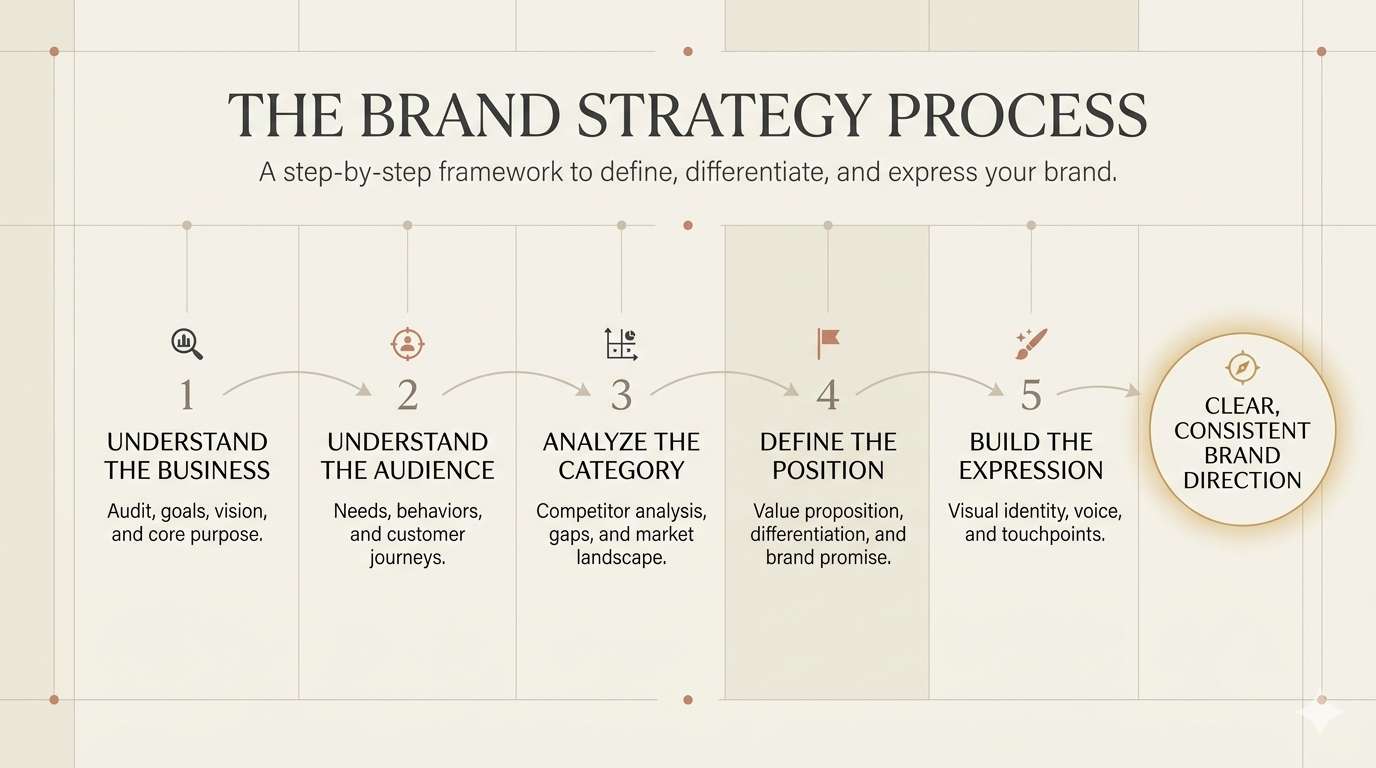
Analyze the Category
Look at competitors and alternatives.
What do they emphasize?
How do they communicate?
What promises dominate the category?
What visual patterns appear repeatedly?
Where does the market feel crowded?
Where are there meaningful opportunities?
This is not about copying competitors.
It’s about understanding the context in which your brand will be interpreted.
Define the Position
Decide what you want the brand to be associated with.
This is where audience, business strengths, category context, and differentiation come together.
Build the Expression
Only after the strategic decisions are reasonably clear should you translate them into messaging, voice, visual identity, content, and other brand assets.
This is where your earlier work on brand identity becomes useful.
A Simple Brand Strategy Example
Imagine a fictional business called Northline Studio.
It provides branding services.
That’s the category.
But its strategy could become more specific.
Audience: independent consultants and service businesses
Problem: their expertise is strong but their brand communication is unclear
Purpose: help expertise-driven businesses communicate their value with clarity
Positioning: a strategic branding studio for expertise-led businesses
Differentiation: combines positioning, messaging, and visual identity rather than treating design as an isolated service
Personality: intelligent, calm, direct, practical
Voice: clear, educational, confident, never overly promotional
Now the design has direction.
A minimalist identity might make sense.
Clear educational content might make sense.
A strategic website structure makes sense.
A content strategy focused on positioning and clarity makes sense.
The strategy is influencing the expression.
That’s the point.
What Brand Strategy Is Not
Understanding what brand strategy isn’t can be just as useful.
It isn’t a logo
Your logo is an identity asset.
It isn’t a color palette
Colors are part of the visual identity.
It isn’t a tagline
A tagline can express an idea, but it isn’t the complete strategic foundation.
It isn’t a social media strategy
Social media can communicate the brand strategy, but it doesn’t define the entire brand.
It isn’t a marketing campaign
A campaign has a particular objective and timeframe. Brand strategy provides a longer-term direction.
It isn’t a document
A strategy document records strategic decisions.
The strategy itself exists in the decisions and behaviors of the business.
This distinction is particularly important for small businesses because it’s easy to confuse having a branding document with actually having strategic clarity.
Common Brand Strategy Mistakes
The first mistake is trying to appeal to everyone.
A broad audience may sound commercially attractive, but it often creates vague messaging.
The second is confusing differentiation with decoration.
A different color or unusual logo doesn’t necessarily create meaningful differentiation.
The third is writing generic positioning.
Statements such as “high-quality solutions,” “innovative services,” and “customer-focused approach” are difficult to own because almost every competitor can make them.
The fourth is creating values that don’t influence behavior.
If your values don’t affect decisions, they are probably just words.
The fifth is changing strategy every time a trend appears.
A brand needs enough flexibility to adapt without abandoning its strategic foundation every few months.
And the sixth is treating strategy as finished forever.
Markets change.
Customers change.
Businesses change.
Your strategy should be stable enough to provide direction but flexible enough to evolve when the underlying circumstances change.
Where Brand Strategy Fits in the Bigger Branding Process
You can think about branding as a connected system:
Business
↓
Brand Strategy
↓
Positioning + Audience + Differentiation
↓
Messaging + Voice
↓
Visual Identity
↓
Content + Marketing + Customer Experience
↓
Brand Perception
Each layer affects the next.
If the strategy is unclear, messaging becomes vague.
If messaging is vague, visual communication has less direction.
If the identity is inconsistent, recognition becomes harder.
If the experience doesn’t match the promise, trust can weaken.
This is why strategy deserves attention before visual execution.
How Often Should You Review Your Brand Strategy?
There isn’t a universal schedule.
A brand strategy shouldn’t be rewritten simply because a calendar says it’s time.
Review it when something meaningful changes.
For example:
Your audience has changed.
Your product or service has changed.
You’ve entered a new market.
Your positioning no longer reflects the business.
Competitors have significantly changed the category.
Customer expectations have shifted.
Your business model has evolved.
The important thing is to distinguish between strategic change and temporary discomfort.
Not every slow month means your positioning is wrong.
Not every competitor trend requires a rebrand.
Strategy should be informed by evidence, not constant reaction.
Final Thought
Take a blank page and answer these questions without looking at your existing website:
Who is our primary audience?
What problem do we solve for them?
What do we want to be known for?
What makes our approach meaningfully different?
What three to five qualities should describe our brand?
What should our communication sound like?
What should customers consistently experience?
Now compare those answers with your current website and marketing.
If the two versions sound like different businesses, you have discovered a strategic gap.
That’s useful.
The purpose of a strategy isn’t to make your existing brand sound correct.
It’s to clarify what the brand should become and then align the business around it.
A Practical Brand Strategy Test
Brand strategy can sound like a complicated corporate exercise.
It doesn’t have to be.
At its core, it is about making deliberate decisions:
Who are we building this for?
What problem do we solve?
Why should people choose us?
What should we be known for?
How should we communicate?
What experience should people have?
The answers become the foundation for everything that follows.
Your logo becomes easier to direct.
Your visual identity becomes more purposeful.
Your content becomes more focused.
Your messaging becomes clearer.
Your marketing has a stronger point of view.
Most importantly, you stop making every branding decision from scratch.
That’s the real value of brand strategy.
It gives your brand a direction before you start producing everything that represents it.
Frequently Asked Questions
What is brand strategy in simple terms?
Brand strategy is the long-term direction that defines who a brand serves, what it should stand for, how it should differentiate itself, and how it should communicate and deliver its intended experience.
Why is brand strategy important for small businesses?
It gives small businesses a framework for making consistent decisions about positioning, messaging, identity, content, and customer experience instead of treating each branding decision separately.
What are the main elements of brand strategy?
A practical brand strategy can include purpose, audience, positioning, differentiation, values, personality, voice, brand promise, and customer experience.
Is brand strategy the same as brand identity?
No. Brand strategy defines the strategic direction, while brand identity is the visual and verbal system used to express that direction.
Do I need brand strategy before designing a logo?
It is strongly useful to establish the strategic foundation first. Understanding your audience, positioning, personality, and intended perception gives the logo and broader identity a meaningful context.
Can a small business create its own brand strategy?
Yes. A small business can establish a useful initial strategy by researching its audience and category and making clear decisions about positioning, differentiation, values, personality, and communication. More complex businesses may benefit from professional strategic support.
Can brand strategy change over time?
Yes. A strategy should evolve when meaningful changes occur in the business, market, audience, or competitive environment. Evolution should be deliberate rather than driven by every short-term trend.
1 Comment
[…] you are unfamiliar with the strategic foundation behind this process, start with What Is Brand Strategy? A Beginner’s Guide and then explore the Brand Positioning Guide […]