
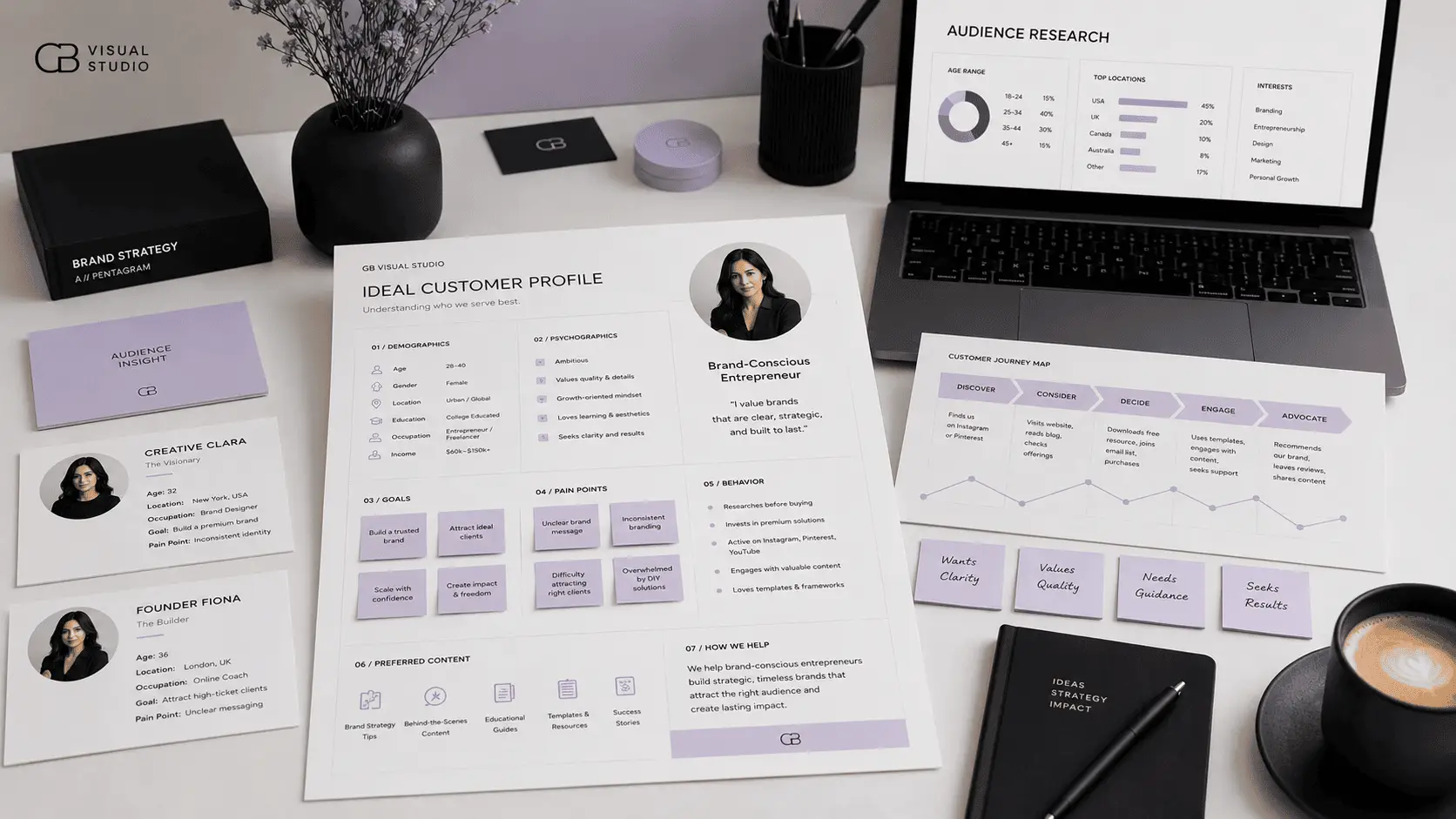
Not every person who can buy from your business is your ideal customer.
That distinction matters.
A brand becomes easier to position, communicate, market, and grow when it understands which customers it is specifically designed to serve.
This is where an Ideal Customer Profile (ICP) becomes useful.
An ICP is a strategic description of the type of customer who is the strongest fit for your business based on factors such as their needs, problems, circumstances, goals, buying behavior, and relationship with your offer.
For a small business, freelancer, creator, consultant, or service provider, this doesn’t mean inventing a fictional customer with a favorite coffee order and a detailed personality profile.
It means understanding the real conditions that make someone a strong fit for your brand.
A useful ICP can influence everything from brand positioning and messaging to content topics, product development, sales conversations, and customer experience.
And when it is built correctly, it helps answer one of the most important branding questions:
Who are we actually trying to be relevant to?
What You'll Learn
ToggleWhat Is an Ideal Customer Profile?
An Ideal Customer Profile describes the type of customer who is most aligned with what your business offers.
The definition changes slightly depending on the business model.
For a B2B company, an ICP might include company size, industry, budget, decision-making structure, and business needs.
For a freelancer or consumer-facing brand, the profile may focus more heavily on the customer’s situation, problem, goals, preferences, buying motivation, and ability to benefit from the offer.
The important distinction is between an ideal fit and simply a potential buyer.
For example, a branding studio might technically work with any business.
But its strongest fit could be:
Founder-led small businesses that have already established an offer but struggle to communicate their value clearly and need a practical brand system they can use consistently.
That description immediately provides more strategic information than:
Small businesses.
The first describes a business situation and problem.
The second is simply a broad category.
ICP vs. Target Audience vs. Buyer Persona
These concepts overlap, but they serve different purposes.
Target audience
A target audience is a broader group of people a brand wants to reach.
For example:
Small business owners and entrepreneurs.
Ideal Customer Profile
An ICP describes the type of customer that represents a particularly strong fit for the business.
For example:
Founder-led service businesses that have validated their offer and are ready to establish a consistent brand system.
Buyer persona
A buyer persona is usually a more detailed representation of a particular customer type, often including motivations, behaviors, objections, and contextual characteristics.
You don’t necessarily need an elaborate persona document.
For many small businesses, a well-defined ICP provides enough strategic clarity to improve positioning and communication without creating unnecessary complexity.
Why Your ICP Matters for Brand Strategy
Your ideal customer affects your brand strategy because positioning is always relative to an audience.
A brand cannot be meaningfully positioned without knowing who the position is supposed to matter to.
Your ICP can influence:
Your positioning.
Your value proposition.
Your messaging.
Your content strategy.
Your product development.
Your pricing communication.
Your visual and verbal identity.
Your sales process.
Your customer experience.
For example, a brand serving experienced business owners may communicate differently from one serving people starting their first business.
The service might be similar.
The context isn’t.
That context changes the messaging.
Step 1: Start With the Problem, Not Demographics
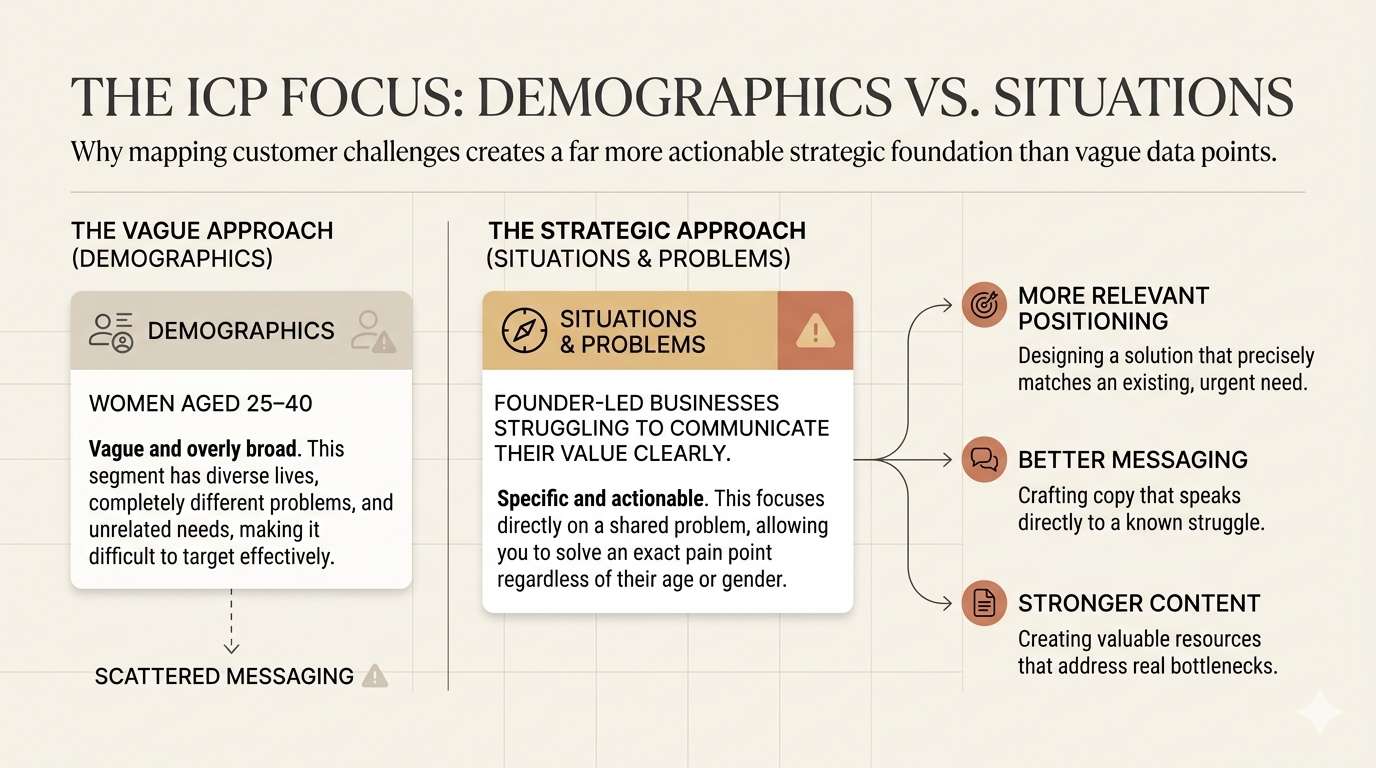
Demographics can be useful, but they shouldn’t be your starting point.
“Women aged 25–40” tells you relatively little about why someone would buy your branding service.
A stronger starting question is:
What problem makes this person actively need what we offer?
Suppose you sell brand strategy.
Potential customers might include:
A new founder who doesn’t know how to define the brand.
A growing business whose original identity no longer reflects its offer.
A freelancer struggling to differentiate from competitors.
A creator turning a personal audience into a business.
These people may share some demographics.
More importantly, they share situations in which your expertise becomes relevant.
Start there.
Step 2: Identify the Customer's Current Situation
Your ideal customer isn’t simply defined by what they want.
Their current situation matters.
Ask:
What have they already done?
What are they struggling with now?
What have they tried?
What isn’t working?
What has changed recently?
What happens if they don’t solve the problem?
For example, someone who has just created a business has a different branding need from someone whose business has existed for five years and is preparing for expansion.
Both may say:
“I need better branding.”
But the underlying problem is different.
Understanding that difference gives your brand more strategic precision.
Step 3: Understand Their Desired Outcome
Customers don’t necessarily buy the thing you sell.
They buy what they believe that thing will help them accomplish.
A business might purchase a brand strategy project because it wants:
More clarity.
Better differentiation.
A more consistent customer experience.
Stronger communication.
Greater confidence when presenting the business.
A foundation for growth.
Your job is to identify the outcome that matters most to your ideal customer.
Ask:
What would be different in their business after the problem is solved?
The answer can become an important part of your value proposition.
Step 4: Identify Their Buying Triggers
People don’t usually purchase simply because they fit a demographic.
Something often creates urgency.
For example:
A new business launch.
A major change in the offer.
A rebrand.
Entering a new market.
Increasing prices.
Launching a product.
Growing a team.
Struggling to explain the business.
A website redesign.
A change in target audience.
These moments can become buying triggers.
Understanding them helps you create more relevant content.
Instead of publishing generic content about branding, you can address the specific moment when your ideal customer realizes:
“Our current brand isn’t working anymore.”
That is much closer to the customer’s actual decision-making context.
Step 5: Understand Their Objections
An ideal customer isn’t simply someone who wants your offer.
They also have reasons for hesitating.
Common objections might include:
“I don’t know if we need this yet.”
“Can’t I do this myself?”
“It seems expensive.”
“I already have a logo.”
“I don’t know what branding would change.”
“We’re too small.”
“I need to focus on sales first.”
These objections are strategically valuable.
They tell you what your audience needs to understand before they can make a confident decision.
Your content can then address those questions naturally.
This is one reason an ICP should influence your content strategy rather than remain inside a strategy document.
Step 6: Understand What They Value
Two customers can have the same problem but value different solutions.
Imagine two businesses that both need branding.
One prioritizes:
Speed.
Affordability.
Independence.
Another prioritizes:
Strategy.
Customization.
Long-term consistency.
Their ideal solutions are different.
Ask:
What does my ideal customer consider important when choosing a solution?
Look beyond price.
They may care about expertise, simplicity, education, customization, responsiveness, convenience, credibility, flexibility, or a particular process.
These priorities can become useful positioning inputs.
Step 7: Study Real Customers and Real Conversations
The strongest ICP isn’t created entirely from assumptions.
Look at evidence.
Review:
Customer questions.
Sales conversations.
Emails.
Comments.
Reviews.
Support requests.
Product purchases.
Consultation inquiries.
Search behavior.
Social discussions.
Look for repeated language.
If customers repeatedly say:
“I don’t know how to explain what I do.”
that phrase tells you something.
If they repeatedly ask:
“How do I make my brand look professional?”
that’s another signal.
Use the customer’s own language whenever possible.
It can improve both positioning and messaging because you’re addressing the problem as the customer experiences it.
Step 8: Create a Simple ICP Statement
Once you’ve collected the information, compress it.
Use this framework:
Our ideal customer is [type of customer] who is [current situation], struggling with [problem], wants [desired outcome], and values [important buying criteria].
For example:
Our ideal customer is a founder-led small business that has a viable offer but struggles to communicate its value clearly, wants a stronger and more consistent brand, and values practical strategy they can actually use.
That’s enough to guide many decisions.
You don’t need a 30-page customer persona.
A Practical ICP Framework
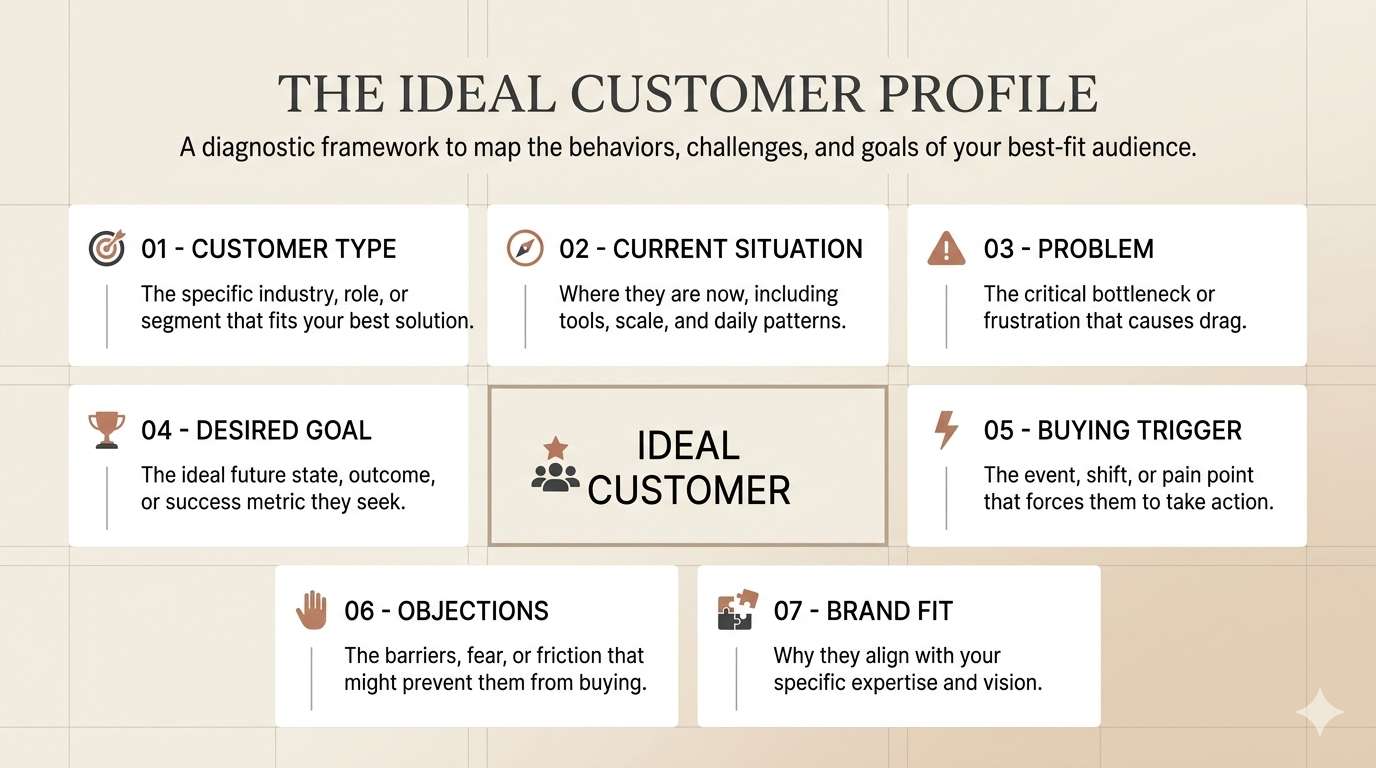
Use these seven dimensions to build your profile:
| Dimension | Question |
|---|---|
| Customer type | Who is this person or business? |
| Situation | What is happening in their business right now? |
| Problem | What are they struggling with? |
| Goal | What do they want to achieve? |
| Trigger | What makes them look for a solution now? |
| Objection | What might prevent them from buying? |
| Fit | Why is your offer particularly relevant to them? |
The final column is important.
Your ICP isn’t only about describing the customer.
It should explain why your business is a good match for them.
Don't Define Your ICP by What You Want to Hear
This is an important distinction.
You may want customers who:
Pay premium prices.
Never negotiate.
Love your content.
Buy immediately.
Need everything you sell.
But those are preferences.
An ICP should describe observable customer characteristics and business situations that indicate strong fit.
Instead of:
“Customers who appreciate quality.”
define what that means.
For example:
“Customers who prioritize strategic thinking over the lowest-cost execution and are willing to invest in a structured process.”
Now the characteristic can actually influence qualification and positioning.
Your ICP Should Influence Your Positioning
Once you know your ideal customer, revisit your positioning.
Ask:
What does this customer need to believe about our brand before choosing us?
Suppose your ICP is a small business owner who understands that branding matters but feels overwhelmed by the process.
A position built around complexity and jargon may create friction.
A position built around clarity, practical strategy, and accessible implementation may be more relevant.
The point isn’t to choose the position for the customer.
It is to make sure your positioning addresses a meaningful need within the audience you’re deliberately trying to serve.
For the broader framework, read Brand Positioning Guide 2026.
Your ICP Should Also Influence Content
Once your ICP is clear, content planning becomes more focused.
Instead of asking:
“What should we post today?”
you can ask:
“What problem is our ideal customer trying to solve right now?”
That produces better content opportunities.
If your ideal customer struggles with positioning, create content around differentiation.
If they are preparing for a rebrand, explain what should happen before redesigning.
If they don’t understand brand strategy, teach the fundamentals.
If they’re unsure whether they need professional branding, explain the decision factors.
Your content becomes a response to customer problems rather than a collection of disconnected topics.
Common ICP Mistakes
Making the audience too broad
“Entrepreneurs” isn’t an ICP.
It’s a huge category.
Add the situation, problem, or need that makes a particular group especially relevant.
Making the profile too narrow without evidence
The opposite problem is creating an extremely specific customer profile simply because it sounds strategic.
Your audience should be specific enough to guide decisions but broad enough to represent a real market opportunity.
Assuming instead of researching
Your assumptions can be useful as a starting hypothesis.
They shouldn’t become permanent facts without validation.
Focusing only on demographics
Age, location, job title, and income can matter.
But the customer’s problem and situation often provide more actionable strategic information.
Creating the ICP once and forgetting it
Markets evolve.
Products change.
Customer needs change.
Review your ICP when your business or market changes significantly.
ICP Is a Strategic Filter, Not a Restriction
Defining an ideal customer doesn’t mean refusing everyone else.
It gives your business a primary strategic focus.
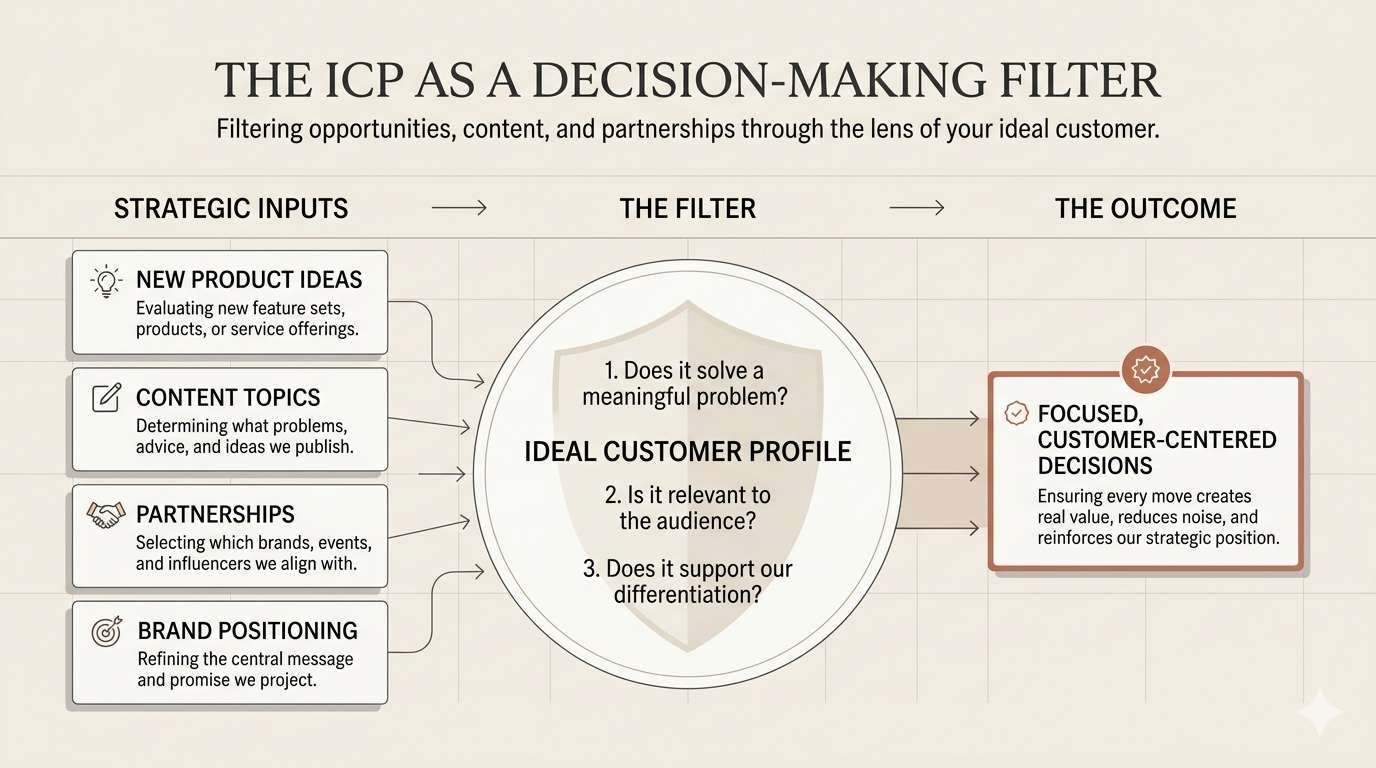
Think of it as a filter.
When considering a new product, ask:
Does this solve a meaningful problem for our ideal customer?
When creating content:
Would this help them make a decision or solve a problem?
When evaluating a partnership:
Does this put us in front of a relevant audience?
When refining positioning:
Does our differentiation matter to them?
This makes the ICP operational.
It becomes part of how the business makes decisions.
Final Takeaway
A strong Ideal Customer Profile isn’t a fictional character created for a marketing presentation.
It’s a practical description of the customer your business is particularly well equipped to serve.
Start with their situation.
Understand the problem.
Identify the desired outcome.
Study buying triggers and objections.
Listen to the language real customers use.
Then connect those insights to your own capabilities.
The result is more than a customer profile.
It becomes a foundation for positioning, messaging, content, product development, and customer experience.
And the clearer your understanding of the right customer, the easier it becomes to answer another important branding question:
What should this brand sound like when it speaks to them?
That leads naturally to the next part of the Brand Strategy system: brand voice.
2 Comments
[…] is why defining your ideal customer and brand positioning first creates a stronger foundation for defining […]
[…] existing Ideal Customer Profile Guide 2026 can help establish the research foundation before using AI to analyze […]