
Your brand can have a strong logo, a carefully chosen color palette, a clear positioning strategy, and a well-designed website—and still feel inconsistent.
One reason is often overlooked:
The brand doesn’t sound like the same brand everywhere.
The Instagram caption sounds casual.
The website sounds corporate.
The product description sounds overly promotional.
The email sounds completely different.
The customer-support message uses another tone altogether.
Individually, none of these pieces may seem problematic.
Together, they create an inconsistent experience.
This is where brand voice becomes important.
Brand voice defines the characteristic way a brand communicates. It influences the words it chooses, the level of formality it uses, how it explains ideas, how it expresses personality, and how it responds to customers.
A strong brand voice doesn’t mean every sentence has to sound identical.
It means the underlying personality remains recognizable even when the context changes.
This guide explains what brand voice is, how it differs from tone, how to define yours, and how to turn it into a practical system your business can actually use.
What You'll Learn
ToggleWhat Is Brand Voice?
Brand voice is the consistent personality and communication style a brand expresses through language.
Think about it like a person’s voice.
A person might speak more quietly in a library and more energetically at a celebration.
The situation changes.
But you can still recognize the person.
Brand communication works similarly.
Your brand may write a short Instagram caption, a detailed educational article, a customer-service email, or a product description.
The format and emotional intensity can change.
The underlying voice should still feel like the same brand.
For example, a brand might consistently sound:
Clear, practical, intelligent, and approachable.
Those characteristics can remain stable across different channels while the specific tone changes according to the situation.
Brand Voice vs. Brand Tone
These concepts are closely related, but they aren’t identical.
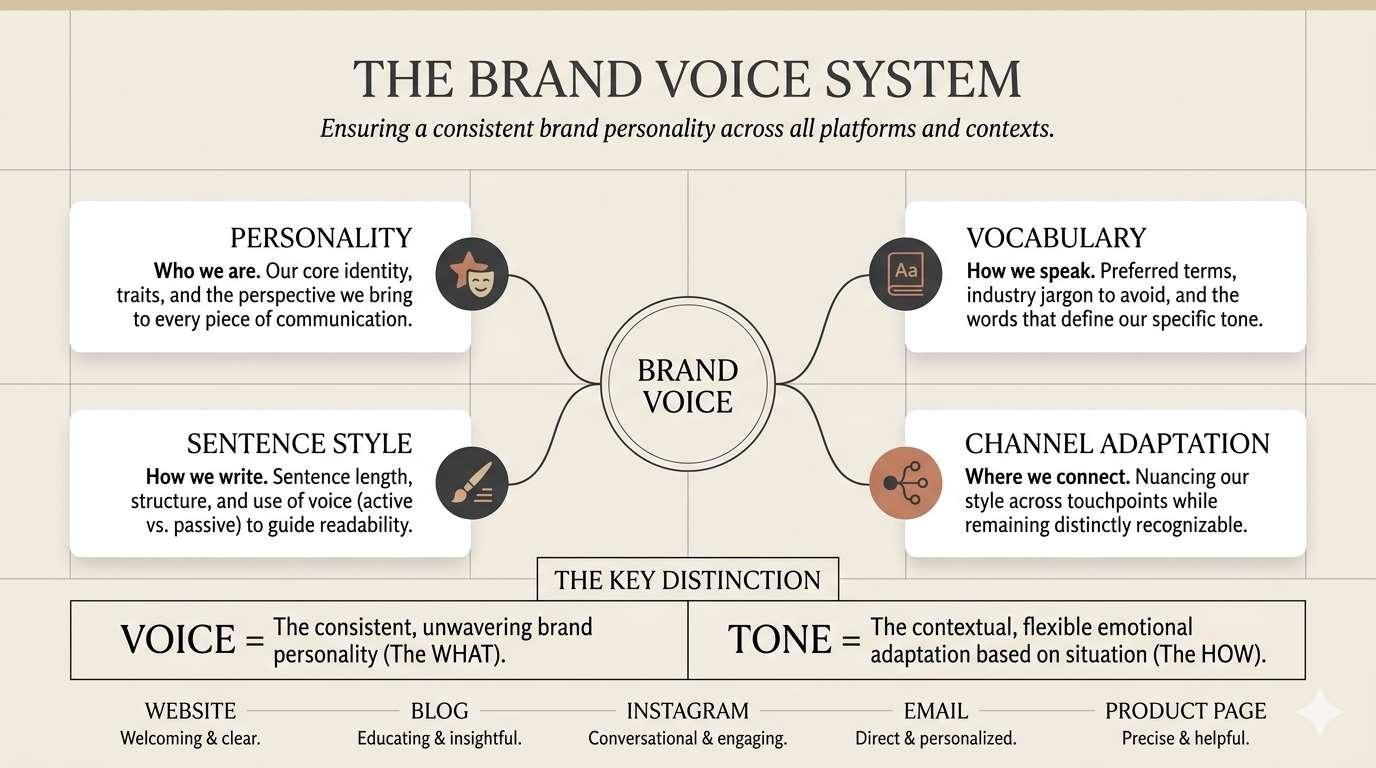
Brand voice
Voice is the consistent personality of the brand’s communication.
Brand tone
Tone is how that voice adapts to a particular situation.
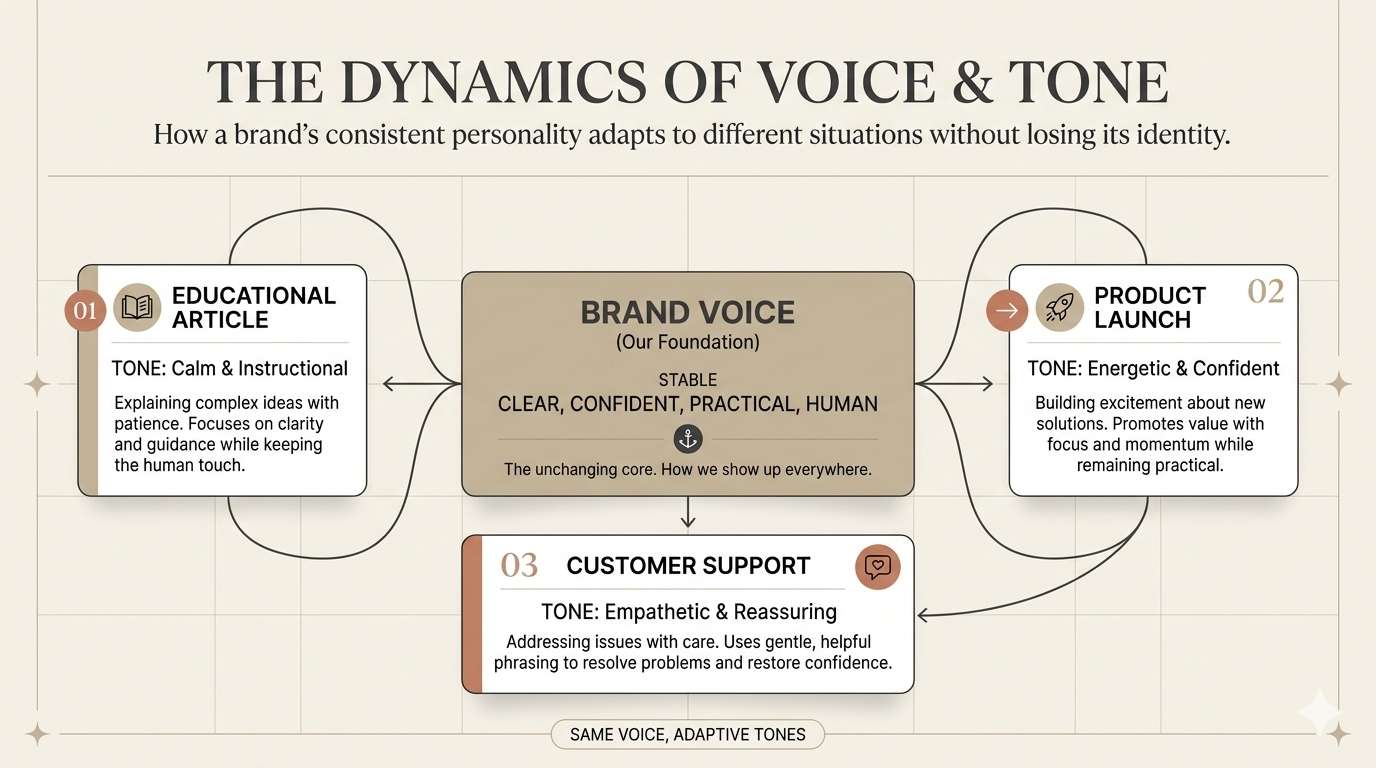
Imagine a brand whose voice is:
Clear, confident, practical, and human.
When publishing an educational article, its tone might be:
Calm and instructional.
When announcing a new product, the tone might become:
Confident and energetic.
When responding to a frustrated customer, the tone might become:
Empathetic and reassuring.
The voice remains recognizable.
The tone changes with context.
This distinction prevents a common problem: trying to create one rigid writing style for every situation.
Why Brand Voice Matters
People don’t experience a brand only through visual identity.
They experience it through words.
Website headlines.
Product descriptions.
Social posts.
Emails.
Advertisements.
Customer support.
Packaging.
Sales conversations.
Educational content.
Even small interface messages can contribute to how a brand feels.
A consistent voice helps create continuity between these touchpoints.
It can also make content creation easier.
Without defined principles, every new caption or article starts from zero.
With a clear voice, you already have a framework for deciding:
What words to use.
What words to avoid.
How much personality to show.
How formally to communicate.
How directly to make a point.
How to explain complicated ideas.
How to respond when something goes wrong.
Your brand voice therefore becomes both a brand asset and an operational tool.
Brand Voice Begins With Brand Strategy
Voice shouldn’t be chosen independently from your brand strategy.
Your positioning, audience, values, personality, and offer all influence how your brand should communicate.
For example, imagine two businesses selling similar professional services.
One targets experienced executives.
Another targets first-time founders.
Their communication may need to differ even if their underlying service is similar.
Likewise, a brand positioned around accessibility and education may need a communication style that makes complicated information easier to understand.
This is why defining your ideal customer and brand positioning first creates a stronger foundation for defining voice.
Step 1: Review Your Brand Personality
Start by describing your brand as if it were a person.
Not literally.
The exercise is simply a way to identify communication characteristics.
Ask:
If my brand walked into a room, how would it communicate?
Would it be:
Quiet or expressive?
Formal or conversational?
Serious or playful?
Direct or diplomatic?
Analytical or intuitive?
Minimal or descriptive?
Educational or provocative?
Choose characteristics that actually fit your business.
Avoid choosing traits simply because they sound attractive.
A luxury financial brand may not need to sound playful.
A children’s education brand may not need to sound formal.
A creative studio may have room for more personality than a regulated professional service.
Context matters.
Step 2: Choose 3–5 Core Voice Characteristics
Avoid creating a long list of adjectives.
A practical brand voice can often be described with three to five meaningful characteristics.
For example:
Clear
We explain ideas without unnecessary jargon.
Confident
We make informed recommendations instead of constantly qualifying every statement.
Practical
We focus on useful advice that can be applied.
Human
We communicate naturally rather than sounding like corporate documentation.
These characteristics give writers something actionable to work with.
Step 3: Define What Each Characteristic Means
This is where a brand voice becomes useful.
Consider the difference between:
“Our voice is professional.”
and:
“Our voice is professional but conversational. We avoid corporate jargon, unnecessary formality, and exaggerated claims.”
The second version provides direction.
For every characteristic, define:
What it means
What it looks like in writing
What it does not mean
For example:
Confident
Means: Clear recommendations based on reasoning.
Looks like: “Start with positioning before redesigning your logo.”
Doesn’t mean: Aggressive, arrogant, or absolute.
This prevents different writers from interpreting the same word differently.
Step 4: Create a “We Are / We Are Not” Framework
This is one of the simplest ways to make voice guidelines practical.
For example:
| We are | We are not |
|---|---|
| Clear | Overly technical |
| Confident | Arrogant |
| Practical | Generic |
| Human | Overly casual |
| Strategic | Complicated |
This creates boundaries.
And boundaries are particularly important when multiple people contribute to content.
They can also be useful when AI is involved in content production because the guidelines provide a reference for editing AI-generated drafts.
Step 5: Study Your Existing Content
You may already have a recognizable voice.
Look through your best-performing or most representative:
Website pages.
Instagram captions.
Emails.
Blog articles.
Product descriptions.
Customer messages.
Identify repeated patterns.
Do you frequently use short sentences?
Do you explain concepts through examples?
Do you ask direct questions?
Do you use technical terminology?
Do you tell stories?
Do you use humor?
Do you make strong recommendations?
Do you write conversationally?
Don’t assume your intended voice is the same as your actual voice.
Your existing content can reveal the difference.
Step 6: Build a Vocabulary System
Brand voice isn’t only about tone.
Words matter.
Create three simple groups:
Words we use
Words that naturally fit your brand.
For a practical branding studio, this could include:
strategy, clarity, positioning, practical, consistent, audience, system, direction, useful.
Words we avoid
Words that don’t fit the brand’s personality or standards.
For example:
revolutionary, guaranteed, effortless, secret formula, overnight success.
Words we use carefully
Words that may be appropriate depending on context.
For example:
premium, expert, innovative, transformative.
The purpose isn’t to create a dictionary.
It’s to establish consistency.
Step 7: Define Your Sentence Style
Two brands can use the same vocabulary and still sound completely different.
Sentence structure matters.
Decide whether your brand generally favors:
Short or long sentences.
Direct or indirect language.
Active or passive constructions.
Questions or statements.
Simple or technical vocabulary.
Conversational or editorial writing.
For example:
Generic:
“Our comprehensive suite of innovative solutions is designed to facilitate the optimization of your brand’s strategic positioning.”
Clearer:
“We help you clarify your positioning so customers understand why your brand matters.”
The second is easier to understand.
If clarity is part of the brand voice, the second style is more aligned.
Step 8: Create Voice Rules for Different Channels
Your voice should remain consistent, but every platform has different communication requirements.
Your website may need more structured, informative language.
Instagram may be more conversational.
A blog article can be detailed and educational.
Email may feel more personal.
A product page should be persuasive without becoming exaggerated.
The underlying voice remains the same.
The expression changes with the channel.
For example:
Core voice: Clear + practical + confident.
Blog: Educational and detailed.
Instagram: Conversational and concise.
Email: Personal and direct.
Product page: Clear, persuasive, and benefit-focused.
This is tone adaptation, not a completely different brand voice.
Step 9: Create Before-and-After Examples
Examples are more useful than adjectives alone.
Suppose your voice is:
Clear, confident, practical, human.
A weak example might be:
“It is imperative for businesses to strategically optimize their brand identity in order to facilitate enhanced consumer recognition.”
A stronger version could be:
“A recognizable brand starts with a consistent identity. Your logo is only one part of the system.”
The second communicates the idea more directly.
Create examples for your actual business.
Show writers what the voice sounds like rather than expecting them to interpret a list of adjectives.
Step 10: Use Your Voice to Strengthen Brand Messaging
Brand voice and brand messaging work together.
Messaging determines what the brand needs to communicate.
Voice determines how it communicates it.
For example:
Message: Your positioning should be clear before you redesign your visual identity.
Voice: Clear, practical, confident.
The resulting communication might be:
“Don’t start with the logo. Start by deciding what you want your brand to be known for.”
The strategic message and communication style reinforce each other.
This is why voice should be connected to your broader brand strategy rather than treated as a standalone copywriting exercise.
Brand Voice Example
Imagine a fictional branding studio called Northline Studio.
Its audience is small businesses that need strategic branding without unnecessary complexity.
Its voice might be:
Clear — Explain branding without jargon.
Strategic — Connect recommendations to business goals.
Practical — Give readers something they can use.
Calm — Avoid exaggerated urgency and aggressive selling.
Human — Write like an experienced person explaining something to another person.
Now consider three pieces of communication.
Educational article
“Your logo can make a brand recognizable, but it can’t determine what customers think about the business by itself.”
Social post
“Before redesigning the logo, ask a harder question: what exactly should the brand be known for?”
Product CTA
“If your brand still feels unclear, start by defining the foundation before redesigning the surface.”
Different formats.
Same voice.
Common Brand Voice Mistakes
Trying to sound professional
“Professional” isn’t a sufficiently specific voice.
Almost every business wants to sound professional.
Define what professional means for your brand.
It might mean precise, calm, direct, knowledgeable, or formal.
Being too casual
A conversational voice doesn’t require slang, excessive emojis, or forced humor.
Approachability comes from clarity and natural communication—not from trying to sound like a friend in every sentence.
Changing personality by platform
Your tone can adapt.
Your underlying personality shouldn’t disappear.
Using too much jargon
Technical language can demonstrate expertise when the audience understands it.
Unnecessary jargon often creates distance rather than authority.
Making every sentence sound clever
Strong writing isn’t a competition for the most creative sentence.
Clarity usually matters more.
Letting AI define the voice
AI can help draft, rewrite, brainstorm, and adapt content.
But your brand voice should come from your strategy and standards.
Use AI to execute the system—not invent the identity without direction.
Create a One-Page Brand Voice Guide
You don’t need a 50-page document.
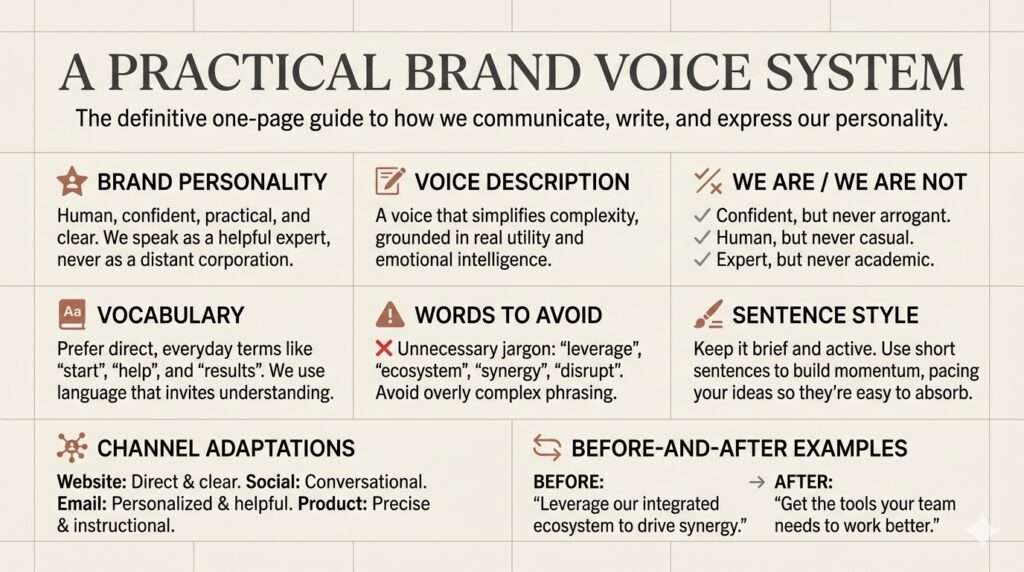
A practical brand voice guide can fit on one page.
Include:
Brand personality
Three to five defining characteristics.
Voice description
A short paragraph explaining how the brand communicates.
We are / We are not
Clear boundaries.
Vocabulary
Words and phrases that fit.
Words to avoid
Language that doesn’t fit.
Sentence style
Guidelines for clarity, length, formality, and structure.
Channel adaptations
How voice changes slightly across website, social media, email, and other channels.
Examples
A few before-and-after examples.
That is enough to give your content system a usable foundation.
How to Keep Your Brand Voice Consistent
Consistency doesn’t mean reviewing every sentence against a rigid checklist.
Instead, develop a simple editing habit.
Before publishing, ask:
Does this sound like our brand?
Then ask:
Would our ideal customer understand it?
And finally:
Does it communicate the idea clearly without sounding exaggerated or artificial?
If several people create content, use the same voice guide.
If AI contributes to your workflow, give it the same guidelines and review the output before publishing.
Over time, repetition creates familiarity.
Final Takeaway
Brand voice is not about finding a clever writing style.
It is about creating a recognizable way for your business to communicate.
Start with your strategy.
Understand your audience.
Define your personality.
Choose three to five meaningful voice characteristics.
Explain what each characteristic means.
Create boundaries.
Build vocabulary guidelines.
Adapt tone to the situation without changing the underlying personality.
Then test the voice across real content.
The objective isn’t for every sentence to sound identical.
The objective is for customers to recognize the same brand behind the words.
When your positioning explains what you want to be known for, your values explain what principles guide you, and your brand voice explains how you communicate, the pieces of your brand strategy begin working as one system.
Frequently Asked Questions
What is brand voice?
Brand voice is the consistent personality and communication style a brand expresses through language. It influences vocabulary, sentence structure, formality, communication style, and how the brand expresses its personality.
What is the difference between brand voice and tone?
Brand voice is the relatively consistent personality of the brand’s communication. Tone changes depending on the situation. A brand can maintain the same voice while using a more empathetic tone for customer support and a more energetic tone for a product launch.
How do I define my brand voice?
Start with your brand strategy, audience, positioning, and values. Then identify three to five personality characteristics, define what each means, establish vocabulary and writing rules, and create examples showing the desired style.
How many brand voice characteristics should I have?
Three to five is a practical starting point. Too many characteristics can become difficult to remember and apply consistently.
Can brand voice change?
It can evolve as a business, audience, or positioning changes. However, frequent unnecessary changes can make the brand harder to recognize. Evolve the voice deliberately rather than changing it for every trend.
Can AI help create brand voice guidelines?
AI can help analyze existing writing, identify patterns, generate examples, and adapt content to an established voice. However, the strategic definition of the brand voice should be based on the brand’s positioning, audience, values, and business objectives.
Should brand voice be included in brand guidelines?
Yes. A brand guideline can document the personality, vocabulary, writing principles, tone adaptations, and examples that help maintain consistent communication across channels.
1 Comment
[…] For a deeper framework, see Brand Voice: A Complete Beginner’s Guide. […]