Why does someone choose a Starbucks coffee over a competitor’s that’s objectively equal in quality and often cheaper? Why do people recognize Nike’s swoosh in a millisecond and instantly associate it with “just do it”? Why does a cluttered, inconsistent brand feel less trustworthy than a minimal, coherent one?
The answer isn’t about marketing tactics or clever advertising. It’s about psychology.
Most customer brand decisions don’t happen consciously. They happen in your customer’s subconscious mind, in a system of thinking that’s fast, emotional, and automatic. Understanding how this psychology works and why it dominates brand choice is the foundation of effective branding.
In this article, I’ll break down the psychological mechanisms that make branding actually work. You’ll learn why System 1 thinking drives 95% of brand decisions, how emotional memory creates lasting brand preference, and what cognitive biases mean for your brand design. More importantly, you’ll understand how to apply these principles so your brand actually influences customer perception the way you intend.
This isn’t abstract theory. It’s the science that explains why some brands feel inevitable and others feel forgotten.
What You'll Learn
ToggleSubconscious Brain is the Real Decision-Maker
When you encounter a brand whether it’s a logo on a shelf, a website, or a social post your brain doesn’t pause to consciously evaluate it. Instead, most of the “decision” has already been made before you’re even aware it’s happening.
Research consistently shows that between 70 and 95% of purchasing decisions are driven by subconscious factors: emotion, instinct, identity, and social context. Not by rational comparison of features.
This is the key insight that changes how you think about branding.
Most people assume brand choice is deliberate. They think customers consciously compare options, weigh pros and cons, and make a rational decision. But that’s not how brains work. Your conscious mind is lazy. It doesn’t want to do the work of comparing and analyzing unless it absolutely has to.
Instead, your brain uses a shortcut system. It makes snap judgments based on familiarity, emotional association, how easy something is to process, and what your identity-seeking brain thinks the choice says about you to others. All of this happens automatically, before your conscious mind gets involved.
This automatic system is so powerful that by the time your conscious mind shows up to “make a decision,” the choice has already been made. Your conscious mind is just there to provide logical justification for an emotional decision that already happened.
Understanding this changes everything about how you build a brand. Because if you design your brand to appeal to the conscious mind with detailed feature lists and rational arguments you’re appealing to the system that doesn’t actually make the decision. You’re appealing to System 2.
Thinking: How the Brain Makes Instant Brand Choices
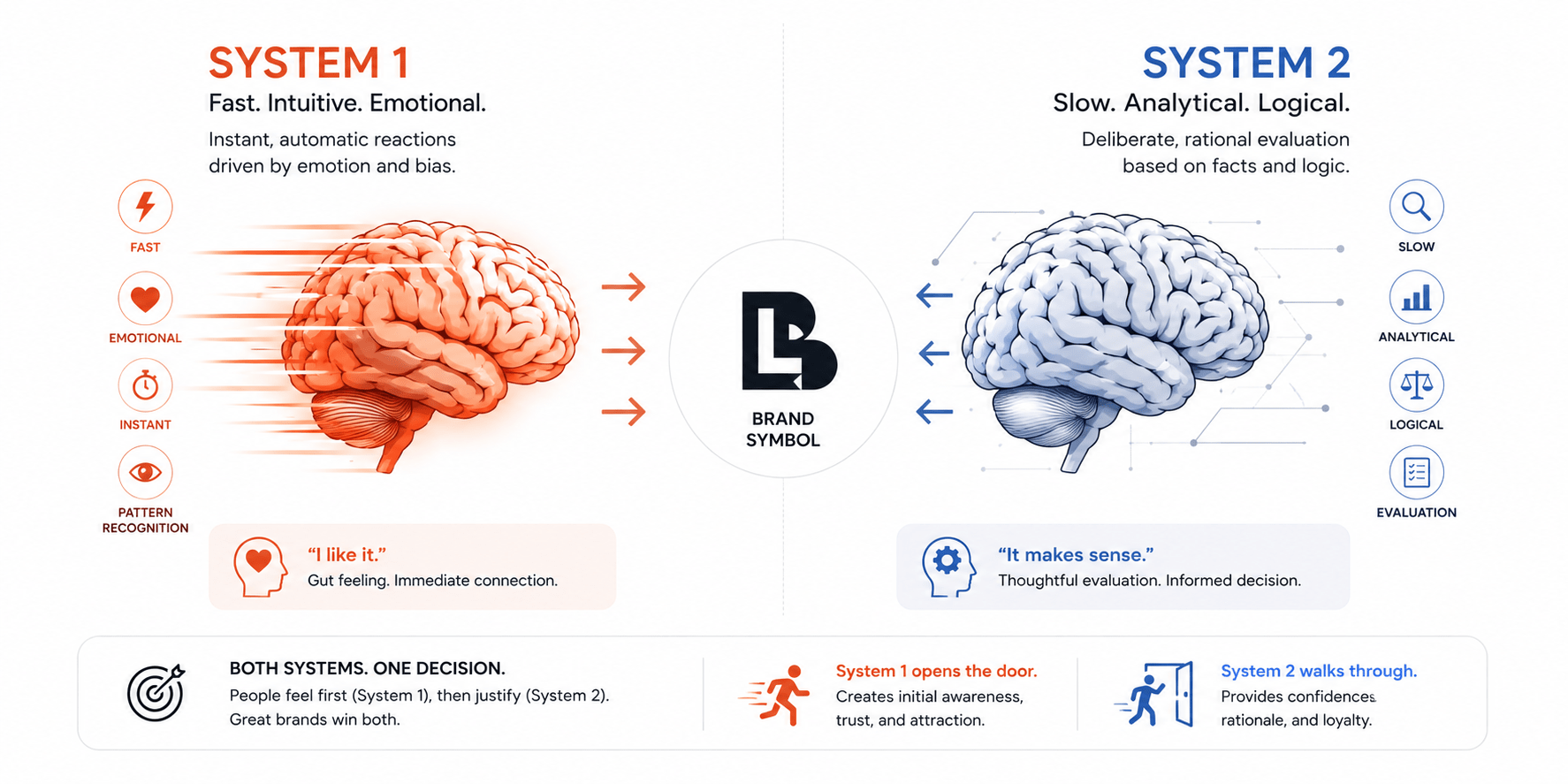
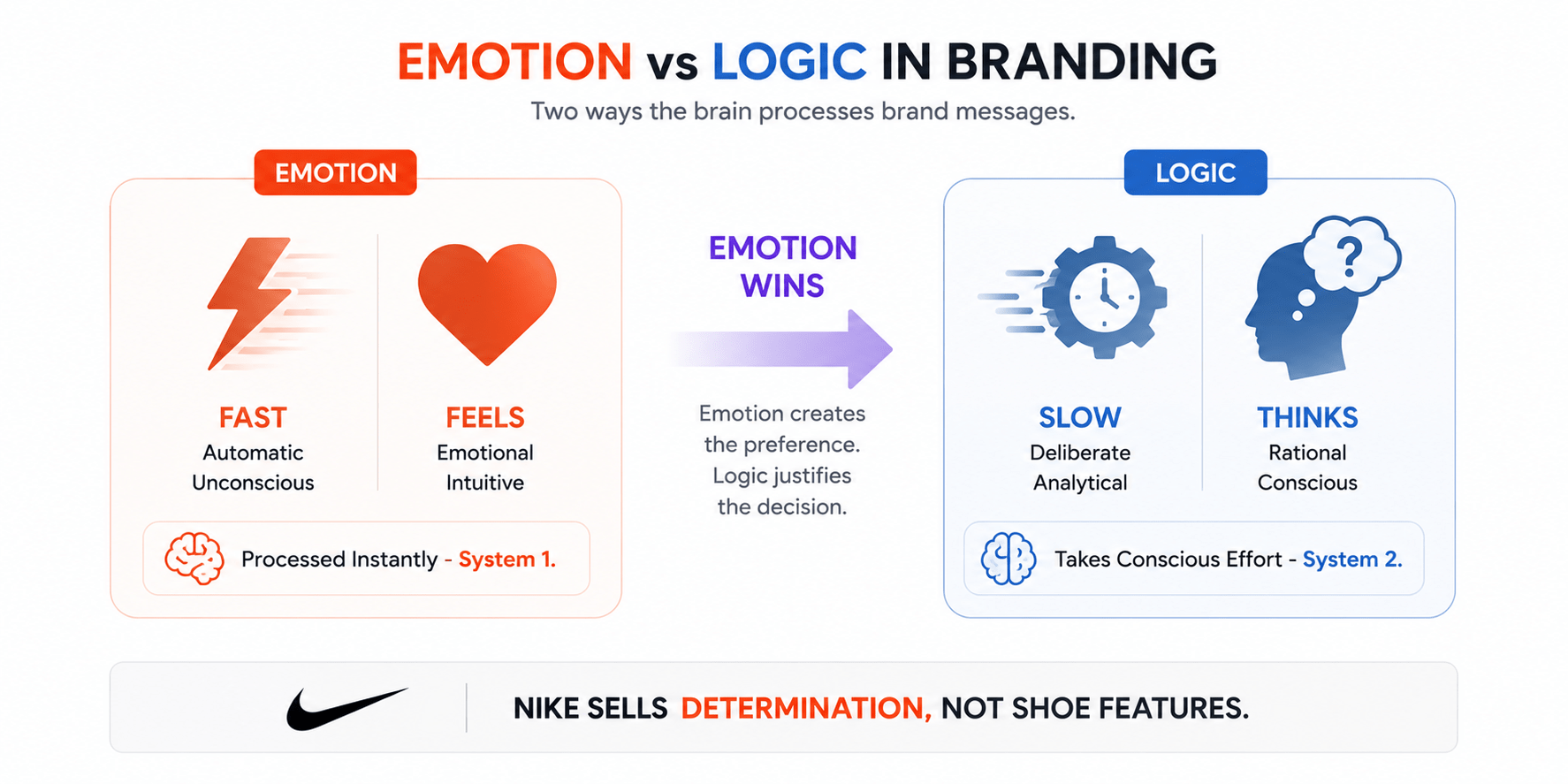
Daniel Kahneman, the Nobel Prize-winning psychologist, describes human thinking as two systems operating simultaneously. System 1 is fast, automatic, and emotional. System 2 is slow, deliberate, and analytical.
System 1 is always on. It’s running in the background, making instant judgments about everything you encounter. It’s the gut feeling that tells you someone’s trustworthy before they’ve said a word. It’s the immediate recognition of a familiar brand on a supermarket shelf. It’s the snap judgment that a website feels professional or sketchy before you’ve read a single word of copy.
System 1 doesn’t deliberate. It reacts. And it makes the vast majority of your decisions including your brand choices.
System 2 is the conscious, effortful mode you engage when you need to think through something complex. It’s slow, it consumes mental energy, and your brain only activates it when necessary. For most everyday purchasing decisions especially for lower-stakes consumer goods System 2 never activates at all.
Here’s what this means for branding: The brand that succeeds is the brand that wins in System 1 processing, before System 2 even has a chance to evaluate.
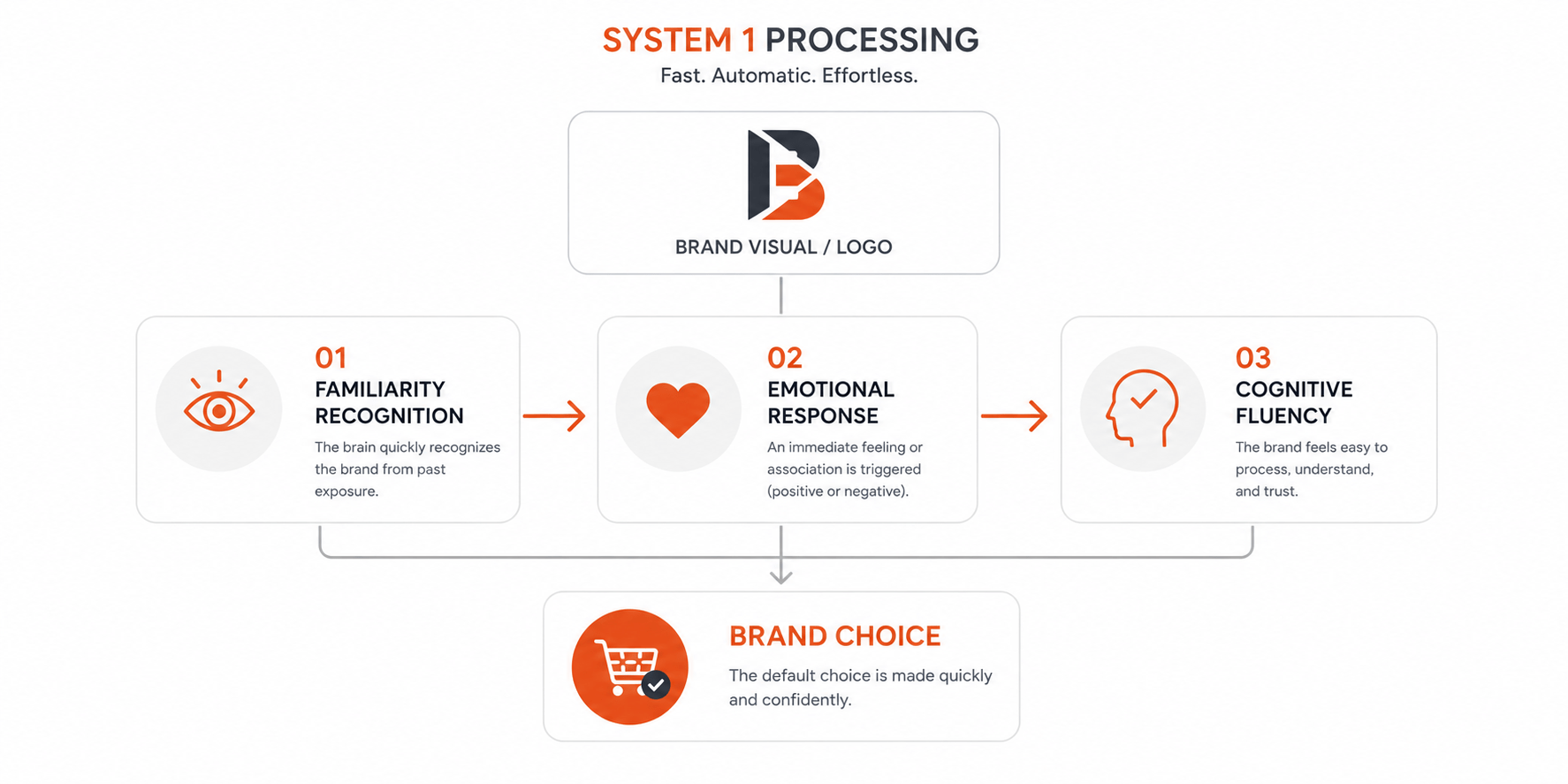
When System 1 encounters your brand, it’s asking unconscious questions: Do I recognize this? Does it feel safe? Does it feel familiar? Is it easy to process? What does choosing this say about me? Is this what people like me choose?
If the answer to these questions is yes if your brand creates instant recognition, emotional ease, and a sense of social belonging the choice is made. System 1 has decided. System 2 just provides the rational justification afterward.
This is why consistent, simple, visually distinctive branding is so powerful. It makes your brand easy for System 1 to process. Consistency creates familiarity. Simplicity creates cognitive fluency (the ease with which the brain processes information). Distinctive visual assets create instant recognition.
Design a brand that confuses System 1 cluttered visuals, inconsistent messaging, unclear positioning—and your customer’s brain has to work harder. More cognitive effort = less trust, less emotional connection, less preference. Your customer will prefer a simpler, clearer competitor instead.
Three Psychological Mechanisms That Drive Brand Preference
Brand psychology works through three interconnected psychological mechanisms. Understanding each one shows you exactly what’s happening in your customer’s brain when they choose your brand.
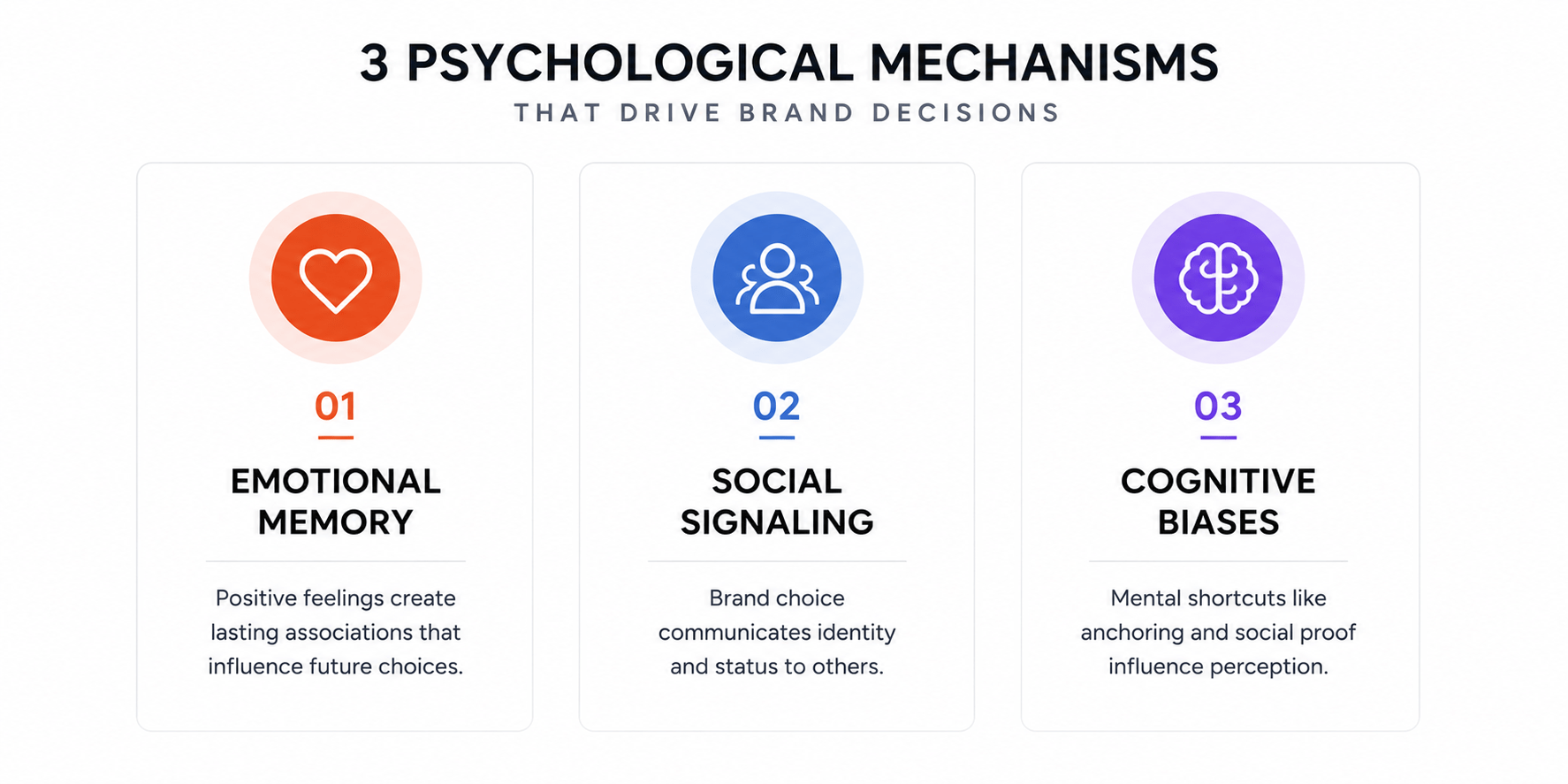
Mechanism 1: Emotional Memory
People don’t remember facts about brands. They remember how a brand made them feel.
Your brain encodes emotional experiences differently than it encodes logical information. Emotional experiences create stronger memories, and these memories directly influence future decisions. This is called emotional memory and it’s the most powerful driver of brand loyalty.
When you consistently create positive emotional associations with your brand through tone of voice, visual design, customer experience, consistency, storytelling your customer’s brain builds a positive memory. That memory isn’t conscious. But it’s there, influencing every future decision.
This is why Starbucks customers don’t just buy coffee. They buy the memory of the experience. They buy the ritual. They buy the feeling. The same goes for Apple customers, Nike customers, or any brand with genuine loyalty.
Brands that create positive emotional memories don’t have to convince people to buy. The emotional memory does it automatically. The customer wants to choose them.
Mechanism 2: Social Signaling
Your brain cares deeply about what your choices communicate to other people.
Brands function as social signals. When you wear Nike instead of a generic brand, you’re signaling something about yourself. When you choose Apple over a cheaper laptop, you’re making a statement about your identity and values. Brands understand this and position themselves as desirable identity markers.
This is especially true for higher-visibility purchases. Nobody can see your internal hard drive. But everyone can see your phone, your shoes, your coffee cup. Brands that position themselves as identity markers as a way to signal who you are tap into this deep human need for social belonging and status.
Effective branding leverages this by positioning the brand as something your customer is proud to be associated with. It’s not just a product; it’s a reflection of their values, their taste, their identity.
Mechanism 3: Cognitive Biases
Your brain uses mental shortcuts to make decisions faster. These shortcuts are called heuristics or cognitive biases, and brands strategically leverage them.
Anchoring Bias: Your brain heavily weighs the first information it encounters. That’s why luxury brands often show a higher price first it anchors your perception of value upward, making the actual price feel more reasonable by comparison.
Social Proof: Your brain is wired to follow the crowd. If everyone else seems to prefer a brand, your brain automatically assumes it must be good. This is why customer reviews, testimonials, and “bestseller” badges are so powerful.
Confirmation Bias: Once your brain forms an initial impression, it seeks out information that confirms it while ignoring contradicting information. A strong brand impression creates confirmation bias in your favor customers actively seek reasons to keep believing in you.
Brands don’t necessarily manipulate these biases (though some do). More often, a strong, consistent brand naturally creates these biases in the customer’s mind. The bias works in the brand’s favor because the brand has earned it through consistent positive experience.
Why Emotional Connection Beats Features Every Time
Here’s a hard truth that destroys a lot of marketing: Features don’t drive brand choice. Emotions do.
You’ve probably heard that “customers buy on emotion, then justify with logic.” This isn’t poetic. It’s literally how the brain works.
Your brain has a system called somatic markers physical/emotional responses that are connected, through experience and learning, to predicted outcomes. When you encounter a brand, your body/mind generates an emotional response before your conscious mind has evaluated anything. That emotional response creates a “gut feeling” about the brand. Then, your conscious mind kicks in and provides logical justification for the emotional decision that already happened.
This is why Nike doesn’t sell shoe specifications. Nike sells determination and achievement. The emotional value (the feeling of being capable, of pushing past limits) is what actually drives the purchase. The shoe specs are just the logical justification afterward.
A brand that leads with features (“This shoe has XYZ technology”) will always lose to a brand that leads with emotion (“This shoe is for people who don’t quit”). The emotional brand wins in System 1. The feature-focused brand only appeals to System 2, which isn’t making the decision anyway.
This is also why brand consistency matters so much. Every touchpoint your website, your social posts, your customer service, your product packaging, even your LinkedIn profile either reinforces or undermines the emotional connection. Inconsistency confuses System 1. Consistency strengthens it.
How to Apply Brand Psychology to Your Design Decisions
Now that you understand how psychology drives brand choice, here’s how to actually use it.
Design for System 1 Recognition
Make your brand instantly recognizable. Use consistent visual elements (logo, colors, typography). Create a distinctive visual signature that’s easy for the brain to process. Simple, coherent design is more memorable than complex, decorative design because it’s easier for the brain to encode and recall.
This is why the best brands are often visually minimal. Apple, Nike, Google they all use simplicity as a strategy. Not because they’re “cool,” but because simplicity creates cognitive fluency. Your brain processes simple, consistent design more easily. Ease = trust.
Build Emotional Memory Through Consistency
Every interaction your customer has with your brand creates an emotional impression. Make sure that impression is consistent. Use the same voice, the same visual style, the same messaging across every touchpoint. Over time, this consistency builds emotional memory. Your customer starts to feel something when they encounter your brand, before they consciously think about it.
For freelancers and small businesses, this is your competitive advantage. A scrappy personal brand with consistent voice, visual identity, and messaging will outperform a polished, inconsistent brand every time. Because consistency creates memory. Memory creates preference.
Create Social Signaling Through Distinctive Assets
Build visual elements that are unmistakably yours. A distinctive logo, a specific color combination, a unique tone of voice, a signature visual style. These become social signals. When customers choose your brand, they’re not just choosing a product; they’re making a statement about themselves.
For personal brands, this is essential. Your visual identity and voice should signal something about your values, your perspective, your identity. Customers who choose you should feel like they’re joining a group of people who think the way you do.
Design for System 1 Recognition
Before launching a brand or redesigning one, ask:
- Is this instantly recognizable? (System 1 test)
- Is this easy to process? (Cognitive fluency test)
- Does this create a positive emotional response? (Emotional memory test)
- Does this signal something about identity? (Social signaling test)
- Does this leverage cognitive biases in our favor? (Bias test)
Conclusion
Brand psychology explains why some brands feel inevitable and others feel forgotten. It’s not accident or luck. It’s the result of understanding how the human brain actually works not how we like to think it works.
The brain makes most decisions in System 1: fast, emotional, automatic, largely unconscious. The brand that wins is the brand that appeals to System 1 through emotional memory, social signaling, and leveraging cognitive biases. It’s the brand that’s consistent, distinctive, and easy to process.
This is why branding matters more than most people realize. Branding isn’t decoration. It’s infrastructure for decision-making. It’s the system that shapes how customers perceive you before they consciously evaluate you.
If you understand psychology, you understand branding. And if you understand branding, you have an unfair advantage over competitors who are still trying to win through features and rational arguments.
Your customers’ brains have already made the decision. Your job is to make sure your brand is the one that wins in System 1.
Ready to Apply Brand Psychology to Your Brand?
Understanding the psychology is one thing. Applying it to your actual brand is another.
The next step is auditing your brand against these psychological principles. Are you designing for System 1 recognition? Are you building emotional memory through consistency? Are you creating social signaling through distinctive assets?
If you want to go deeper into how to apply these principles to your visual identity, positioning, and messaging strategy, read our complete Branding Beginner’s Guide.
And if you’re specifically interested in how psychology applies to brand voice and messaging, see our guide on Brand Voice: The Psychology of Tone and Connection.
Your brand isn’t just about how you look. It’s about how your customer’s brain works when they encounter you. Design for the brain, not for logic, and watch your brand become unforgettable.