You can spend weeks creating an ebook, template pack, online resource, or AI-powered digital product and still struggle to make your first sale. The product might look professional, but that does not automatically mean people want it.
Learning how to validate a digital product idea helps you test whether your target audience has a real problem, wants your proposed solution, and is willing to take action before you invest significant time in building it.
The goal is not to predict every future sale. It is to replace assumptions with evidence.
In this guide, you will learn how to research a product idea, evaluate buyer signals, use a five-factor validation scorecard, and test demand before creating the complete product.
What You'll Learn
ToggleWhat Does It Mean to Validate a Digital Product Idea?
Digital product validation is the process of gathering evidence that a specific audience needs a solution and may be willing to pay for it.
Your product could be an ebook, workbook, Notion template, Canva template, prompt library, spreadsheet, digital planner, or another downloadable resource. Regardless of the format, the validation process starts with the problem rather than the product itself.
For example, saying “I want to sell an AI prompt ebook” describes a product format. Saying “I want to help beginner creators turn one business idea into a week’s worth of content using AI” describes a more specific problem and outcome.
The second statement gives you something concrete to test.
Effective validation examines three things:
- Problem demand: Do people experience this problem frequently enough to seek a solution?
- Solution relevance: Does your proposed product address the problem in a useful, specific way?
- Purchase intent: Are potential buyers willing to take meaningful action, ideally including paying for the solution?
Market research and competitor analysis can help you understand demand, existing alternatives, and potential gaps before committing to a product. The U.S. Small Business Administration recommends examining customer demand, competition, and pricing as part of business planning.
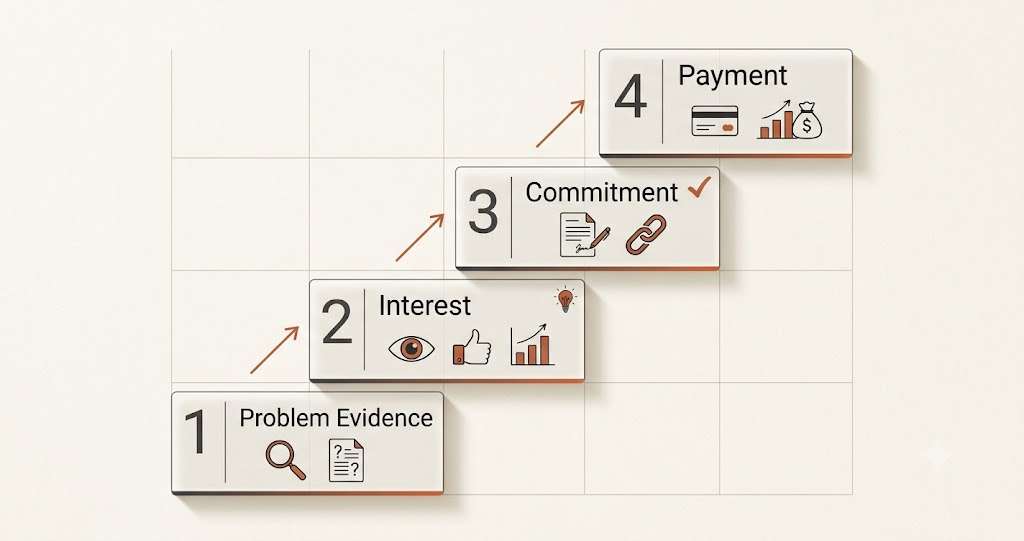
How to Validate a Digital Product Idea: The Four-Level Signal Ladder
Not every positive response is equally valuable. Someone liking your social media post has made a different level of commitment from someone joining a product waitlist or paying for a preorder.
Use the following four levels to evaluate your evidence, moving from early problem research toward stronger purchase signals.
Level 1: Find evidence of the problem
Before creating a solution, establish that the problem exists outside your own imagination.
Search for recurring questions, frustrations, and requests from people who match your intended audience. Useful research sources include online communities, comments on relevant social media posts, reviews of competing products, customer discussions, and search suggestions.
Suppose you are considering a digital product that teaches creators how to use AI to develop digital products. Look for people discussing difficulties with choosing an idea, identifying buyers, writing product content, or deciding what to create first.
Record the exact language people use. Repeated phrases can reveal which parts of the problem matter most to them.
Do not treat one comment as proof of market demand. Look for patterns across multiple people and sources.
Your action: Collect at least 10 relevant problem statements as an initial research exercise. This is a practical starting target, not a statistically validated sample size.
Level 2: Test interest in your proposed solution
Once you understand the problem, describe your proposed product in one clear sentence.
For example:
“An AI digital product planning kit that helps beginner creators research an idea, outline a product, and prepare it for launch.”
Share this concept through a relevant social media post, a newsletter, a community discussion where promotion is permitted, or a direct conversation with suitable potential buyers.
Observe the responses. Are people asking what is included? Are they describing their own difficulties? Do they want to know when it will be available?
These reactions are more informative than a general compliment, but they remain early signals. Interest does not necessarily translate into a purchase.
Your action: Test one specific product promise at a time. Avoid presenting five unrelated ideas in a single post, because you will not know which one attracted attention.
Level 3: Ask for a meaningful commitment
The next step is to give interested people an opportunity to do something concrete.
Depending on your product, you could offer an early-access waitlist, a focused research questionnaire, a sample template, or a relevant email freebie.
For instance, you could create a landing page for an AI Digital Product Idea Scorecard. The page explains what the resource helps users evaluate and invites them to sign up for access.
Track the number of relevant visitors, signups, and completed responses rather than simply counting likes or profile visits.
Set your evaluation target before launching the test. Choose a realistic threshold based on your audience size, traffic, and available resources. A small, highly relevant audience may provide useful evidence even when its absolute signup count is modest.
Your action: Measure whether the right people complete the requested action and whether their responses support your product hypothesis.
Level 4: Test willingness to pay
A purchase is a stronger signal of commercial demand than a like or an expression of interest.
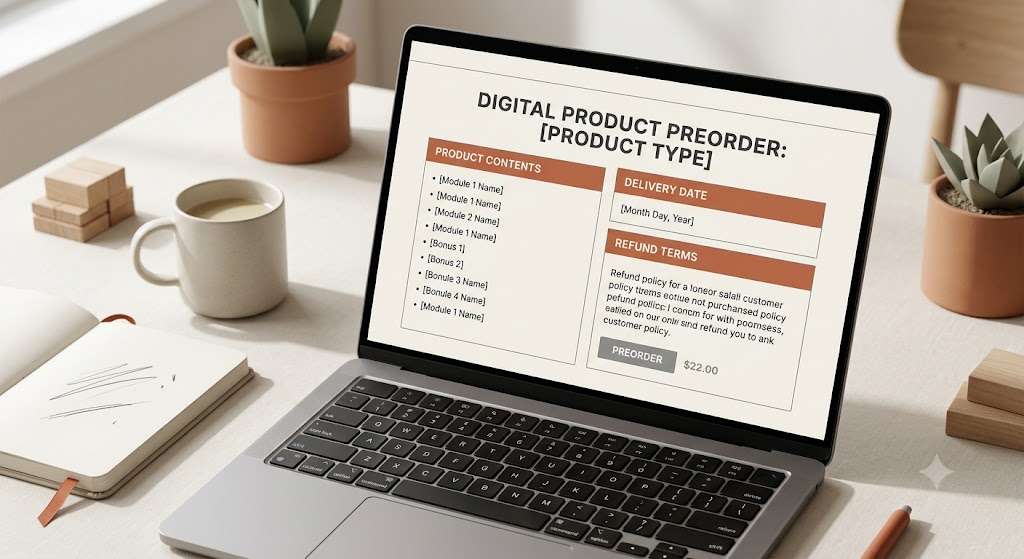
One way to test purchase intent is through a preorder or presale. You present the proposed product, its contents, price, delivery date, and applicable refund terms before the complete product is ready.
For example, you might offer an AI Content Planning Template Pack to a small group of potential buyers at an introductory price. Explain exactly which templates are included, what is still being developed, and when buyers can expect delivery.
Only accept preorders when you have a realistic plan to fulfil them. If you cannot deliver as promised, communicate promptly and handle cancellations and refunds appropriately. Your legal obligations depend on the markets and platforms involved.
Never invent customer testimonials, fake sales numbers, or false scarcity to manufacture demand.
Your action: Evaluate actual purchases, not just stated willingness to buy. A preorder test provides useful evidence, but a small number of sales does not guarantee sustained demand.
How to Score Your Digital Product Idea Before Building It
If you have several ideas, comparing them with the same criteria can help you choose where to focus.
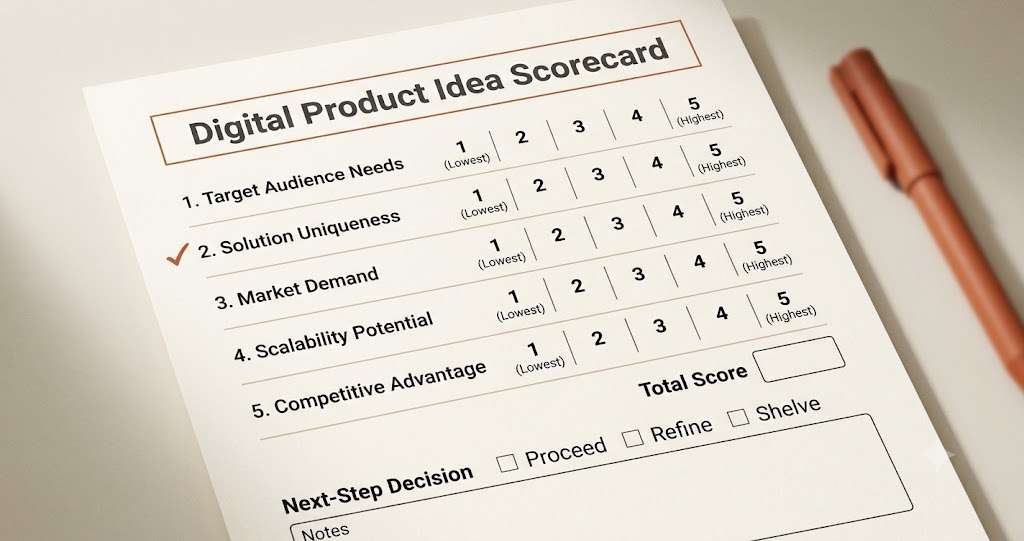
Use this five-factor scorecard. Rate each factor from 1 to 5, where 1 represents weak evidence or poor fit and 5 represents strong evidence or excellent fit.
| Validation factor | What to evaluate |
|---|---|
| Problem severity | How frustrating, urgent, or costly is the problem? |
| Demand evidence | Have you found only complaints, or have people also signed up or purchased? |
| Audience access | Can you reach relevant potential buyers through existing channels? |
| Competitive gap | Can you provide a more useful, specific, accessible, or differentiated solution? |
| Expertise and effort | Can you build a credible first version with your current skills, time, and resources? |
Add the five ratings for a total between 5 and 25.
Treat the total as a decision aid rather than a scientifically established prediction of sales. A high score cannot compensate for missing evidence of demand.
For example, an idea might score highly on problem severity, audience access, and ease of creation but receive only 1 out of 5 for demand evidence. That result suggests you should continue testing before building the complete product.
Example: An AI content template pack
Imagine a creator considering a downloadable pack that helps small digital businesses plan content with AI.
The creator discovers recurring questions about content planning and sees reviews of existing resources mentioning that the templates are too generic. A social post describing the proposed pack attracts detailed questions. A focused waitlist then receives signups from relevant creators.
The creator subsequently offers a clearly described preorder with a delivery date and appropriate terms.
This process reveals more than simply designing the pack and publishing a sales page. It identifies a specific audience, a recurring problem, a potential competitive gap, and evidence of purchase intent.
This is an illustrative scenario, not a documented customer case study. The lesson is to test each assumption before treating it as established.
How to Validate a Digital Product Idea With No Audience
You do not need a large following to begin researching a product idea. You do, however, need access to people who experience the problem you want to solve.
Start with existing demand signals rather than immediately trying to grow a social media account.
Research competing products. Examine product descriptions, customer reviews, pricing, formats, and recurring complaints. Look for problems that existing products do not adequately address. Competition is not automatically a reason to abandon an idea; it can indicate that people already seek solutions.
Participate in relevant communities. Read questions and discussions in communities where your intended buyers spend time. Follow community rules and contribute useful information instead of repeatedly posting promotional links.
Conduct focused customer interviews. Ask people about their recent experiences with the problem. Find out what they tried, what frustrated them, and what they currently use. Questions about actual behaviour are generally more informative than asking whether someone likes an imaginary product.
Publish a simple concept page. Explain the audience, problem, proposed outcome, and planned format. Measure qualified signups and specific inquiries. Remember that a signup is evidence of interest, not proof of a future purchase.
Test a small paid offer when appropriate. Once you have enough evidence to describe the offer clearly, consider a transparent preorder or a small paid pilot that you can fulfil.
These methods follow the basic logic of market research: understand the customer, examine alternatives, and test the proposed offer against real responses rather than relying exclusively on assumptions.
Example: An AI content template pack
Imagine a creator considering a downloadable pack that helps small digital businesses plan content with AI.
The creator discovers recurring questions about content planning and sees reviews of existing resources mentioning that the templates are too generic. A social post describing the proposed pack attracts detailed questions. A focused waitlist then receives signups from relevant creators.
The creator subsequently offers a clearly described preorder with a delivery date and appropriate terms.
This process reveals more than simply designing the pack and publishing a sales page. It identifies a specific audience, a recurring problem, a potential competitive gap, and evidence of purchase intent.
This is an illustrative scenario, not a documented customer case study. The lesson is to test each assumption before treating it as established.
Common Digital Product Validation Mistakes
Mistake 1: Asking whether people would buy
People may respond positively to hypothetical purchase questions without actually intending to spend money.
Instead, ask what they have tried to solve the problem, what they currently use, and what they found inadequate. Then observe whether they take a meaningful next step.
Mistake 2: Treating likes and views as proof of demand
Social engagement can indicate that a topic attracts attention, but it does not establish willingness to pay.
Measure actions that relate directly to your hypothesis: relevant replies, completed questionnaires, qualified signups, and purchases.
Mistake 3: Researching the wrong audience
Feedback from friends, other creators, or general followers may not represent your intended buyers.
Define the audience before conducting the test. A product for beginner digital entrepreneurs, for example, should be evaluated with people who resemble that target group.
Mistake 4: Copying competitors without finding a gap
A competing product may already solve the problem well. Creating a similar resource with a different cover may not give customers a compelling reason to choose yours.
Compare the audience, promised outcome, usability, format, level of detail, and price. Identify a genuine opportunity to serve a specific need better.
Mistake 5: Ignoring negative results
A weak response is not automatically a failed experiment. It may mean the audience is too broad, the problem is not urgent, the offer is unclear, or the proposed solution is not compelling enough.
Change one important variable at a time and test again. If the evidence continues to be weak, consider a different idea before investing further.
Free Ways to Research Digital Product Demand
You can conduct an initial validation exercise without purchasing expensive research software.
- Search engines: Explore autocomplete suggestions and related searches to discover how people describe a problem.
- Competitor reviews: Identify repeated complaints, missing features, and requests for more specific resources.
- Social platforms: Study relevant comments, discussions, and questions to understand audience language.
- Your own analytics: Review which topics generate qualified website visits, email signups, and product-page interactions.
- Free surveys and interviews: Ask targeted questions about real experiences and existing alternatives.
- Keyword research tools: Use search demand as one input, not a definitive measure of purchase intent.
Combine these sources rather than relying on a single metric. Search activity can indicate interest in a topic, while competitor pricing and direct customer feedback can help you understand the commercial context.
For additional guidance, consult the U.S. Small Business Administration’s market research and competitive analysis resources. The resource explains how to investigate demand, customer characteristics, competition, and pricing.
Your Digital Product Validation Action Plan
You do not need to create the complete product to begin. Start with a defined hypothesis and a small experiment.
Step 1: Write down the specific person you want to help and the problem they need to solve.
Step 2: Collect examples of that problem from real discussions, reviews, and customer research.
Step 3: Write a one-sentence product promise that explains the intended outcome.
Step 4: Test the concept with a relevant audience and record meaningful responses.
Step 5: Offer a concrete next step, such as a waitlist, focused questionnaire, or transparent paid preorder.
Step 6: Review your evidence and scorecard. Decide whether to build a first version, refine the offer, run another experiment, or move on.
The objective is not to eliminate every risk before launching. It is to avoid investing heavily in an idea before you have enough evidence to justify the next step.
Frequently Asked Questions
Can I validate a digital product idea without an audience?
Yes. Begin with competitor reviews, relevant communities, search research, and direct conversations with people who match your intended customer profile. You can then test a concept page, waitlist, or paid offer with an appropriate audience.
How many people need to sign up before I build?
There is no universal number. The right threshold depends on your audience size, traffic quality, product price, and business goals. Define your target before the experiment and evaluate the quality of the responses as well as the count.
Is pre-selling a digital product a good idea?
A preorder can help test willingness to pay before you finish building. It must be transparent: disclose the product’s current status, what buyers will receive, the expected delivery date, and applicable cancellation or refund terms. Do not accept payment unless you have a credible fulfilment plan.
What if people like my idea but nobody buys?
Investigate the gap between interest and purchase intent. Your audience may not feel enough urgency, the offer may be unclear, the price may not match perceived value, or you may be reaching people who are unlikely to buy. Test these explanations rather than immediately creating more content or adding features.
Should I build a minimum viable product or validate first?
You can validate before building a complete product. Research and concept tests come first; a small prototype or minimum viable product can then help you learn whether the solution works in practice. Choose the smallest experiment that answers your most important unanswered question.
Final Thoughts
A digital product idea becomes more credible when evidence supports it. Start with the problem, understand the audience, study existing alternatives, and test increasingly meaningful forms of commitment.
Do not confuse a polished design with a validated offer. Build the smallest useful version your evidence supports, learn from the response, and improve it before investing in a larger product.