People often think personal branding means posting regularly on social media, choosing a professional profile photo, creating a recognizable visual style, or becoming known for a particular topic.
Those things can be part of it.
But they are not the foundation.
A personal brand is the perception people develop when they repeatedly encounter your expertise, ideas, communication style, work, and reputation.
If someone sees your name for the first time today, what do you want them to understand about you?
What do you want to be known for?
Who should think of you when they need your expertise?
And, perhaps most importantly, why should they remember you instead of someone else offering something similar?
That is where personal branding becomes a strategic discipline rather than a social media exercise.
A strong personal brand connects expertise, positioning, personality, reputation, content, and consistency into one recognizable presence.
This guide explains how to build that foundation from the ground up and how to turn your personal brand into an asset that supports your career, business, creative work, or professional opportunities.
What You'll Learn
ToggleWhat Is Personal Branding?
Personal branding is the intentional process of shaping how your expertise, values, personality, and work are understood and remembered by other people.
Your personal brand is not simply your logo, Instagram profile, LinkedIn page, website, or personal color palette.
Those are expressions of the brand.
The deeper brand exists in the association people make with your name.
For example, someone might become known for:
- explaining complex financial ideas simply
- creating distinctive visual identities
- helping founders clarify their businesses
- teaching photography to beginners
- sharing practical career advice
- developing thoughtful commentary about a particular industry
The important part is not merely visibility.
It is association.
You want people to be able to connect your name with a specific area of value.
That is why personal branding is closely connected to the same principles used in business branding: positioning, differentiation, audience understanding, messaging, identity, and consistency.
Personal Brand vs Personal Branding
These terms are related but slightly different.
Your personal brand is the perception and associations people have about you.
Personal branding is the ongoing process of intentionally shaping and communicating that perception.
Think of it this way:
Personal brand = what people remember.
Personal branding = what you consistently do to influence what they remember.
You cannot completely control how people perceive you.
But you can control many of the signals they receive.
Your work, content, communication, expertise, behavior, visual identity, website, and professional relationships all contribute to those signals.
Why Personal Branding Matters
Personal branding can be useful because people often make decisions based not only on what a person offers, but also on whether they understand that person’s expertise and trust their perspective.
HubSpot’s overview of personal branding similarly describes it as a way for professionals to increase visibility and strengthen their professional identity.
For an independent professional, this can affect how potential clients discover you.
For a founder, it can influence how people understand the person behind the company.
For a freelancer or consultant, it can help communicate expertise before a sales conversation happens.
For a creator, it can provide a foundation for building an audience around a particular perspective.
But there is an important distinction:
Visibility is not the same as reputation.
You can have thousands of followers and still have an unclear personal brand.
Likewise, someone with a relatively small audience can have a strong reputation within a specific professional niche.
The objective should therefore not simply be to become visible.
It should be to become recognizable for something valuable.
Do You Need a Personal Brand?
Not everyone needs to build a highly visible personal brand.
Some professionals prefer to let their work speak through a company, portfolio, organization, or private network.
Others may deliberately keep their personal and professional identities separate.
Personal branding becomes particularly useful when your expertise, reputation, relationships, or personality are directly connected to the value you provide.
This includes many:
- founders
- freelancers
- consultants
- coaches
- designers
- photographers
- writers
- creators
- educators
- speakers
- agency owners
- independent professionals
The right question is therefore not:
“Do I need to become a personal brand?”
A better question is:
“Would making my expertise and point of view more visible help me achieve my professional goals?”
If the answer is yes, personal branding can become a strategic asset.
Start With the Goal
Before choosing a platform or planning content, determine what your personal brand is supposed to accomplish.
Your goal might be:
Business: attract clients or customers.
Career: become more visible within your profession.
Authority: establish expertise in a specific subject.
Network: attract collaborators, partners, or opportunities.
Education: build an audience around what you teach.
Creative work: attract commissions, clients, or recognition.
Thought leadership: develop a recognizable point of view.
The same person can have several goals, but one or two should normally lead the strategy.
For example, a freelance brand designer might initially want to attract better clients.
That objective should influence what they publish, what projects they showcase, what topics they discuss, and how they describe their expertise.
Without a goal, personal branding easily becomes:
Post → get views → post again → repeat.
With a goal, content becomes part of a larger system.
Find the Intersection Between Expertise and Demand
One of the biggest personal branding mistakes is choosing a niche based only on what you enjoy talking about.
Your interests matter.
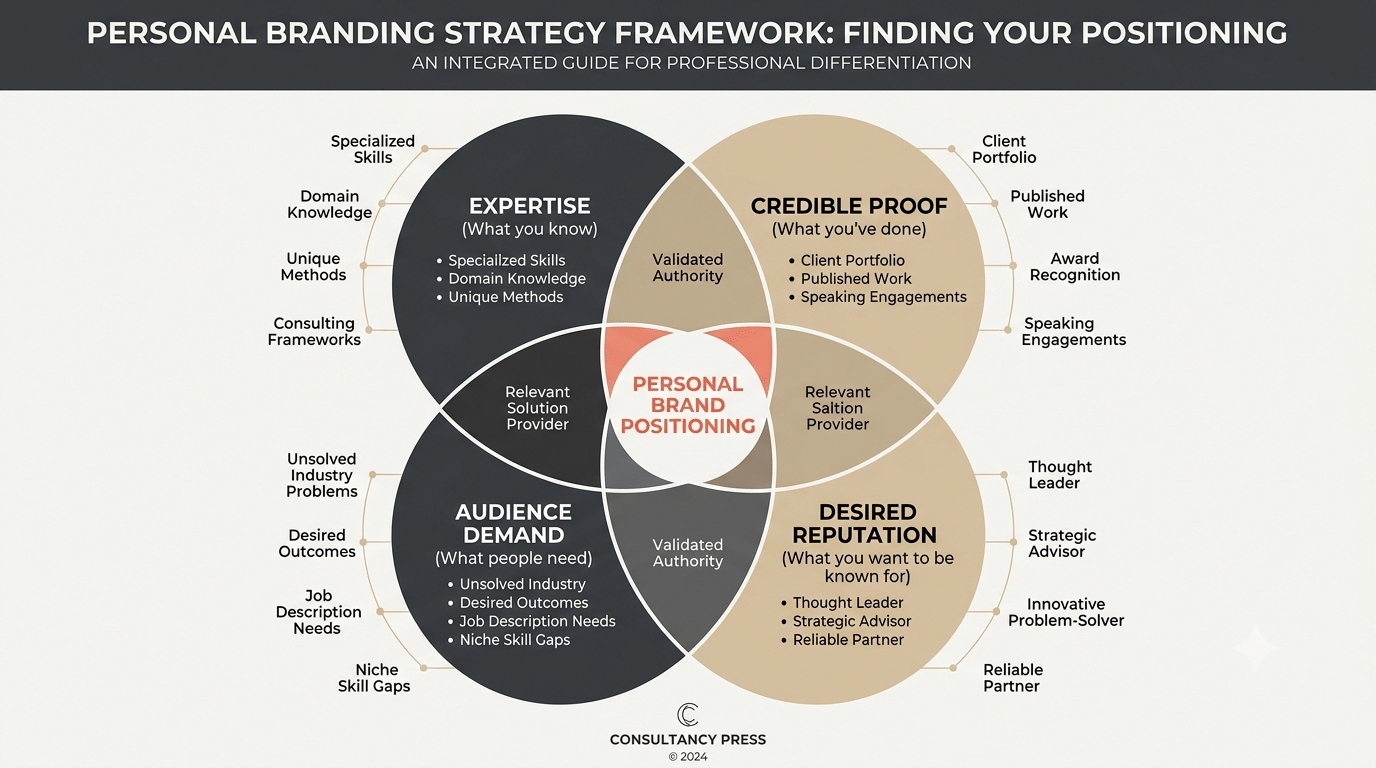
But a useful personal brand sits at the intersection of several things:
What you know
What you can credibly demonstrate
What your audience needs
What you want to be known for
That intersection is where your positioning begins.
Imagine a designer who says:
“I talk about design.”
That is extremely broad.
They could instead focus on:
“I help small businesses understand how strategic branding improves the way their businesses communicate.”
The second statement gives the audience a clearer reason to follow the person.
Specificity creates recognition.
You can always expand later.
Starting with everything makes it difficult for people to know why they should remember you.
Define Your Personal Brand Positioning
Personal brand positioning answers a simple question:
What should people associate your name with?
A useful starting framework is:
I help [specific audience] achieve [specific outcome] through [your expertise or approach].
For example:
I help early-stage founders clarify their brand positioning so they can communicate their businesses more confidently.
This does not need to become your permanent tagline.
It is a strategic statement that helps you make decisions.
If you want a deeper understanding of positioning, read the Brand Positioning Guide 2026.
The same positioning principles used for business brands can be applied to personal brands.
The difference is that you are part of the brand expression.
Your experience, opinions, personality, and reputation become part of the overall proposition.
Build Around a Point of View
Expertise alone does not always make a personal brand memorable.
Your point of view helps.
Suppose ten designers teach people about branding.
They may all discuss:
- logos
- colors
- typography
- brand strategy
- social media
What makes one person memorable?
Often, it is the way they interpret those subjects.
For example:
“A logo cannot fix unclear positioning.”
That is a point of view.
It can become an article, video, carousel, workshop, discussion, or case study.
A useful personal brand therefore needs more than topics.
It needs ideas worth associating with your name.
Ask yourself:
What do I believe about my field that I can explain, demonstrate, or defend?
That question is often more useful than:
What should I post today?
Build Your Personal Brand Around Expertise
Your personal brand should be connected to something real.
That does not necessarily mean you need twenty years of experience.
You can build authority by documenting what you are learning, sharing practical processes, explaining concepts clearly, conducting thoughtful experiments, or demonstrating actual work.
The important thing is to be accurate about your level of expertise.
Do not manufacture authority.
Instead, create evidence.
For a designer, evidence might include:
- portfolio projects
- design breakdowns
- before-and-after examples
- strategic explanations
- case studies
- original frameworks
- educational articles
For a consultant, it might be:
- research
- frameworks
- client lessons
- analysis
- practical examples
- industry observations
For a creator, it might be:
- original ideas
- experiments
- demonstrations
- tutorials
- documented results
Your reputation becomes stronger when your content is supported by evidence rather than simply declarations of expertise.
Create Your Personal Brand Content Pillars
Once your positioning is clear, create several recurring content areas.
You do not need twenty.
Three to five strong pillars are usually enough to establish a recognizable territory.
For example, a brand strategist might use:
Brand Strategy
Educational content explaining strategic principles.
Brand Positioning
Examples, mistakes, frameworks, and analysis.
Visual Branding
Design principles and practical guidance.
Creative Business
Lessons about building and managing a creative business.
Personal Perspective
Experiences, observations, lessons, and opinions.
Notice that the last category is different from the others.
A personal brand should not feel like a company knowledge base with your photograph attached.
Your perspective should exist somewhere within the system.
Use Content to Build Recognition
Your content should repeatedly reinforce the territory you want to own.
That does not mean repeating the same post.
It means approaching the same strategic subject from different angles.
For example, if your personal brand is about brand strategy, you could discuss:
Why positioning matters.
Then:
Three positioning mistakes.
Then:
A positioning teardown.
Then:
How positioning changes website messaging.
Then:
A personal lesson about getting positioning wrong.
The subject remains connected.
The format and perspective change.
Over time, the audience begins to understand what you are known for.
This is one reason consistency matters more than constantly changing topics.
Choose Platforms Based on Your Goal
You do not need to build a serious personal brand on every platform.
Each platform should have a role.
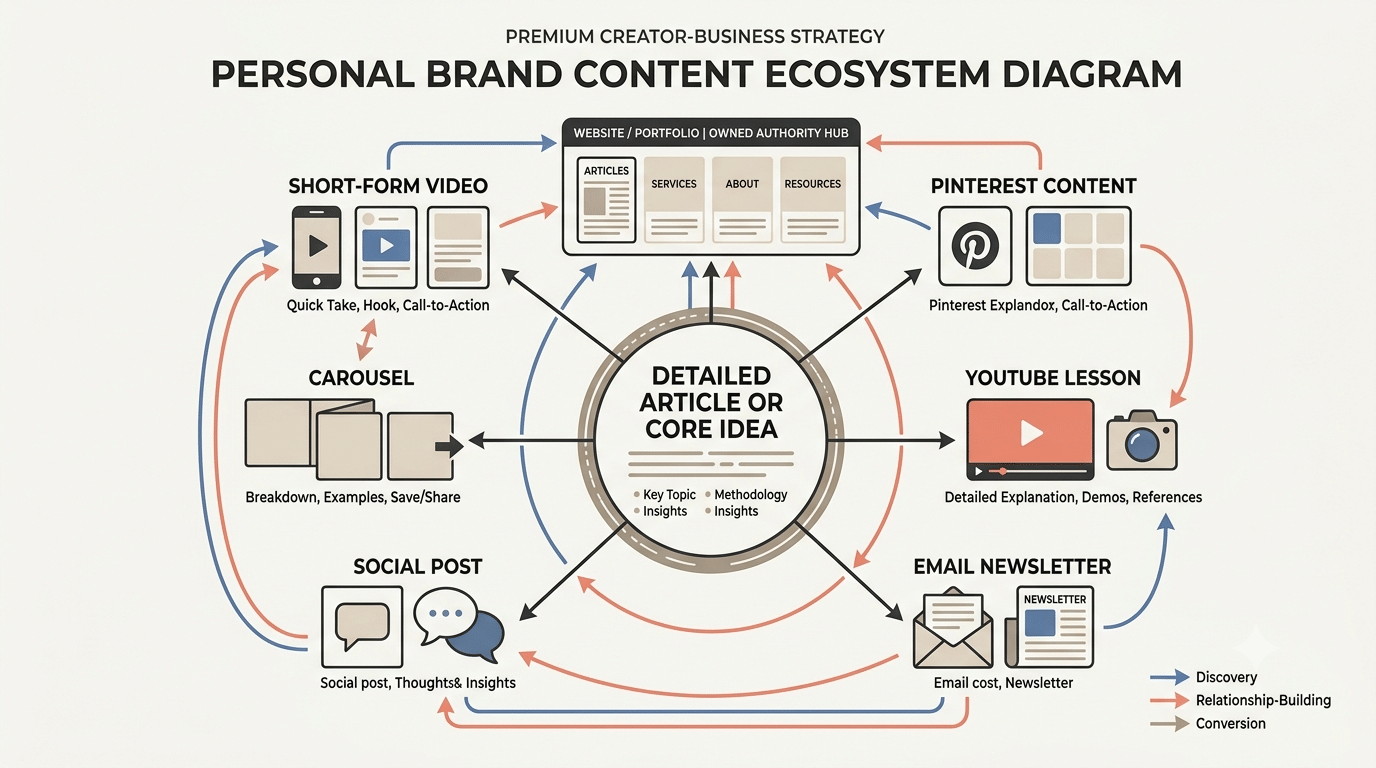
Your website can function as your owned authority hub.
A professional network can support networking, expertise, and professional visibility.
Instagram can support visual communication, storytelling, and relationship-building.
YouTube can support deeper educational content.
Email can create a direct relationship with your audience.
The specific platform matters less than whether the platform matches your audience and objective.
A common mistake is trying to maintain five or six platforms with completely different strategies.
Instead, build a central content system.
For example:
One detailed article
→ short-form video
→ carousel
→ social post
→ Pinterest content
The idea stays connected while the format changes.
Build a Personal Brand Home Base
Social media should not be the entire foundation of your personal brand.
A website gives you an owned space where people can understand your work without relying entirely on a platform’s feed.
A useful personal brand website might include:
Home
Who you are and what you are known for.
About
Your background, perspective, and approach.
Work / Portfolio
Evidence of your expertise.
Insights / Blog
Your ideas and educational content.
Services
What people can work with you on.
Resources
Useful tools, guides, or products.
Contact
A clear next step.
Your social profiles then become discovery and relationship channels that lead people toward this deeper environment.
Create a Consistent Personal Brand Identity
Your personal brand does not need an elaborate visual identity.
It does need consistency.
Your visual system might include:
- profile photography
- typography
- color palette
- graphic style
- image direction
- presentation style
- recurring layouts
But remember:
Personal branding is not personal identity design.
A beautiful profile can support your brand.
It cannot substitute for positioning.
If your content, expertise, and communication are unclear, changing your colors will not solve the problem.
Visual identity should make your existing positioning easier to recognize.
Develop a Consistent Brand Voice
Your personal brand should also have recognizable communication characteristics.
You might be:
- analytical
- direct
- thoughtful
- practical
- conversational
- educational
- provocative
- calm
- encouraging
You do not need to choose every characteristic.
Choose the qualities that genuinely reflect how you want to communicate.
Then make them visible in your writing and speaking.
Your personal brand voice should sound like you with greater intentionality, not like a corporate communications department.
For a deeper framework, see Brand Voice: A Complete Beginner’s Guide.
Build Credibility Through Proof
One of the weakest personal branding approaches is repeatedly saying:
“I am an expert.”
A stronger approach is showing the audience what your expertise looks like.
For example:
Instead of:
“I am a branding expert.”
Publish:
“Here is why this brand’s positioning is difficult to understand.”
Instead of:
“I know design.”
Show:
“Here is how I transformed an inconsistent visual identity into a coherent system.”
Instead of:
“I understand content.”
Explain:
“Here is what I changed in this content strategy and why.”
Proof makes expertise observable.
That makes your personal brand more credible.
Tell Stories, Not Just Lessons
Personal brands become more memorable when ideas are connected to experiences.
Instead of always publishing:
“Five things you should know about branding.”
You can tell the story behind a lesson.
For example:
“I used to think a strong visual identity could solve almost any branding problem. Then I worked through a project where the design was polished, but the business still couldn’t explain what made it different.”
The story creates context.
The lesson creates value.
The combination creates a more distinctive piece of content.
You do not need to reveal private information or manufacture dramatic stories.
Ordinary professional experiences can become useful educational stories when you explain what you learned from them.
Make Your Personal Brand Consistent Without Becoming Repetitive
Consistency does not mean saying exactly the same thing every day.
It means maintaining recognizable strategic signals.
Your:
Positioning should remain relatively stable.
Your:
Core themes should recur.
Your:
Voice should feel recognizable.
Your:
Visual identity should support recognition.
Your:
Quality standard should remain consistent.
But your examples, stories, formats, opinions, and applications can change.
Think of it as a framework rather than a script.
Avoid the Most Common Personal Branding Mistakes
Trying to Be Known for Everything
If your profile says:
Designer | Entrepreneur | Coach | Creator | Marketer | Strategist | Speaker | Writer
the audience may still have no idea what you actually do.
Breadth can be valuable.
But your public positioning needs a clear center.
Copying Someone Else's Personality
Studying successful creators can teach you about formats, storytelling, distribution, and content structure.
It should not turn you into a copy of them.
Your strongest advantage is usually the combination of experiences and perspectives that someone else cannot reproduce.
Confusing Followers With Authority
Audience size is one metric.
It is not the complete measure of a personal brand.
A smaller audience that consistently associates you with valuable expertise may be more strategically relevant than a large audience with no clear association.
Changing Your Positioning Every Week
One week you talk about branding.
The next week productivity.
Then entrepreneurship.
Then lifestyle.
Then AI.
Then motivation.
Eventually, the audience cannot determine what your expertise actually is.
You can evolve.
But give your audience enough consistency to understand the evolution.
Making Everything Promotional
If every post asks people to buy something, your personal brand becomes an advertising channel.
Educational content, perspective, stories, evidence, and useful resources should create value before the sales message appears.
Promotion works better when the audience already understands your expertise.
Chasing Trends That Do Not Fit
A trending topic can create visibility.
But if it has nothing to do with what you want to be known for, the attention may not strengthen your personal brand.
Before joining a trend, ask:
Does this help people understand my expertise?
If not, it may be better left alone.
Create a Simple Personal Branding System
You do not need an unnecessarily complicated content machine.
A practical system can work like this:
Strategy
Define your audience, positioning, expertise, point of view, and goals.
↓
Content
Choose three to five recurring themes.
↓
Proof
Show your work, experience, research, processes, and results where appropriate.
↓
Distribution
Publish through the platforms where your audience actually spends time.
↓
Relationship
Respond, communicate, collaborate, and build genuine professional connections.
↓
Conversion
Give interested people a clear path toward your service, product, newsletter, consultation, portfolio, or other relevant next step.
↓
Review
Look at what attracts the right audience and strengthens your desired reputation.
Then refine.
This is much more sustainable than trying to “go viral.”
How to Measure a Personal Brand
Do not rely exclusively on follower count.
Look at signals that connect to your actual objective.
If your goal is visibility, monitor relevant reach and discovery.
If your goal is authority, look at meaningful engagement, mentions, invitations, collaborations, and whether people increasingly associate you with your subject.
If your goal is business, track:
Qualified inquiries → conversations → opportunities → customers
If your goal is audience building, track:
Relevant visitors → subscribers → returning audience
The metric should follow the objective.
A personal brand is ultimately an asset, not a vanity dashboard.
A 90-Day Personal Branding Framework
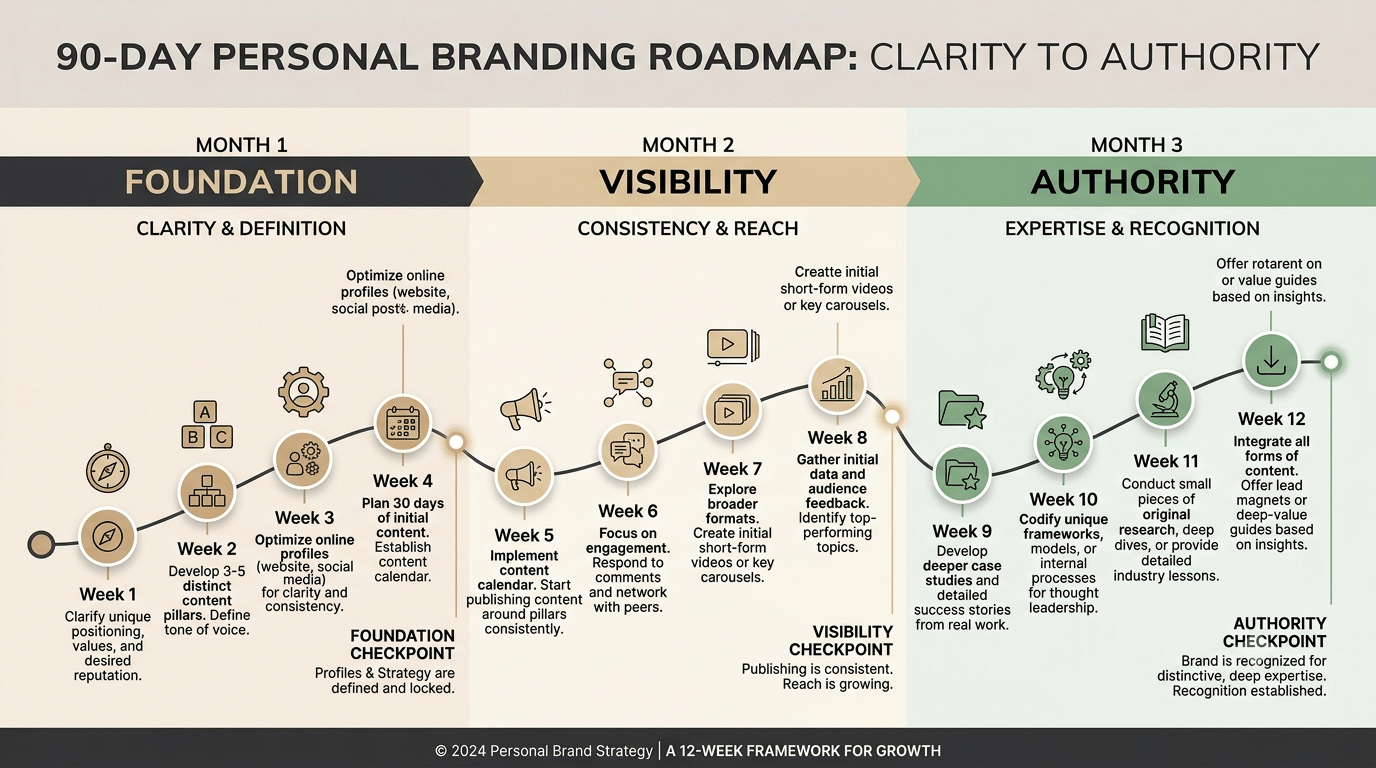
If you are starting from scratch, avoid trying to establish everything simultaneously.
Month 1: Foundation
Clarify:
Who you help → what you know → what you want to be known for → why it matters.
Then update your profiles and website so they communicate the same core positioning.
This is also a good point to complete a basic brand clarity exercise before creating large amounts of content.
Month 2: Visibility
Start publishing consistently around your core content pillars.
Focus on teaching, demonstrating, analyzing, and sharing your perspective.
Do not obsess over creating something completely original every day.
Instead, develop a recognizable body of work.
Month 3: Authority
Now increase the depth.
Publish:
Case studies
Detailed explanations
Original frameworks
Experiments
Research
Strong opinions supported by reasoning
Lessons from actual work
This is where your content can begin moving from simple visibility toward recognizable expertise.
Personal Branding Is a Long-Term Asset
A personal brand rarely becomes valuable because of one post.
It becomes valuable because hundreds of small signals accumulate.
Someone reads an article.
Then sees your video.
Then visits your website.
Then sees a case study.
Then receives your newsletter.
Then encounters your name in a recommendation.
Each interaction reinforces—or weakens—the association.
That is why consistency is so important.
You are not simply trying to create individual pieces of content.
You are building a body of evidence around your name.
Personal Branding and Business Branding Can Work Together
If you are a founder or freelancer, your personal brand and business brand do not necessarily need to compete.
They can perform different roles.
Your business brand can communicate the organization’s positioning, services, products, and experience.
Your personal brand can communicate the expertise, perspective, story, and human thinking behind the business.
For example, a design studio can have a strong company identity while its founder publishes personal insights about branding, design, creative business, or industry observations.
The two can reinforce each other without becoming identical.
This is particularly useful when the founder’s expertise is an important part of why clients trust the company.
Personal Branding Is Not About Becoming an Influencer
This distinction matters.
You can build a strong personal brand without:
- becoming a full-time creator
- posting every day
- making viral videos
- sharing your entire private life
- constantly talking about yourself
- chasing millions of followers
Personal branding is fundamentally about recognition and reputation.
You want the right people to understand:
who you are,
what you know,
what you stand for,
and
how you can help.
Everything else is a method of communicating those things.
Final Takeaway
A strong personal brand is not manufactured through aesthetics alone.
It is built through clarity, expertise, positioning, perspective, evidence, communication, and consistency.
Start by deciding what you want to be known for.
Then identify the audience for that expertise.
Develop a clear position.
Build content around a small number of meaningful themes.
Show evidence of your knowledge.
Develop a recognizable voice and visual identity.
Choose platforms based on your actual goals.
And give people a clear next step when they want to work with you, learn from you, or stay connected.
Most importantly, do not try to become a copy of someone who is already successful.
Your strongest personal brand is usually found at the intersection of what you know, what you care about, what you have experienced, and what your audience genuinely needs.
That combination is difficult to copy—and that is precisely what makes it valuable.
Frequently Asked Questions
What is personal branding?
Personal branding is the intentional process of communicating and shaping how people understand and remember your expertise, values, personality, work, and professional reputation.
How do I start building a personal brand?
Start with your goal, audience, expertise, positioning, and point of view. Once those are clear, create consistent content that demonstrates your knowledge and communicates the association you want people to develop with your name.
What should a personal brand focus on?
A personal brand should focus on a specific area of expertise or value rather than trying to communicate everything about a person. The focus should be broad enough to sustain your work but specific enough for people to understand what you are known for.
Do I need a personal website?
A website is not mandatory, but it can provide an owned home for your professional identity, portfolio, articles, resources, services, and contact information. Social platforms can then function as discovery and distribution channels.
How often should I post for personal branding?
There is no universal posting frequency that guarantees results. A sustainable publishing schedule is more useful than an aggressive schedule you cannot maintain. The priority should be consistent, useful, relevant content.
How long does it take to build a personal brand?
There is no fixed timeline. Recognition generally develops through repeated exposure and consistent evidence of expertise. The objective should be to build a durable body of work rather than expecting a personal brand to develop from a single campaign or viral post.
Is personal branding only for influencers?
No. Personal branding can be useful for freelancers, founders, consultants, designers, professionals, educators, creators, and others whose expertise or reputation contributes to their opportunities. You do not need to become an influencer to build professional recognition.
What is the difference between personal branding and business branding?
Business branding focuses on how an organization, product, or company is perceived. Personal branding focuses on the perception and reputation associated with an individual. A founder can use both strategically, with the personal brand communicating individual expertise and the business brand communicating the organization’s broader value.
Can I build a personal brand without showing my personal life?
Yes. Personal branding does not require sharing private information. You can build recognition through expertise, education, professional experiences, case studies, opinions, research, and useful content while maintaining clear personal boundaries.
What is the biggest personal branding mistake?
Trying to be known for everything is one of the most common strategic problems. When the audience cannot identify what you are particularly good at or why your perspective matters, it becomes harder to build a strong association with your name.
How do I make my personal brand different?
Start with your positioning and point of view rather than your colors or logo. Identify a specific audience, problem, perspective, approach, or combination of expertise that you can credibly own and demonstrate through your work.