

AI can help you build a brand strategy faster.
It can summarize customer research, identify patterns in competitor messaging, generate positioning options, analyze your existing content, develop messaging variations, and help you explore creative directions.
But there is a problem.
If you ask AI to create your brand without giving it a clear strategic foundation, you can end up with something that sounds polished but feels interchangeable.
The words may be professional. The visuals may look impressive. The messaging may be grammatically perfect.
Yet nothing about the brand feels particularly yours.
That is why AI brand strategy is not about replacing strategic thinking with artificial intelligence. It is about using AI as a strategic assistant while keeping human judgment at the center of the brand.
In this guide, you will learn what AI brand strategy actually means, where AI can help, where it should not make the final decision, how to build an AI-assisted brand strategy workflow, and how to use AI without turning your brand into another generic template.
What You'll Learn
ToggleWhat Is AI Brand Strategy?
AI brand strategy is the use of artificial intelligence to support the research, analysis, development, testing, and management of a brand strategy.
Traditional brand strategy often involves researching customers, studying competitors, defining positioning, developing values, establishing messaging, and creating a consistent brand voice.
AI can assist with many of those activities.
For example, instead of manually reviewing dozens of customer comments, you can use an AI system to organize recurring themes. Instead of reading every competitor’s homepage and manually comparing their messaging, AI can help structure the information into comparable categories.
But there is an important distinction:
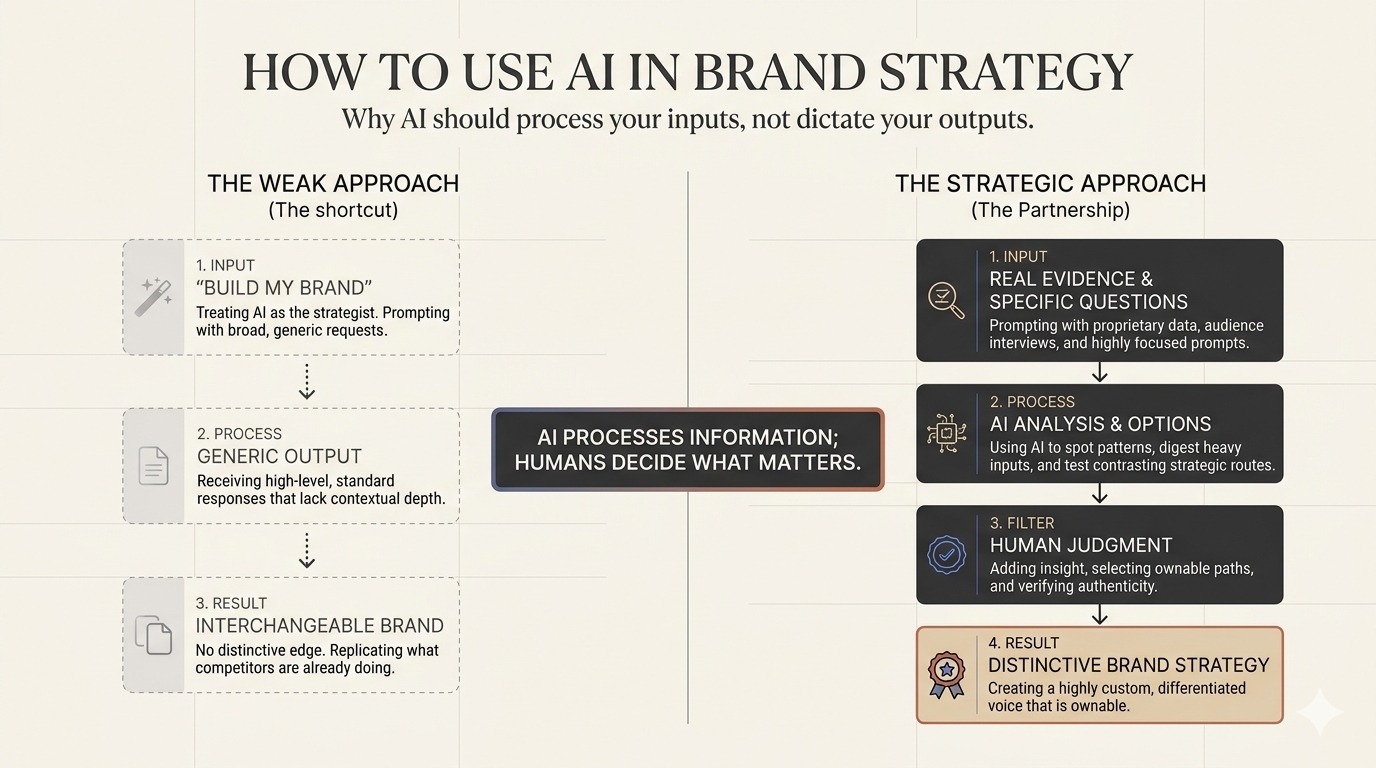
AI can process information and generate possibilities. Your brand still needs human judgment to decide what matters.
That distinction becomes especially important when defining your positioning, purpose, values, differentiation, and personality.
If you are unfamiliar with the strategic foundation behind this process, start with What Is Brand Strategy? A Beginner’s Guide and then explore the Brand Positioning Guide 2026.
Why AI Is Changing Brand Strategy
Brand strategy has always involved large amounts of information.
You need to understand:
- customers
- competitors
- market language
- customer problems
- perceptions
- category expectations
- business strengths
- messaging
- visual communication
- content
AI makes it easier to work with that information.
The significant change is not simply that AI can generate text or images. It can increasingly function as an interface for research, analysis, synthesis, ideation, and structured workflows.
That makes AI particularly useful during the analysis and exploration stages of branding.
For example, imagine that you have collected 100 customer reviews.
The strategic question is not simply:
“What do customers say?”
It is:
“What recurring frustrations, expectations, motivations, and language patterns appear across these customers?”
AI can help you organize that information.
But you still need to determine whether a particular pattern is strategically important.
That human interpretation is where the brand strategy begins.
What Can AI Actually Do for Brand Strategy?
AI is most useful when you give it a specific strategic task rather than asking it to “build my brand.”
Think of AI as a junior strategist with extremely fast processing capabilities but without your complete business context.
You provide the information.
AI helps organize and challenge it.
You make the strategic decision.
This approach creates a much stronger workflow.
AI for Audience Research
One of the first applications is audience research.
You can provide AI with customer interviews, survey responses, reviews, support conversations, comments, or other research material and ask it to identify patterns.
For example:
“Analyze these customer responses and identify recurring problems, desired outcomes, objections, emotional concerns, and phrases customers repeatedly use.”
This can help you move from vague assumptions about your audience toward observable patterns.
However, AI should not be treated as a replacement for actual customer research.
If you have never spoken to your customers, an AI-generated customer profile can easily become a sophisticated guess.
Your existing Ideal Customer Profile Guide 2026 can help establish the research foundation before using AI to analyze it.
AI for Competitor Research
AI can also help organize competitive research.
You might collect information about several competitors and compare:
- their positioning
- target audiences
- promises
- services
- language
- visual direction
- content themes
- pricing structure
- differentiation claims
The goal is not to copy what competitors are doing.
It is to understand the territory they already occupy.
For example, suppose five design studios all describe themselves as:
“creative solutions for growing businesses.”
That language tells you something.
It may indicate that the category is crowded with broad, interchangeable positioning.
Your strategic opportunity may therefore involve becoming more specific.
AI can help reveal patterns like this much faster than manually comparing large amounts of information.
But remember: competitor analysis tells you what exists. It does not automatically tell you what your brand should become.
AI for Brand Positioning
Positioning is one of the areas where AI can be extremely useful—and extremely dangerous.
You can ask AI to generate several positioning directions based on your:
- audience
- category
- strengths
- competitors
- customer problems
- differentiation
- business model
For example:
“Based on this customer research and competitor analysis, generate five possible positioning territories. For each territory, explain the audience, problem, differentiation opportunity, potential weakness, and evidence needed to validate it.”
That is much more useful than:
“Create my brand positioning.”
The first prompt creates strategic options.
The second asks AI to make a strategic decision with insufficient context.
Once AI generates several possibilities, you can evaluate them against your actual business.
Ask:
Is this genuinely different?
Can we credibly own this position?
Does our audience care about it?
Can we consistently deliver on it?
Does it support the business model?
This is where human judgment remains essential.
AI for Brand Values
AI can also help identify potential values from existing business behavior.
Instead of asking:
“Give me 10 brand values.”
which usually produces predictable words such as innovation, integrity, excellence, and customer-centricity,
give AI evidence.
For example:
“Here are 15 decisions this company has made over the last year. Identify the principles that appear repeatedly and group similar principles together. Do not invent values that are not supported by the evidence.”
Now AI is analyzing behavior rather than producing a generic list.
That difference matters.
A strong brand value should influence decisions.
If a value never changes what you do, it may simply be a nice word on a brand document.
For a deeper process, see How to Define Brand Values Step by Step.
AI for Brand Voice
Brand voice is another area where AI becomes useful once the strategic foundation already exists.
Suppose you have 20 pieces of your strongest existing content.
You can ask AI to analyze them for:
- sentence length
- vocabulary
- formality
- directness
- emotional intensity
- recurring expressions
- use of technical language
- use of questions
- storytelling patterns
You can then convert those observations into a practical voice system.
For example:
Brand characteristic: Strategic
Means: We explain the reasoning behind recommendations.
Does not mean: We use complicated industry language to sound intelligent.
Brand characteristic: Practical
Means: We connect ideas to real decisions and actions.
Does not mean: We reduce everything to simplistic checklists.
This produces a much more usable brand voice guide than simply writing:
“Our brand is professional, friendly, and confident.”
Your Brand Voice Guide goes deeper into this process.
AI for Brand Messaging
Once positioning and voice are established, AI can accelerate message development.
You can use the same strategic foundation to create different versions of a message for:
- website headlines
- landing pages
- social media
- product descriptions
- advertisements
- sales pages
- educational content
The important principle is:
Change the expression, not the underlying strategy.
Your homepage, Instagram caption, product page, and email should not sound identical.
But they should communicate the same fundamental brand idea.
AI is particularly useful here because it can adapt an established message to different formats without requiring you to reinvent the strategy each time.
AI for Brand Identity and Creative Direction
AI can also support the visual side of branding.
It can help explore:
- mood directions
- art direction
- visual references
- composition ideas
- photography concepts
- campaign concepts
- packaging directions
- layout possibilities
- creative territories
However, there is an important distinction between visual exploration and final brand identity design.
Generating 50 attractive images does not create a brand identity.
A brand identity needs a system.
That system includes decisions about typography, color, composition, imagery, graphic elements, spacing, layout, logo usage, and visual consistency.
AI can help explore possibilities.
A designer or brand strategist still needs to determine whether those possibilities create a coherent and usable system.
The AI Brand Strategy Workflow
A practical AI-assisted branding process can be built around ten stages.
1. Gather the Brand Inputs
Start with your real business information.
Collect your current:
- website copy
- customer research
- offers
- customer reviews
- sales conversations
- existing content
- competitor research
- brand documents
- performance data
Do not start with a blank AI chat and ask it to invent your business.
The quality of the strategy depends heavily on the quality of the inputs.
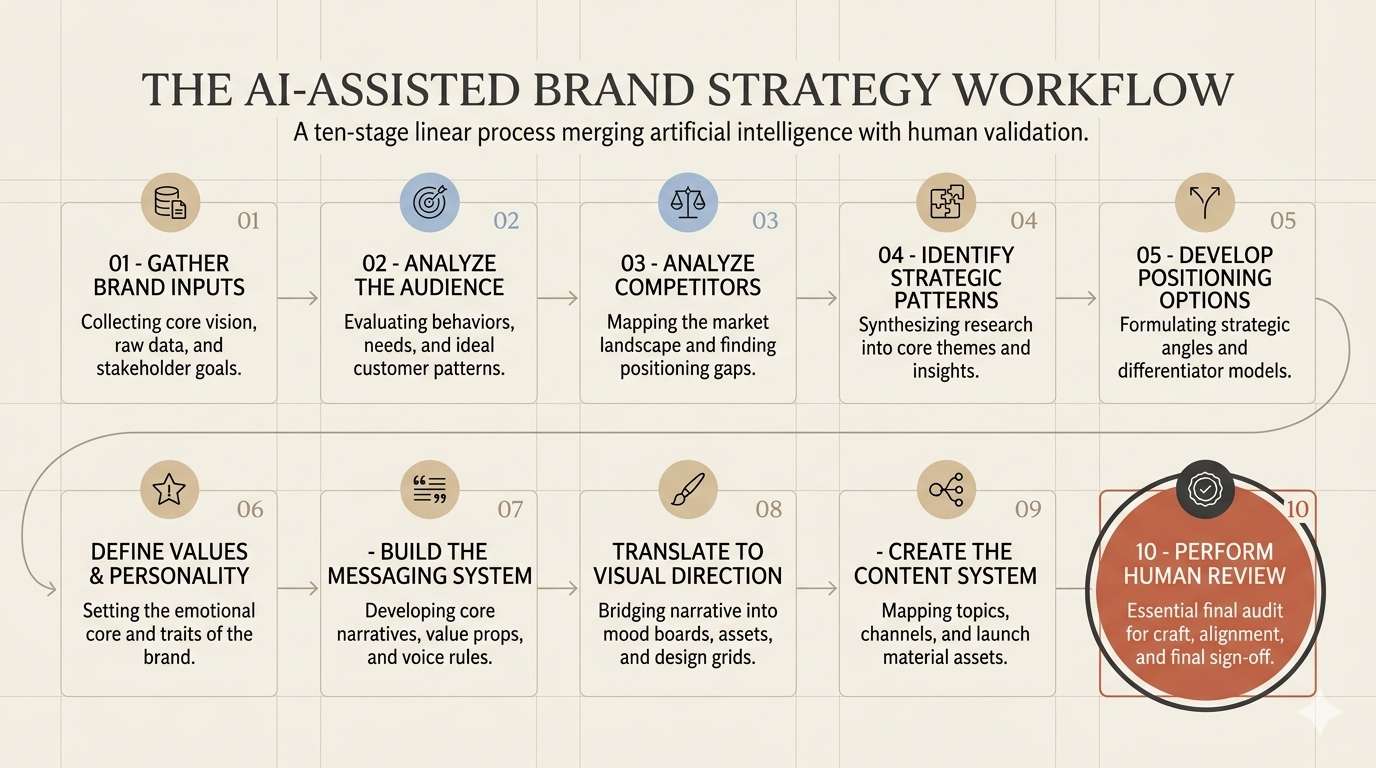
2. Analyze the Audience
Feed your research into AI and ask it to identify recurring patterns.
Look for:
Problems → motivations → objections → desired outcomes → language
The output should become a research aid, not a fictional customer story.
3. Analyze the Competitive Landscape
Organize competitor information into a common framework.
Then ask AI to identify similarities and differences.
One particularly useful question is:
“Where does this category sound interchangeable?”
That question can reveal opportunities for differentiation.
4. Identify Strategic Patterns
Now combine the audience and competitor research.
Look for gaps between:
What customers want
and
What competitors emphasize.
Those gaps can become potential strategic opportunities.
They still need validation.
5. Develop Positioning Options
Generate several possible positioning territories instead of immediately accepting the first answer.
Then test them against:
- relevance
- differentiation
- credibility
- business fit
- customer value
- long-term potential
Your positioning should emerge from evidence and strategic judgment—not from whichever sentence sounds most impressive.
6. Define Values and Personality
Once the strategic direction is clearer, define the principles and personality characteristics that should guide the brand.
This gives AI better boundaries when helping with messaging.
Instead of:
“Write a professional caption.”
you can provide:
“Write a concise caption using our strategic, practical, direct brand voice. Avoid hype, exaggerated promises, generic motivational language, and unnecessary jargon.”
The second instruction gives AI a much stronger strategic context.
7. Build the Messaging System
Create your core message first.
Then derive:
Position → promise → proof → supporting messages → channel-specific expressions
This prevents content from becoming disconnected from the brand strategy.
8. Translate Strategy Into Visual Direction
Use AI to explore visual territories that reflect the positioning and personality.
For example, a premium strategic consultancy may require a completely different visual language from an energetic creator brand.
The visual direction should therefore follow the strategy.
It should not be selected simply because an AI-generated image looks attractive.
9. Create the Content System
Once the strategy is established, AI becomes extremely useful for production.
You can create systems for:
- article ideation
- social content
- email campaigns
- content repurposing
- headline variations
- product messaging
- campaign concepts
This is where the efficiency advantage becomes significant.
Instead of asking AI to invent your brand repeatedly, you give it an established system and ask it to operate within that system.
10. Perform Human Review
This final stage is not optional.
Before publishing or implementing an AI-assisted brand decision, ask:
Is it true?
Is it distinctive?
Does it sound like us?
Is it supported by evidence?
Would our customer recognize the value?
Does it reinforce our positioning?
Does it create unnecessary risk?
If the answer is no, revise it.
A Practical AI Brand Strategy Prompt
Instead of asking AI to “build a brand,” use a structured prompt.
Brand Strategy Analysis Prompt
Role: Act as a brand strategy analyst, not a brand decision-maker.
Business: [describe business]
Audience: [describe audience]
Offer: [describe offer]
Customer research: [insert research]
Competitor information: [insert research]
Existing positioning: [insert current positioning]
Analyze the information and identify:
- recurring customer problems
- customer motivations
- customer objections
- competitor similarities
- potential differentiation opportunities
- positioning territories worth exploring
- assumptions that require validation
- contradictions or weaknesses in the current strategy
Do not invent customer insights that are not supported by the supplied information. Clearly distinguish evidence from interpretation.
The last instruction is particularly important.
You want AI to help you think better, not manufacture certainty.
A Simple Example: Using AI to Position a Small Design Studio
Imagine a fictional studio called Northline Studio.
Its original description is:
“We provide creative design solutions for businesses.”
There is nothing technically wrong with the sentence.
But it could describe thousands of studios.
Northline feeds its customer research and competitor research into an AI system.
The analysis reveals that its strongest clients are not simply looking for attractive graphics.
They are struggling with inconsistent branding across websites, social media, presentations, and sales materials.
That insight creates a potential strategic direction:
Northline could position itself around helping growing service businesses turn inconsistent visual communication into a coherent brand system.
Notice what AI did.
It did not magically discover the perfect positioning.
It helped organize evidence that allowed the strategist to see a stronger opportunity.
That is the right relationship between AI and brand strategy.
What AI Should Not Decide for Your Brand
There are some decisions you should be particularly careful about delegating.
Your Purpose
AI can help you articulate your purpose.
It should not invent one for you.
Purpose comes from the relationship between what your business exists to do, why that matters, and the value you intend to create.
Your Core Values
AI can identify patterns in your behavior.
But your business must decide which principles it is actually willing to protect when making difficult decisions.
Your Differentiation
AI can identify possible gaps.
But differentiation requires evidence.
If every competitor can make the same claim, it is not necessarily differentiation.
Your Positioning
AI can generate positioning options.
Your business needs to choose and validate the strategic direction.
Your Brand Personality
AI can analyze language and suggest characteristics.
But your brand personality should reflect how you genuinely want the business to communicate.
Your Final Visual Identity
AI can generate visual exploration.
A usable identity requires strategic and design judgment, consistency, technical implementation, and a system that works across real-world applications.
The Biggest Risks of AI Branding
AI makes branding faster, but faster does not automatically mean better.
Generic Brand Outputs
The most common problem is sameness.
If you give AI generic instructions, you will often receive generic language.
Words such as:
innovative, authentic, empowering, transformative, seamless
can appear everywhere.
The solution is not simply to ask AI to “be more creative.”
Give it better evidence and stronger strategic constraints.
Trend-Chasing
AI systems can make current trends extremely easy to reproduce.
That creates another problem.
A brand can become visually or verbally fashionable without becoming distinctive.
Ask:
“Does this strengthen our brand or simply make us look current?”
Those are not the same thing.
Hallucinated Research
AI can produce confident statements that are not supported by evidence.
This is particularly dangerous in market research.
Whenever a strategic decision depends on a factual claim, verify the underlying evidence.
AI-generated assumptions should never automatically become brand strategy.
Over-Automation
When every caption, image, email, headline, and campaign is generated by the same process, the brand can gradually lose its human perspective.
AI should increase your creative capacity.
It should not eliminate your point of view.
Privacy and Confidentiality
Be careful when giving AI systems access to customer information, confidential business information, unreleased products, contracts, proprietary research, or sensitive client material.
Data policies differ between products and plans.
For example, OpenAI states that data from ChatGPT Business, Enterprise, Edu, and its API platform is not used to train models by default, while individual services have different data-use controls.
That means you should check the current terms and privacy controls of the specific AI tool and plan you are using before uploading sensitive information.
AI Branding Does Not Mean AI Should Become Your Brand
This is perhaps the most important principle in this entire guide.
Your customers do not need to know that your brand was built with AI.
They need to understand:
Who you are.
What you stand for.
Who you help.
Why you are different.
Why they should trust you.
AI is infrastructure.
Your brand is the meaning built around your business.
The strongest AI-assisted brands will therefore not necessarily be the ones using the most AI.
They will be the ones using AI without losing their strategic point of view.
AI and SEO: Do Not Turn Your Blog Into a Content Factory
This matters particularly if you are using AI to support your brand’s content strategy.
Google’s current guidance does not treat AI use itself as the problem. Its emphasis is on useful, original, people-first content and warns against using generative AI to produce large amounts of pages without adding value.
Google also published a 2026 resource specifically addressing optimization for generative AI features in Search, emphasizing valuable, unique content and noting that traditional SEO fundamentals remain important.
For a brand website, this means AI should help with:
Research → organization → analysis → ideation → editing → optimization
rather than:
Prompt → publish → repeat 500 times.
Your experience, examples, observations, frameworks, original research, and strategic interpretation are what make AI-assisted content valuable.
That is also what makes the content more defensible as a brand asset.
A Better AI Branding System
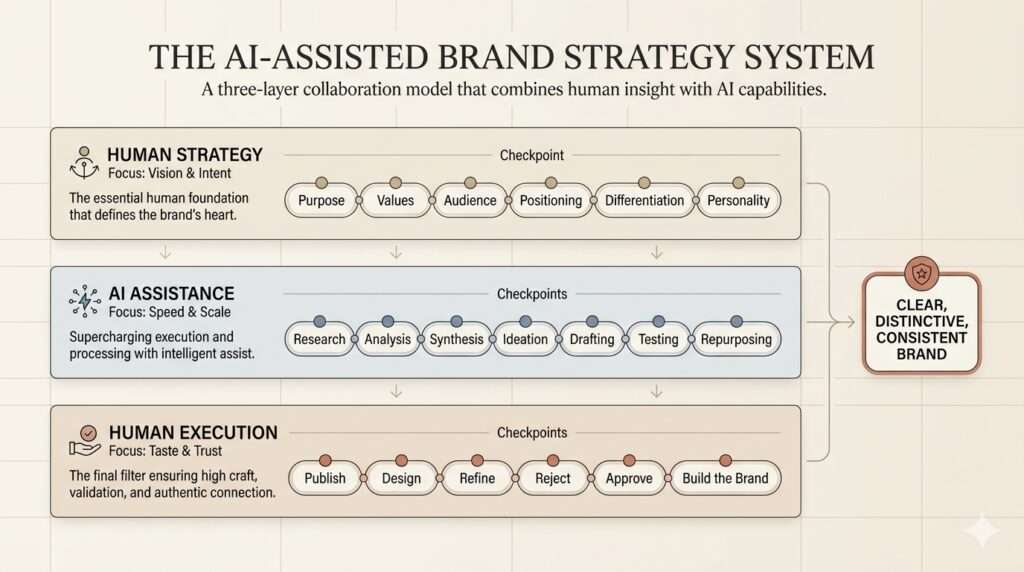
Think of your brand as having three layers.
Layer 1: Human Strategy
This includes:
Purpose → values → audience → positioning → differentiation → personality
These decisions require business context and judgment.
Layer 2: AI Assistance
AI can support:
Research → analysis → synthesis → ideation → drafting → testing → repurposing
This is where efficiency increases.
Layer 3: Human Execution
Your team decides:
What gets published → what gets designed → what gets changed → what gets rejected → what becomes part of the brand
This final layer protects the brand from becoming generic.
The system is therefore not:
Human vs AI.
It is:
Human strategy + AI assistance + human judgment.
How to Know If Your AI-Assisted Brand Strategy Is Working
Do not evaluate the strategy by how impressive the AI output looks.
Evaluate the brand itself.
Can your team explain the brand consistently?
Can customers understand what you offer?
Does your positioning distinguish you from competitors?
Does your messaging reinforce the same central idea?
Can your visual identity support that positioning?
Can you create content without constantly reinventing your message?
Most importantly, does the strategy help you make decisions?
A good brand strategy should make some decisions easier.
It should tell you what fits—and what does not.
The Future of AI Brand Strategy
AI will continue to become more capable at research, analysis, generation, automation, and personalization.
That means the competitive advantage will gradually move away from simply having access to AI tools.
Access is becoming easier.
The more valuable capability is knowing what to ask, what information to provide, what to reject, and what strategic decisions require human judgment.
The brands that benefit most from AI will not necessarily automate everything.
They will build better systems for combining technology with clear strategic thinking.
That distinction matters because AI can increase the speed of production dramatically.
But speed without direction simply produces more content, more designs, and more messages.
A clear strategy gives that speed somewhere useful to go.
Final Takeaway
AI can become a powerful part of modern brand strategy.
Use it to analyze research, identify patterns, explore positioning, refine messaging, examine brand voice, develop creative directions, and accelerate content production.
But do not ask it to become the owner of your brand.
Your strategy should come first.
Your evidence should guide the process.
AI should expand your ability to analyze and create.
And human judgment should decide what becomes part of the brand.
The goal of AI brand strategy is not to make your brand look more like everyone else, faster.
It is to use technology to build, express, and manage a brand with greater clarity and consistency—while preserving the perspective that makes the brand yours.
Frequently Asked Questions
What is AI brand strategy?
AI brand strategy is the use of artificial intelligence to support brand research, analysis, positioning, messaging, voice development, creative exploration, and brand management. AI assists the process, while strategic decisions remain under human control.
Can AI create a complete brand strategy?
AI can help develop a brand strategy, but it should not be treated as an independent strategist. It can analyze information and generate options, but the business still needs to validate research, choose positioning, establish differentiation, and make strategic decisions.
How can AI help with brand positioning?
AI can analyze audience research and competitor information, identify patterns, generate possible positioning territories, compare strategic options, and help develop positioning statements. The final position should be selected and validated using real business and customer evidence.
Can AI create a brand voice?
Yes. AI can analyze existing content and help identify vocabulary, sentence structure, tone, personality characteristics, and recurring communication patterns. It can then help apply those rules consistently across different channels.
Can AI replace a brand strategist?
AI can automate or accelerate parts of strategic work, but brand strategy still requires business context, judgment, interpretation, differentiation, and decision-making. AI is better treated as a strategic tool than as the final decision-maker.
Is AI-generated branding bad for SEO?
Not inherently. Google’s guidance focuses on the quality, originality, helpfulness, and purpose of content rather than simply whether AI was involved. Using AI primarily to mass-produce low-value pages or manipulate search rankings can violate Google’s spam policies.
Should I use AI to create my brand identity?
AI can be useful for exploring visual directions and creative concepts. However, a complete brand identity requires a coherent design system and strategic decisions about how the brand should look and behave across real-world applications.
What is the biggest mistake when using AI for branding?
The biggest practical mistake is treating AI-generated output as strategy. AI can produce polished language and attractive concepts very quickly, but polish does not automatically create differentiation, relevance, or credibility.
1 Comment
[…] For a deeper look at the relationship between AI and branding strategy, see AI Brand Strategy Guide 2026. […]