Think about the last time you saw a familiar color combination, logo, packaging style, advertisement, or visual layout and immediately knew which company it belonged to.
You may not have stopped to analyze the design.
You simply recognized it.
That reaction is one of the outcomes businesses are trying to create through brand recognition.
Brand recognition is not about making a logo visually attractive or publishing as much content as possible. It is about building a collection of distinctive and consistent signals that allow people to identify your brand when they encounter it.
For a startup or small business, this can become especially important as the brand appears across more places: websites, social media, search results, advertisements, emails, packaging, presentations, products, and customer conversations.
The challenge is that recognition does not usually come from one isolated branding decision.
It develops through repeated exposure to a coherent brand.
This guide explains what brand recognition is, how it differs from brand awareness, what makes a brand recognizable, and how you can build a stronger recognition system through strategy, visual identity, messaging, consistency, and customer experience.
What You'll Learn
ToggleWhat Is Brand Recognition?
Brand recognition is the ability of people to identify a brand when they encounter recognizable brand-related cues.
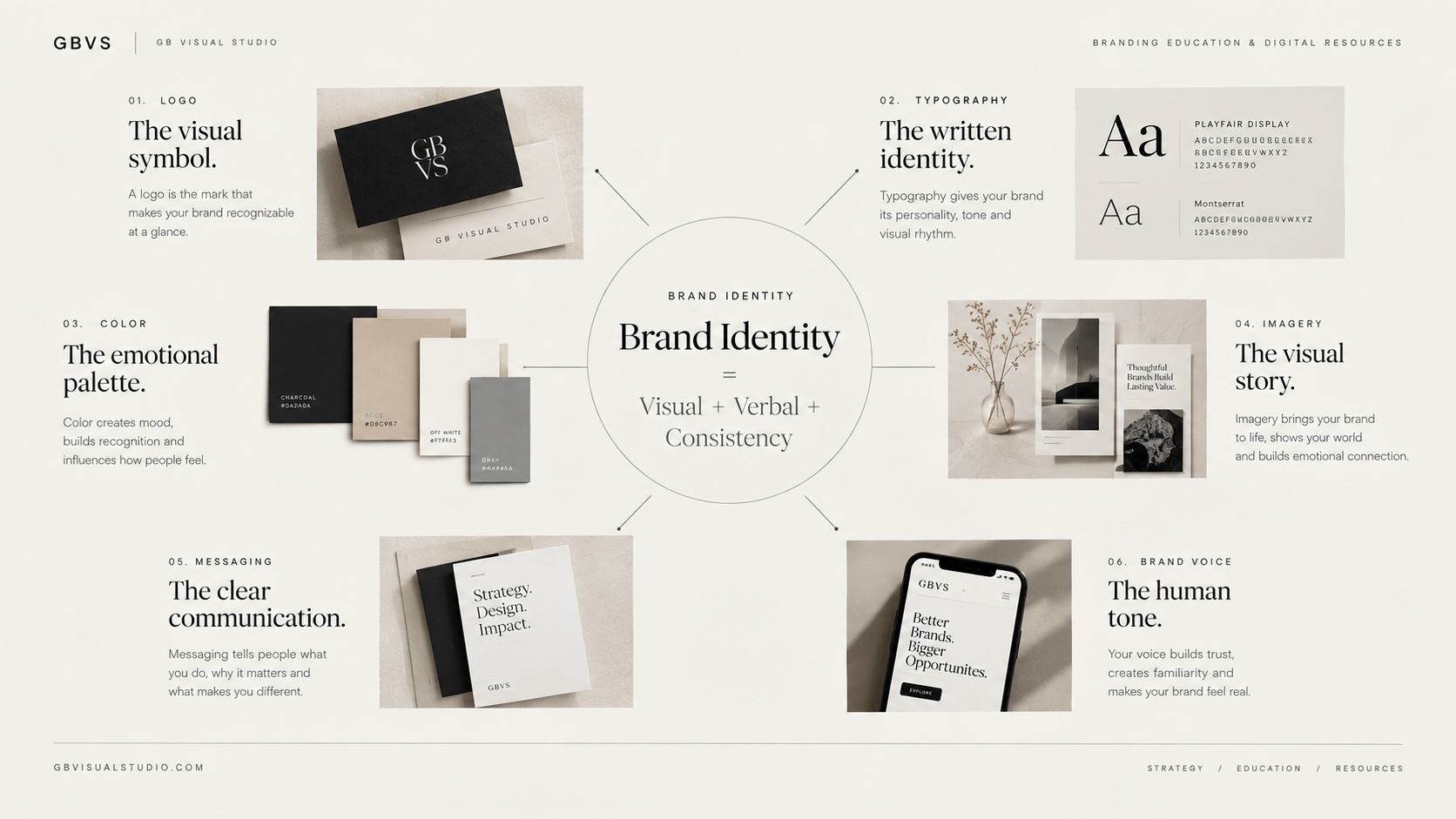
Those cues can include:
- a logo
- colors
- typography
- packaging
- photography
- visual patterns
- product design
- brand voice
- slogans or phrases
- distinctive experiences
The important point is that recognition does not always require someone to see the company name.
For example, someone might recognize a brand from its packaging before reading the label. Someone might recognize a company’s social post from its visual system before seeing the account name.
This is why brand recognition is closely connected to the broader brand identity system.
A recognizable brand gives people multiple opportunities to connect an experience with the same underlying business.
Brand Recognition vs Brand Awareness
Brand recognition and brand awareness are related, but they are not identical.
Brand awareness is the broader concept of whether people know that a brand exists and have some level of familiarity with it.
Brand recognition is more specifically about whether people can identify the brand from recognizable cues.
Consider two hypothetical businesses.
People may have heard of Company A but struggle to identify its logo, visual style, or communication.
Company B may have fewer overall mentions, but its customers immediately recognize its distinctive visual and verbal cues.
Both have awareness.
Company B has stronger recognition among the people who encounter its brand signals.
There is another related concept: brand recall.
Recognition generally involves identifying a brand when a cue is presented.
Recall involves retrieving the brand from memory without necessarily being shown the cue.
For example:
Recognition: “I have seen this logo before. That’s Brand X.”
Recall: “I need running shoes. Which brands come to mind?”
These concepts overlap, but they represent different parts of how people remember brands.
Why Brand Recognition Matters
Recognition reduces the amount of mental work required to identify a familiar brand.
Imagine seeing ten social media posts from ten different businesses.
If nine use generic layouts, stock photography, interchangeable fonts, and similar messaging, they can become difficult to distinguish.
A recognizable brand creates stronger associations.
Over time, people can begin connecting particular visual and verbal signals with a particular company.
This can support several areas of the business.
Recognition can improve consistency
When a company has defined recognizable brand assets, teams have clearer guidance about how the brand should appear.
This can make content creation more coherent.
Recognition can strengthen familiarity
Repeated exposure to consistent brand signals can make a business feel more familiar to its audience.
Familiarity does not guarantee purchase, but it can make the brand easier to identify when the relevant buying situation arises.
Recognition can support differentiation
Distinctive brand assets can help a company stand apart from competitors.
This becomes particularly valuable in categories where many companies use similar claims and visual conventions.
Recognition can create continuity across channels
A customer may encounter the same brand through Google, Instagram, a website, an email, a product, and customer support.
A coherent identity connects those separate encounters.
What Makes a Brand Recognizable?
A recognizable brand usually does not depend on a single element.
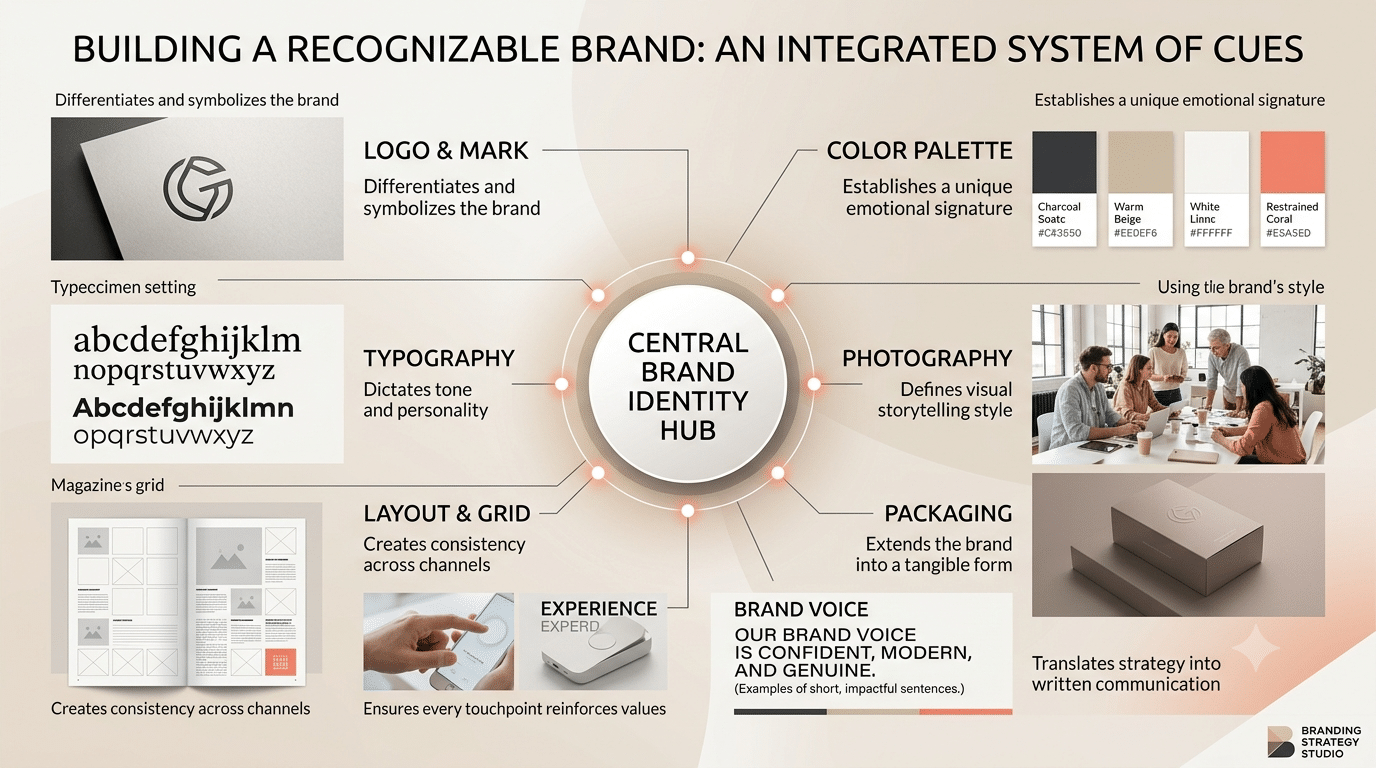
It develops from a system of associated cues.
Think of your brand as a collection of signals.
Your logo is one signal.
Your color palette is another.
Your typography is another.
Your photography, layouts, language, packaging, product experience, and distinctive ideas can become additional signals.
The more consistently those signals are used—and the more distinctive they are—the easier it becomes for people to connect them with the same brand.
But there is an important balance.
A brand should be consistent without becoming repetitive and distinctive without becoming confusing.
1. Start With Clear Brand Positioning
Recognition becomes much easier when the brand itself has a clear meaning.
If you are trying to make everyone your audience, your communication may become generic.
If you do not know what your business wants to be known for, your content may change direction constantly.
If your positioning is unclear, visual consistency alone cannot fully solve the problem.
Start with:
Who is the brand for?
What does it offer?
What problem does it solve?
What makes its approach different?
What should people associate with it?
Your Brand Positioning Guide 2026 provides a deeper framework for this stage.
Recognition should reinforce positioning.
If your positioning says one thing while your visual identity communicates something completely different, people receive mixed signals.
2. Build a Distinctive Visual Identity
Visual identity is one of the most obvious contributors to recognition.
But a recognizable visual identity is more than a logo.
It can include:
Logo system: primary logo, alternate versions, icon, and appropriate responsive applications.
Color system: primary and supporting colors used consistently.
Typography: defined typefaces and hierarchy.
Imagery: a recognizable photography, illustration, or image treatment.
Graphic language: shapes, patterns, lines, textures, framing devices, or other visual elements.
Layout: consistent principles for spacing, composition, hierarchy, and information presentation.
This creates a visual language.
Someone should be able to encounter different pieces of your content and still recognize that they belong to the same brand.
That is one reason a strong brand identity should be designed as a system rather than a collection of isolated assets.
3. Choose Distinctive Brand Colors
Color can become an important recognition cue.
But choosing a color simply because you like it is not enough.
The color needs to work within the overall positioning and identity.
Suppose every competitor in a category uses the same blue.
Using another shade of blue may technically create a different palette, but it may not create meaningful visual distinction.
At the same time, choosing an unusual color purely to stand out can create problems if it conflicts with the brand’s personality or audience expectations.
The goal is not simply:
“Use a unique color.”
It is:
“Build a distinctive color system that works consistently and supports the brand’s intended meaning.”
For a deeper look at strategic color decisions, see Color Psychology in Brand Guidelines.
4. Develop Consistent Typography
Typography is often overlooked because people tend to notice logos and colors first.
But typography can become one of the quietest recognition mechanisms in a brand.
A consistent type system creates continuity across:
- websites
- social media
- presentations
- documents
- advertisements
- packaging
- digital products
You do not need an unusual font.
You need a deliberate system.
Define which typefaces are used for headings, body text, captions, labels, buttons, and other recurring applications.
Then use them consistently.
5. Create a Recognizable Content Style
Your content should not look like it was created independently every time.
Imagine a brand publishing:
- one minimalist carousel
- one colorful meme
- one corporate stock-photo post
- one heavily animated graphic
- one luxury editorial post
- one completely different template
Every post may be individually attractive.
Together, they may not communicate one recognizable brand.
A better approach is to establish repeatable content principles.
For example, your brand might consistently use a particular composition, typography hierarchy, photography style, amount of whitespace, illustration treatment, or editorial approach.
The objective is not to make every post identical.
It is to make different content feel related.
6. Build a Consistent Brand Voice
Recognition is not purely visual.
People can recognize brands through language as well.
Think about how your brand communicates.
Is it:
- concise or detailed?
- formal or conversational?
- analytical or emotional?
- playful or serious?
- direct or descriptive?
- instructional or inspirational?
Your voice should reflect the brand’s personality and audience.
Then establish practical rules around vocabulary, sentence structure, tone, and recurring language patterns.
A strong Brand Voice makes communication more recognizable even when visual elements are absent.
For example, an email from your company should feel like the same brand as a caption from your Instagram account.
7. Develop Distinctive Brand Assets
One of the strongest ways to build recognition is to develop assets that people can associate specifically with your brand.
These might include:
- a distinctive graphic shape
- a recurring illustration style
- a recognizable photography treatment
- a specific packaging structure
- a proprietary visual pattern
- a recognizable icon system
- a distinctive content format
- recurring language or naming conventions
The important word is distinctive.
A generic gradient is not necessarily a strong brand asset.
Neither is a standard stock-photo treatment used by hundreds of businesses.
A useful brand asset should help create association.
8. Make Your Logo Work as Part of a System
Your logo still matters.
But it should not be forced to carry the entire burden of recognition.
A strong logo needs to function across different sizes, backgrounds, applications, and contexts.
That is why a brand should usually have an appropriate logo system rather than relying on one file.
Test it on:
- website headers
- mobile screens
- social avatars
- documents
- packaging
- advertisements
- small digital placements
If the logo becomes unreadable when reduced, recognition suffers.
For practical guidance, see Logo Mistakes to Avoid in 2026.
9. Create Brand Guidelines
Recognition depends heavily on consistency.
Consistency becomes difficult when nobody knows what the brand rules are.
That is where brand guidelines become useful.
A practical brand guideline document can establish:
- logo usage
- colors
- typography
- imagery
- layout
- graphic elements
- tone of voice
- examples of correct application
- examples of incorrect application
The goal is not to create a document that sits unused in a folder.
The goal is to make consistent implementation easier.
Read Brand Guidelines Explained to understand how this system works.
10. Apply the Brand Consistently Across Touchpoints
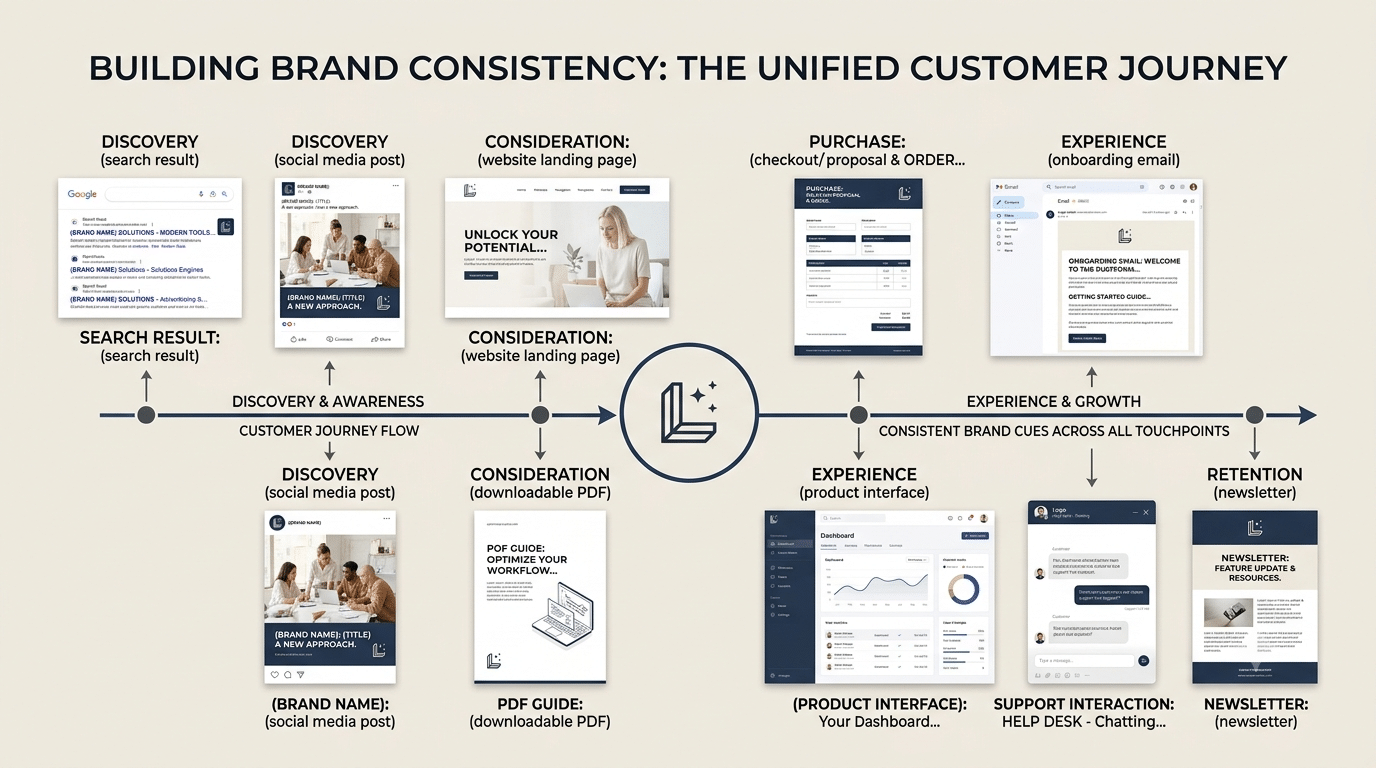
Imagine a customer discovers your business on Instagram.
They click your website.
Then they download a PDF.
Later they receive an email.
Then they see an advertisement.
If each interaction looks and sounds completely different, the customer has to reconstruct the connection each time.
A consistent brand creates continuity.
Review the important customer-facing touchpoints:
Discovery: search results, social media, advertisements, partnerships.
Consideration: website, landing pages, articles, case studies, presentations.
Purchase: checkout, proposals, invoices, product pages.
Experience: onboarding, product interface, customer service, emails.
Retention: newsletters, community, updates, loyalty communication.
Recognition is strengthened when these experiences feel like parts of the same brand.
11. Repeat the Right Signals
There is a difference between repetition and consistency.
Repetition says:
“Show the same thing again.”
Consistency says:
“Communicate the same underlying brand through different executions.”
You might use the same typography system while creating completely different content.
You might use the same color system across a website, presentation, and social graphic without making them identical.
You might maintain the same voice while discussing completely different subjects.
This is how a brand can remain recognizable without becoming visually monotonous.
12. Give the Audience Something to Associate With You
Recognition becomes stronger when people have something meaningful to connect with the brand.
That could be a distinctive idea.
A particular methodology.
A recognizable perspective.
A recurring educational framework.
A memorable product experience.
A specific category association.
For example, a branding studio might repeatedly become associated with a particular way of explaining brand strategy.
The association then extends beyond the logo.
People may encounter the idea first and connect it with the company later.
This is where content strategy becomes part of brand building.
Brand Recognition Is Not the Same as Being Everywhere
A common misconception is that the fastest way to become recognizable is to publish everywhere.
More platforms do not automatically create stronger recognition.
If the brand is inconsistent across those platforms, additional exposure can actually multiply inconsistency.
A better approach is to establish a strong core identity and communication system first.
Then adapt it appropriately to each platform.
Your Instagram post does not need to look exactly like your website.
Your Pinterest pin does not need to have identical dimensions or composition.
Your email does not need to imitate your social media.
But they should still feel like they belong to the same brand.
How to Measure Brand Recognition
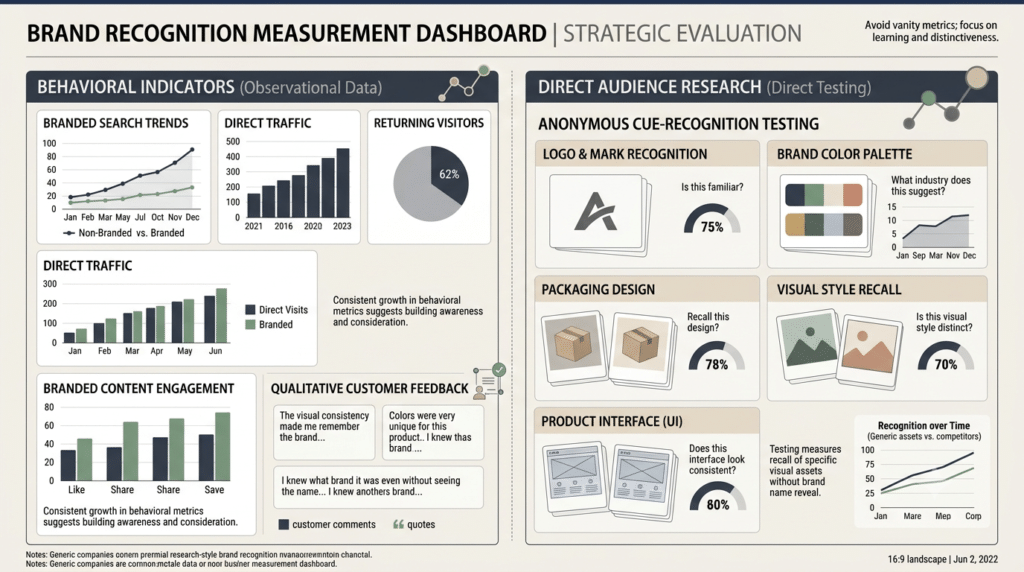
Brand recognition can be evaluated through research rather than assumptions.
One straightforward approach is to show people brand cues without immediately revealing the company name.
For example, you might test:
- logo
- color combination
- packaging
- visual style
- product interface
- advertising creative
Then ask whether participants can identify the brand.
You can also ask what category or company they associate with a particular cue.
For digital businesses, supporting indicators can include branded search behavior, direct traffic, returning visitors, engagement with branded content, and qualitative customer feedback.
However, these metrics should not be treated as perfect measurements of recognition on their own.
A rise in branded searches, for example, can have several explanations.
The strongest measurement approach combines behavioral data with direct audience research.
A Practical Brand Recognition Audit
You can perform a simple audit by collecting ten pieces of content from your brand.
Do not show the company name or account handle.
Give the collection to someone who is familiar with your target market.
Ask:
Could you tell these belong to the same company?
Then ask:
What visual elements made you think that?
What words or communication patterns stood out?
Which pieces felt least connected?
What company or category do you associate with the material?
The answers can reveal whether your identity has recognizable patterns or whether every asset is operating independently.
This is particularly useful for startups and small businesses that create content across multiple platforms.
A Simple Framework for Building Brand Recognition
A useful way to approach recognition is:
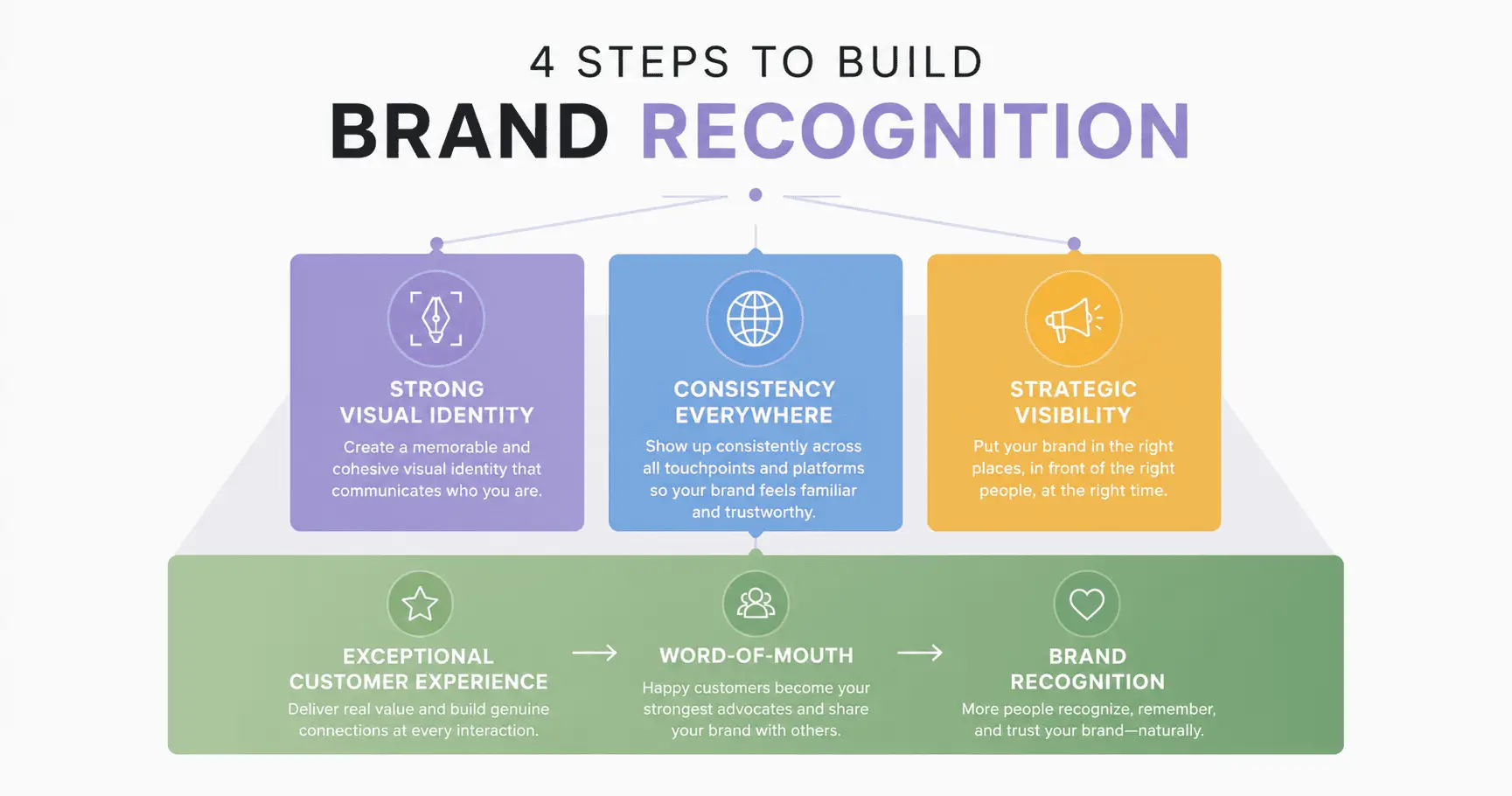
Meaning → Distinction → Identity → Consistency → Exposure → Association
First, establish meaning.
What does your brand stand for?
Then create distinction.
What makes the brand identifiable within its category?
Build the identity.
How should that meaning and difference look and sound?
Maintain consistency.
Can customers encounter the same underlying brand across touchpoints?
Create appropriate exposure.
Are the right people encountering the brand repeatedly?
Finally, build association.
Do those people begin connecting your distinctive signals with your business?
This sequence is more useful than simply trying to increase the number of posts you publish.
Example: Turning an Ordinary Brand Into a Recognizable One
Imagine a fictional design studio called North & Form.
Initially, its social media contains different templates every week.
One post uses serif typography.
Another uses bold sans-serif type.
Some posts use stock photography.
Others use illustrations.
The colors change constantly.
Nothing is technically wrong with the individual designs.
But the collection does not feel like one brand.
The studio starts by clarifying its positioning: it helps small businesses create strategic, editorial-style brand identities.
Its visual system then becomes more controlled.
It establishes a restrained color palette, consistent typography, generous whitespace, a specific image treatment, and a recurring graphic device.
Its content voice becomes calm, analytical, and practical.
The posts remain varied.
But the underlying system remains recognizable.
Eventually, someone can encounter one of its posts without seeing the account name and still recognize the visual language.
That is the result the studio was trying to create.
Common Brand Recognition Mistakes
Changing the visual identity constantly
If the colors, typography, templates, and visual style change every few weeks, the audience receives fewer consistent signals.
Copying category conventions
If every competitor uses the same visual language, following the category too closely can make recognition harder.
Using too many brand elements
Distinctiveness does not require visual complexity.
Too many colors, fonts, graphic devices, and styles can create noise instead of recognition.
Treating the logo as the entire brand
A recognizable brand should have multiple cues.
Prioritizing aesthetics over strategy
A visually beautiful brand can still be unclear.
Recognition works better when people understand what the brand represents.
Inconsistent social media design
Individual posts may look good while the overall profile lacks a coherent visual language.
Ignoring verbal identity
Brands can be visually consistent and verbally inconsistent.
The language should reinforce the same personality.
Rebranding too frequently
Recognition requires continuity.
If the company completely changes its identity every year, it repeatedly resets some of the associations it has been building.
Mistaking visibility for recognition
Millions of impressions do not automatically mean people can identify your brand.
The quality and consistency of the signals matter.
How Long Does It Take to Build Brand Recognition?
There is no universal timeline.
Recognition depends on factors such as audience size, category competition, distinctiveness, exposure, consistency, customer experience, and the frequency with which people encounter the brand.
A small business should therefore avoid thinking:
“How many days until people recognize us?”
A more useful question is:
“Are we consistently building the same associations with the right audience?”
Recognition is cumulative.
Each coherent customer interaction can reinforce the brand.
Each contradictory interaction can weaken the connection.
Brand Recognition and Brand Growth
As a business grows, recognition can become increasingly valuable because the number of customer touchpoints grows with it.
A small business may initially communicate directly with customers through one person.
A growing company may communicate through designers, marketers, salespeople, customer support, freelancers, agencies, social media managers, and automated systems.
Without a clear brand system, every additional contributor can introduce variation.
Brand recognition therefore has an operational dimension.
The brand needs to be understandable enough that different people can reproduce it accurately.
That is why positioning, brand identity, voice, guidelines, and content systems should work together.
Final Takeaway
Brand recognition is not created by a logo alone.
It develops when people repeatedly encounter a coherent collection of meaningful and distinctive brand signals.
The process can be summarized simply:
Clarify the brand → define the difference → build the identity → establish the voice → create distinctive assets → apply them consistently → expose the right audience → reinforce the association.
The objective is not to make every piece of content identical.
The objective is to make different experiences feel connected.
When someone sees your content, visits your website, reads your email, interacts with your product, or encounters your advertising, they should gradually build the same mental association.
That is what turns a collection of marketing materials into a recognizable brand.
And recognition should not be treated as the final destination.
A recognizable brand still needs to be relevant, credible, useful, and trusted.
But recognition gives those deeper brand relationships something important to build on:
people know who they are looking at.
Frequently Asked Questions
What is brand recognition in simple terms?
Brand recognition is the ability to identify a company from recognizable cues such as its logo, colors, typography, packaging, visual style, language, or other distinctive brand elements.
What is the difference between brand recognition and brand awareness?
Brand awareness is the broader familiarity people have with a brand. Brand recognition specifically refers to identifying a brand when recognizable cues are presented.
How do you increase brand recognition?
Distinctiveness does not require visual complexity.
Too many colors, fonts, graphic devices, and styles can create noise instead of recognition.
Does a logo create brand recognition?
A logo can contribute to recognition, but it is only one part of the system. Strong recognition usually comes from multiple consistent brand cues working together.
How important is consistency for brand recognition?
Consistency is important because repeated, coherent signals make it easier for audiences to connect different brand experiences with the same company. Consistency should not mean making every piece of content identical.
Can a small business build strong brand recognition?
Yes. A small business does not need a massive audience to establish recognition within its target market. A clear position, distinctive identity, consistent communication, and focused audience can provide a strong foundation.
Does posting more content increase brand recognition?
Not automatically. More content creates more exposure, but recognition depends on whether the content consistently communicates distinctive brand signals to the relevant audience.
Should you rebrand if your brand is not recognizable?
Not necessarily. First determine why the brand is difficult to recognize. The problem may be inconsistent implementation, weak positioning, generic visual assets, unclear messaging, or insufficient exposure rather than the fundamental identity itself.