Define your audience and Build a stronger brand?
Download and get practical foundation worksheets for your Ideal Customer Profile, Brand Strategy, Brand Positioning, Brand Voice, and Brand Identity all in one place.
Imagine visiting a company’s website.
The homepage sounds professional.
The Instagram captions are full of slang.
The emails feel robotic.
The customer support replies are overly formal.
Even if the logo and colors are consistent, something feels off.
That’s what happens when a business doesn’t have a clear brand voice.
Your visuals help people recognize your business.
Your words help people remember it.
Every headline, email, blog post, social media caption, and customer conversation shapes how people experience your brand.
When your communication is consistent, customers begin to trust you.
When it constantly changes, your brand feels confusing.
In this guide, you’ll learn what brand voice is, why it’s an essential part of branding, and how to create a communication style that reflects your personality and connects with your audience.
By the end, you’ll have a practical framework for writing with consistency across every platform.
What You'll Learn
ToggleWhat Is Brand Voice?
Brand voice is the consistent personality and communication style your business uses across every customer interaction.
It defines how your brand speaks not just what it says.
Your brand voice influences:
- Website copy
- Blog articles
- Social media posts
- Email newsletters
- Product descriptions
- Advertisements
- Customer support
- Sales pages
- Video scripts
- Presentations
Think of it as your brand’s personality expressed through words.
A strong brand voice makes your business feel familiar, trustworthy, and memorable.
Think of Brand Voice Like a Person’s Personality
Imagine meeting a friend.
No matter where you talk over coffee, on the phone, or through text messages they still sound like themselves.
Their personality stays recognizable.
Your business should work the same way.
Whether someone reads your blog, opens your emails, or watches your videos, they should immediately recognize your communication style.
That consistency creates trust.
Brand Voice Is More Than Writing Style
Many beginners think brand voice is simply choosing between formal and casual writing.
It goes much deeper.
Your brand voice reflects:
- Your values
- Your personality
- Your positioning
- Your audience
- Your mission
For example:
A luxury consulting firm may communicate with calm confidence and precision.
A children’s education brand may sound encouraging, playful, and energetic.
Neither voice is better.
The right voice depends on your audience and your brand strategy.
Your Brand Voice Should Reflect Your Strategy
Brand voice doesn’t exist on its own.
It grows from your brand strategy.
If your strategy positions your business as a trusted expert, your communication should sound knowledgeable and reassuring.
If your strategy emphasizes creativity and innovation, your voice may be more energetic and imaginative.
That’s why strategy comes before messaging.
Your brand voice doesn’t exist on its own. It grows from the strategic decisions you make about your business. If you haven’t defined those decisions yet, start by creating a clear brand strategy before developing your messaging. Once your strategy is in place, you can build a visual brand identity that reinforces the same personality across every customer touchpoint.
Why Brand Voice Matters
People don’t only remember what brands look like.
They remember how brands make them feel.
Your words influence those feelings.
Let’s explore why a consistent brand voice matters.
Brand Voice Builds Trust
Trust grows through consistency.
When every interaction sounds like it comes from the same business, customers feel more confident.
Whether they’re reading your homepage or contacting customer support, the experience feels connected.
Consistency reduces uncertainty.
And reduced uncertainty often leads to stronger relationships.
Brand Voice Strengthens Recognition
Your logo isn’t the only thing people recognize.
Your writing style becomes recognizable, too.
Think about brands whose emails, advertisements, or social posts feel instantly familiar.
They’ve developed a communication style that’s consistent over time.
That’s the goal of a strong brand voice.
Brand Voice Creates Emotional Connection
Words influence emotions.
A warm, supportive voice can make customers feel welcome.
A confident, expert voice can make them feel reassured.
A playful voice can make them smile.
When your communication reflects your audience’s expectations, people feel understood.
That emotional connection builds loyalty.
Brand Voice Improves Content Consistency
Without a documented voice, different pieces of content often sound like they were written by different people.
A defined brand voice keeps your:
- Blog articles
- Website copy
- Product pages
- Social media captions
- Emails
- Advertisements
consistent across every platform.
This is especially valuable as your team grows.
Brand Voice Supports Your Brand Identity
Your visual identity tells customers what your brand looks like.
Your brand voice tells them what your brand sounds like.
Together, they create a complete brand experience.
A premium visual identity paired with clear, confident messaging feels cohesive.
A mismatch between visuals and words creates confusion.
Brand Voice Helps You Stand Out
Many businesses offer similar products or services.
Your communication style can become a competitive advantage.
People often remember how you explain ideas, the words you choose, and the personality behind your content.
A distinct voice makes your brand easier to remember.
Brand Voice vs Tone of Voice
These terms are closely related, but they’re not identical.
| Brand Voice | Tone of Voice |
|---|---|
| Your consistent communication personality | How that personality adapts to different situations |
| Stays the same over time | Changes depending on context |
| Reflects your brand identity | Reflects the current conversation |
| Long-term | Situation-specific |
For example:
A friendly brand always remains friendly.
However, its tone changes.
A product launch email may sound excited.
A customer support response may sound calm and reassuring.
The personality stays consistent.
The tone adapts.
Brand Voice vs Brand Personality
These concepts also work together.
| Brand Personality | Brand Voice |
| Who your brand is | How your brand communicates |
| Human characteristics | Communication style |
| Strategic foundation | Practical execution |
Your personality influences your voice.
If your personality is confident, your writing should sound confident.
If your personality is approachable, your communication should feel welcoming.
The Core Elements of Brand Voice
A strong brand voice isn’t created by chance.
It’s built through a set of clear decisions that guide every piece of communication.
Whether you’re writing a blog post, replying to an email, or publishing a social media caption, these elements help your brand sound consistent.
Let’s explore the eight building blocks of an effective brand voice.
1. Brand Personality
Your voice begins with your personality.
Ask yourself:
If my brand were a person, how would people describe it?
Choose three to five personality traits that reflect your business.
Examples include:
- Confident
- Friendly
- Professional
- Calm
- Curious
- Creative
- Helpful
- Elegant
- Bold
- Honest
- Optimistic
- Practical
These traits become the foundation for every message you create.
2. Voice Characteristics
Once you’ve defined your personality, translate it into writing characteristics.
For example:
| Personality | Writing Style |
|---|---|
| Confident | Clear recommendations and decisive language |
| Friendly | Conversational and welcoming |
| Professional | Well-structured and informative |
| Creative | Fresh ideas and engaging storytelling |
| Calm | Reassuring and thoughtful explanations |
| Playful | Light-hearted language and humor where appropriate |
This makes your voice easier to apply consistently.
3. Messaging Pillars
Your audience shouldn’t have to guess what your brand stands for.
Define three to five core topics you consistently communicate.
For a branding business, those pillars might include:
- Brand Strategy
- Brand Identity
- Personal Branding
- Design Systems
- Business Growth
Every blog, email, or social media post should connect back to one or more of these themes.
Over time, customers begin to associate your brand with those subjects.

4. Vocabulary and Word Choice
Words shape perception.
The vocabulary you choose should reflect your personality and audience.
For example, a beginner-focused brand may use simple, everyday language.
An industry publication might use more technical terminology.
Create a list of:
Words You Use Frequently
Examples:
- Strategy
- Clarity
- Growth
- Consistency
- Purpose
- Confidence
- Simplicity
- Foundation
Words You Avoid
Examples:
- Buzzwords without explanation
- Overly complicated jargon
- Aggressive sales language
- Clickbait phrases
- Misleading claims
A documented vocabulary creates consistency across every platform.
5. Sentence Structure and Writing Style
Your writing style affects how your content feels.
Decide on guidelines such as:
- Short paragraphs
- Clear headings
- Active voice
- Everyday language
- Practical examples
- Simple explanations
- Logical structure
6. Tone of Voice
Although your brand voice remains consistent, your tone changes depending on the situation.
Think of tone as your emotional adjustment.
Examples include:
Educational Blog
Helpful.
Patient.
Detailed.
Sales Page
Confident.
Persuasive.
Benefit-focused.
Customer Support
Empathetic.
Calm.
Solution-oriented.
Product Launch
Excited.
Energetic.
Encouraging.
The personality stays the same.
Only the emotional emphasis changes.
7. Storytelling Style
Stories help people remember information.
Decide how your brand tells stories.
Do you prefer:
- Customer success stories?
- Founder experiences?
- Behind-the-scenes insights?
- Educational examples?
- Case studies?
A consistent storytelling style strengthens recognition.
For example, GB Visual Studio often introduces concepts using simple analogies before explaining the practical framework.
That teaching style becomes part of the brand experience.
8. Voice Documentation
The final step is documenting everything.
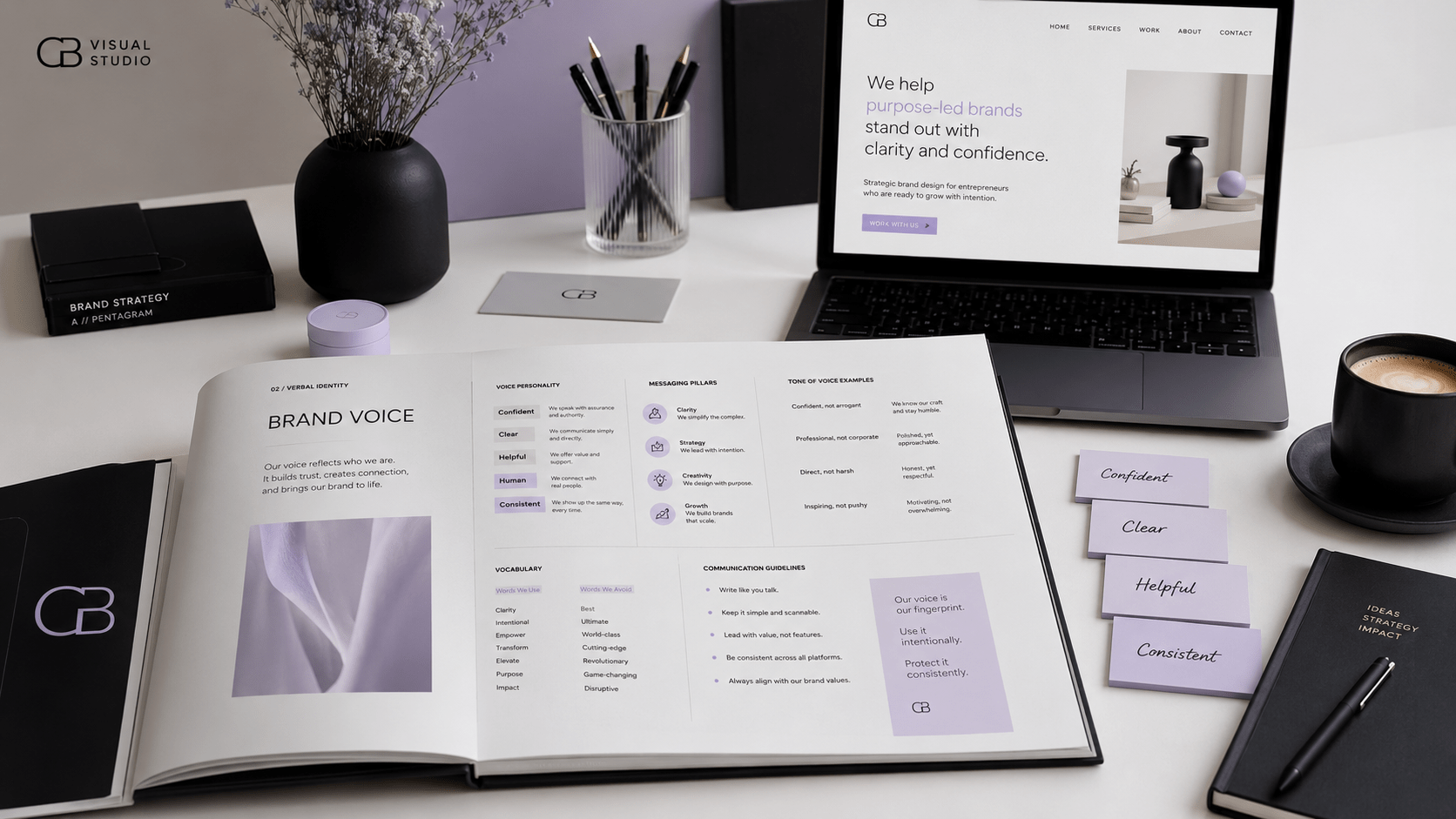
Your brand voice guide should include:
- Personality traits
- Writing style
- Tone examples
- Vocabulary
- Messaging pillars
- Grammar preferences
- Formatting rules
- Sample headlines
- Sample email copy
- Do’s and don’ts
Documentation ensures consistency, especially when multiple people create content.
How These Elements Work Together
Think of brand voice as a conversation.
Your personality defines who is speaking.
Your messaging explains what they’re talking about.
Your vocabulary shapes the words they choose.
Your writing style affects how they communicate.
Your tone adapts to different situations.
Together, these elements create a recognizable communication style.
How to Create a Brand Voice
A memorable brand voice doesn’t happen by accident.
It’s intentionally designed, documented, and used consistently across every customer interaction.
Whether you’re writing your website, sending emails, creating social media posts, or publishing blog articles, these steps will help you develop a brand voice that feels authentic and recognizable.
Step 1: Start with Your Brand Strategy
Your brand voice should reflect your overall brand strategy.
Before deciding how your business should sound, revisit the foundation you’ve already built.
Ask yourself:
- Why does my business exist?
- Who is my ideal customer?
- What problem do I solve?
- What makes my business different?
- How do I want customers to remember me?
The answers shape your communication style.
For example, if your brand is positioned as a trusted advisor, your writing should feel knowledgeable, supportive, and clear.
If your brand is built around creativity and innovation, your communication may feel more energetic and imaginative.
Your brand voice should reflect your overall strategy. Before deciding how your business should sound, make sure you’ve defined your positioning, purpose, audience, and messaging. If you haven’t done that yet, start with our What Is Brand Strategy? guide, which walks you through creating the strategic foundation every brand needs.
Step 2: Understand Your Audience
Your audience influences the language you use.
The goal isn’t to sound impressive.
The goal is to communicate in a way your audience immediately understands.
Consider questions like:
- What experience level do they have?
- What challenges are they trying to solve?
- What words do they already use?
- What kind of content do they enjoy?
- How formal or casual do they expect businesses in your industry to sound?
For example:
A beginner learning about branding appreciates simple explanations and practical examples.
An experienced designer may expect more technical discussions.
Meeting your audience where they are creates stronger connections.
The language you choose should always reflect the people you’re trying to reach. Creating a detailed Ideal Customer Profile helps you understand your audience’s goals, challenges, and communication preferences, making it much easier to develop a voice that resonates.
Step 3: Choose Three to Five Brand Personality Traits
Your personality becomes the foundation of your voice.
Instead of trying to sound like everyone else, identify a few characteristics that genuinely represent your business.
Examples include:
- Confident
- Friendly
- Professional
- Calm
- Helpful
- Curious
- Bold
- Optimistic
- Minimal
- Educational
Limit yourself to three to five traits.
Too many characteristics make your communication inconsistent.
Step 4: Build Your Messaging Pillars
Your messaging should consistently reinforce what your brand is known for.
Choose three to five core topics you’ll regularly discuss.
For example, a branding business might focus on:
- Brand Strategy
- Brand Identity
- Brand Voice
- Personal Branding
- Brand Positioning
Every article, video, email, and social media post should connect back to one or more of these pillars.
Over time, your audience begins to associate your business with those subjects.
Step 5: Create a Brand Voice Guide
The final step is documenting everything.
A simple brand voice guide ensures consistency across every platform and makes it easier for anyone creating content for your business.
Include:
- Brand personality
- Voice characteristics
- Tone examples
- Messaging pillars
- Preferred vocabulary
- Words to avoid
- Grammar preferences
- Formatting guidelines
- Headline examples
- Social media examples
- Email examples
- Do’s and Don’ts
This document becomes your communication reference.
Whether you’re writing yourself or working with freelancers, everyone can create content that sounds like your brand.
Put Your Brand Voice into Practice
A documented voice is only valuable if you use it consistently.
Review your communication across every customer touchpoint, including:
- Website pages
- Blog posts
- Product descriptions
- Email newsletters
- Social media captions
- Customer support replies
- Sales pages
- Lead magnets
- Presentation slides
Ask yourself:
- Does this sound like my brand?
- Is the language consistent?
- Would someone recognize this without seeing my logo?
- Does it reflect my personality?
- Is it genuinely helpful for my audience?
Small improvements made consistently create a recognizable brand over time.
Remember, customers don’t build trust after reading one blog post or one email.
They build trust through repeated, consistent experiences.
The more consistently your brand communicates, the more familiar and memorable it becomes.
Common Brand Voice Mistakes
Even businesses with beautiful branding can struggle to build trust if their communication feels inconsistent.
The good news is that most brand voice mistakes are easy to fix once you know what to look for.
Here are the most common ones beginners make—and how to avoid them.
Mistake 1: Copying Another Brand’s Voice
It’s natural to admire successful brands.
You might love Apple’s simplicity, Nike’s confidence, or Duolingo’s playful personality.
But copying their communication style won’t make your brand memorable.
Your audience wants to hear your perspective, not an imitation of someone else’s.
Instead of asking,
“How does this brand write?”
Ask,
“How should my brand communicate based on my audience and values?”
Study other brands for inspiration, but build a voice that’s authentic to your business.
Mistake 2: Confusing Brand Voice with Tone
Many people use these terms interchangeably.
They’re connected, but they’re not the same.
Your brand voice stays consistent.
Your tone changes depending on the situation.
For example:
A friendly brand can sound:
- Excited during a product launch.
- Calm when solving a customer problem.
- Encouraging in an educational blog post.
The personality remains the same.
Only the emotional delivery changes.
Understanding this difference helps your communication stay consistent without sounding repetitive.
Mistake 3: Trying to Sound Professional Instead of Human
Professional doesn’t have to mean complicated.
Many businesses fill their websites with corporate jargon that customers don’t naturally use.
Instead of writing:
“We leverage innovative solutions to maximize operational efficiency.”
Write:
“We help businesses build brands that are clear, consistent, and memorable.”
Simple language is easier to understand.
Clear communication builds trust.
Mistake 4: Changing Your Writing Style on Every Platform
Some brands sound professional on their website, casual on Instagram, overly promotional in emails, and robotic in customer support.
This inconsistency weakens recognition.
Your audience should feel like they’re talking to the same brand everywhere.
The platform may change.
Your personality shouldn’t.
Mistake 5: Focusing Only on Selling
Customers don’t want every message to be a sales pitch.
Strong brands educate before they sell.
Teach.
Answer questions.
Share useful ideas.
Solve problems.
When your content consistently provides value, promotions feel more natural because trust already exists.
A helpful brand voice creates long-term relationships, not just short-term sales.
Mistake 6: Ignoring Your Audience
Your communication should reflect the people you’re trying to reach.
A beginner audience needs clear explanations and practical examples.
An experienced audience may expect more detailed insights.
If your writing doesn’t match your audience’s knowledge level, people quickly lose interest.
Always write for the reader not for yourself.
Mistake 7: Using Inconsistent Vocabulary
One week, your business talks about “clients.”
The next week it’s “customers.”
Then “members.”
Then “users.”
Small inconsistencies make your messaging feel less polished.
Create a preferred vocabulary list for your brand.
For example, decide whether you consistently use terms like:
- Brand Strategy
- Brand Identity
- Audience
- Clients
- Customers
- Community
- Members
Using the same language repeatedly strengthens recognition and improves clarity.
Mistake 8: Never Documenting Your Brand Voice
Perhaps the biggest mistake is assuming you’ll remember everything.
As your business grows, you’ll likely create more content, hire freelancers, or work with a team.
Without a documented brand voice guide, everyone will write differently.
A simple document containing your personality, writing style, vocabulary, tone examples, and messaging pillars can save hours of editing and keep every customer interaction consistent.
How to Avoid These Mistakes
Building a strong brand voice doesn’t require perfect writing.
It requires consistency.
Before publishing any piece of content, ask yourself:
- Does this sound like my brand?
- Is the language simple and clear?
- Would my audience understand it immediately?
- Does it reflect my personality?
- Am I helping before I’m selling?
If the answer is yes, you’re moving in the right direction.
Remember, customers recognize brands through repeated experiences.
Every email, caption, article, and conversation contributes to that experience.
The more consistently you communicate, the more familiar and trustworthy your brand becomes.
Final Thoughts
Your brand voice is one of the most valuable assets your business can build.
Unlike a logo or color palette, your voice appears in almost every customer interaction. It’s present in your website copy, blog articles, emails, social media posts, presentations, product descriptions, and customer support conversations.
That’s why consistency matters.
People don’t build trust after reading one blog post or seeing one Instagram caption. They build trust through repeated experiences that feel familiar, helpful, and authentic.
A strong brand voice isn’t about sounding clever or using complicated words.
It’s about communicating with clarity.
When your audience knows what to expect from your content, they become more confident in your business.
As you continue building your brand, remember these key principles:
- Start with your brand strategy.
- Understand your audience.
- Define your personality.
- Create clear messaging guidelines.
- Adapt your tone without changing your voice.
- Document your communication standards.
- Stay consistent across every customer touchpoint.
The strongest brands aren’t always the loudest.
They’re the ones that who communicate with purpose, consistency, and authenticity.
Whether you’re writing your first website page or publishing your hundredth blog post, your words should always reflect the same personality and values.
Because over time, your communication becomes part of your reputation.
And a trusted reputation is one of the most valuable competitive advantages any business can have.
Define your audience and Build a stronger brand?
Download and get practical foundation worksheets for your Ideal Customer Profile, Brand Strategy, Brand Positioning, Brand Voice, and Brand Identity all in one place.