If you’re building a business, you’ve probably heard people say things like:
“You need a strong logo.”
But here’s the problem.
A logo can be professionally designed, visually memorable, and perfectly executed—and your business can still have a weak brand.
That’s because a logo and a brand are not the same thing.
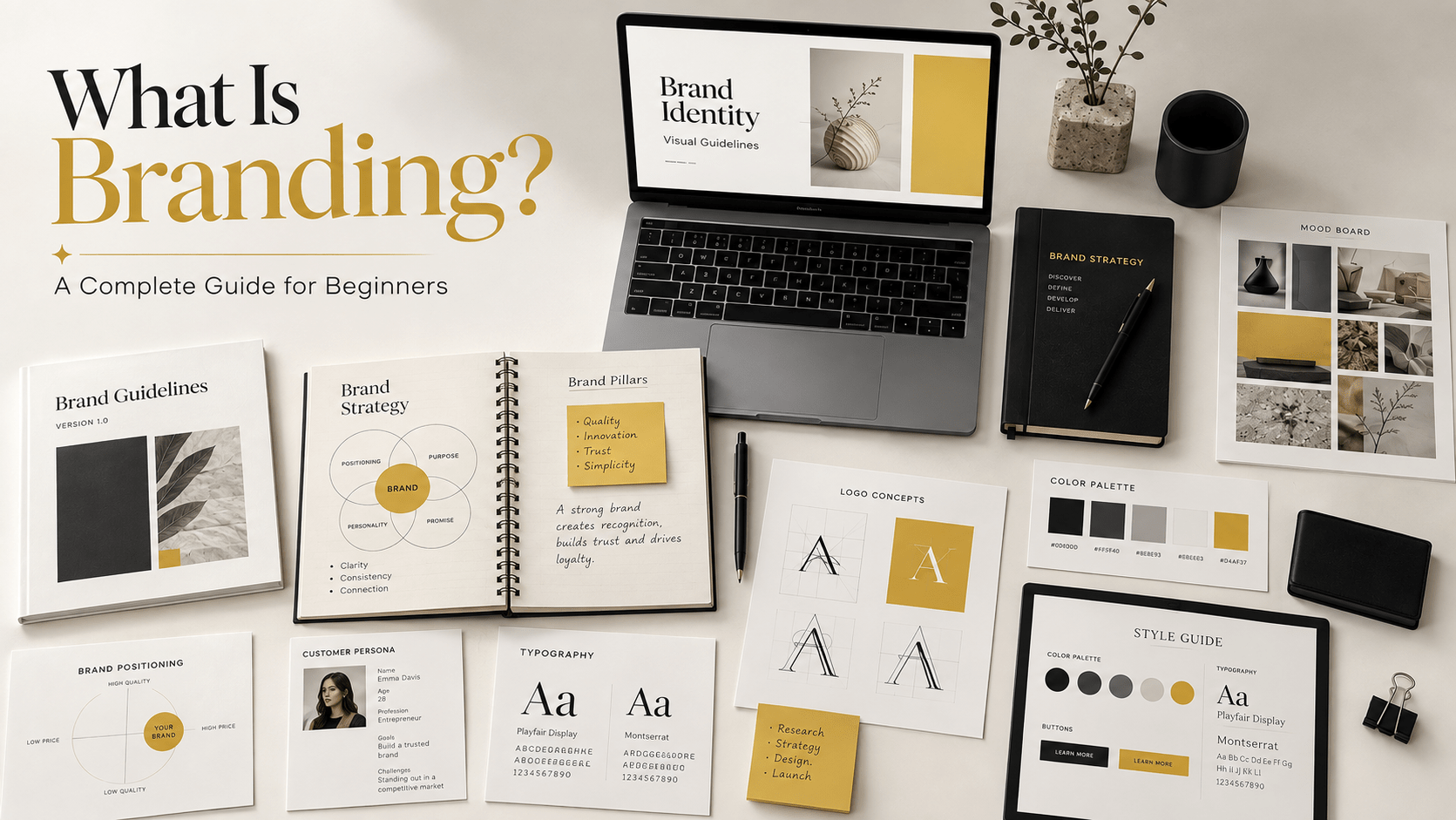
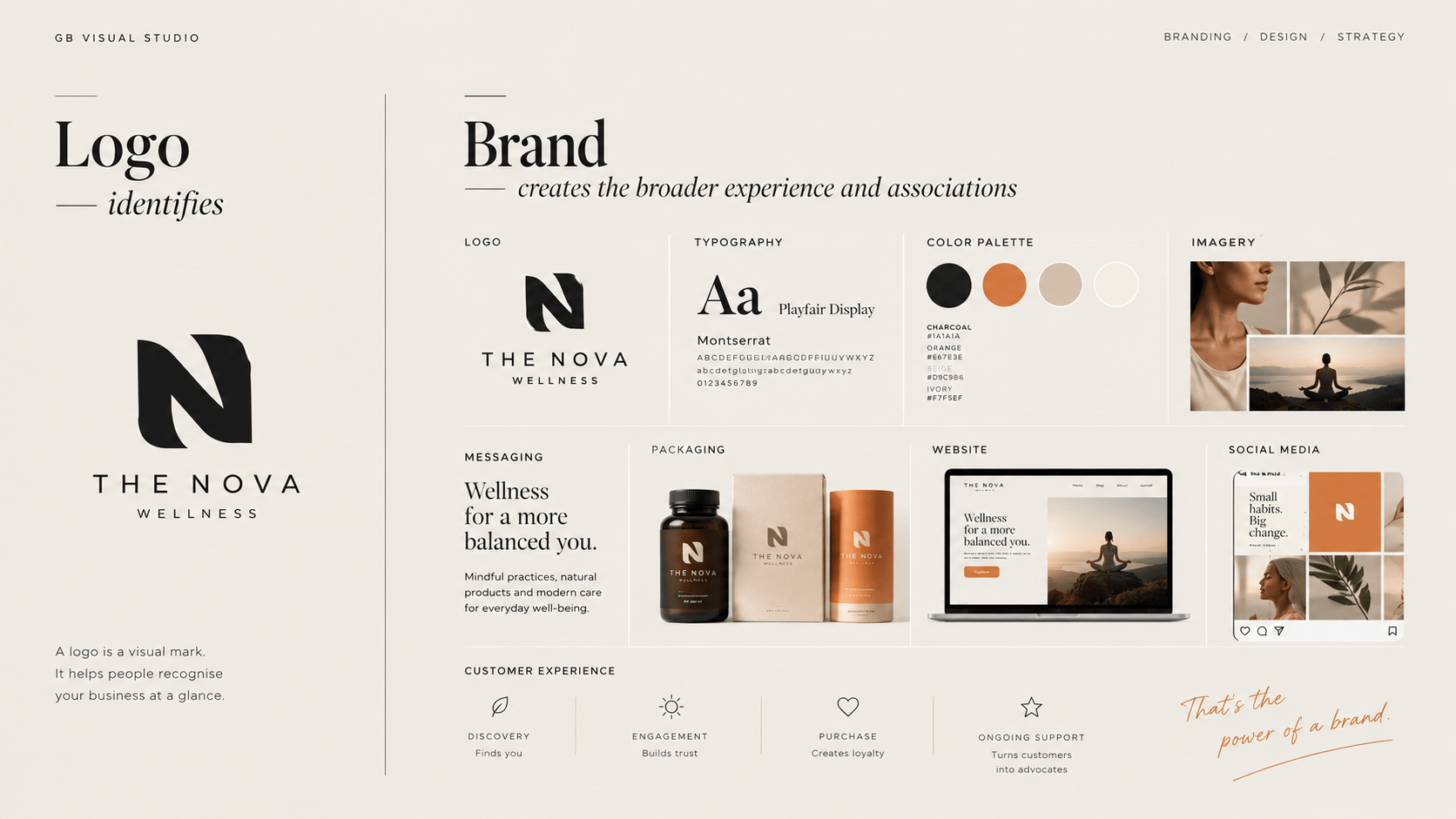
A logo is a visual identifier. It helps people recognize a business, product, or organization. A brand is much broader: it encompasses the perceptions, associations, experiences, expectations, and meaning connected to that business.
Your logo is something you create.
Your brand is something that develops through what you consistently communicate and deliver.
Adobe similarly describes a logo as one component of a broader brand identity system that can include typography, color, imagery, voice, layout, and other elements.
Understanding this difference changes how you approach branding.
Instead of asking:
“What should my logo look like?”
you start asking:
“What should my business be known for?”
That is a much more useful question.
What You'll Learn
ToggleWhat Is a Logo?
A logo is a visual mark used to identify a business, organization, product, or service.
It might be a:
- wordmark
- symbol
- monogram
- combination mark
- emblem
Its primary job is recognition.
Think of the logo as a visual signature.
When someone sees it repeatedly alongside your products, website, packaging, advertisements, or content, the mark can become associated with the business.
But a logo doesn’t explain everything about the business.
A small symbol cannot communicate your entire positioning, customer experience, values, personality, visual language, and reputation by itself.
That’s why a logo should be treated as one asset within a larger identity system rather than the complete definition of a brand.
What Is a Brand?
A brand is considerably broader.
It includes the collection of associations and perceptions people develop around a business.
Think about everything someone experiences:
They see your website.
They read your Instagram posts.
They interact with your customer service.
They purchase your product.
They receive your emails.
They see your packaging.
They hear someone talk about your company.
They use your product.
They encounter your advertising.
All of these interactions contribute to how the business is understood and remembered.
Adobe distinguishes between brand identity, which represents how a business chooses to communicate itself, and brand image, which describes how audiences actually perceive it.
So your brand isn’t simply the thing you design.
It is the meaning that develops around the business through repeated interactions.
Logo vs Brand: The Simple Difference
Here’s the easiest way to understand it:
A logo identifies the business. A brand gives people reasons to recognize, remember, understand, and choose the business.
Or think about it this way:
Logo = identifier
Brand identity = system
Branding = ongoing process
Brand image = audience perception
Brand = broader meaning and associations surrounding the business
These concepts overlap, but they aren’t interchangeable.
Confusing them often leads businesses to spend too much time redesigning their logo when the actual problem exists somewhere else.
Logo vs Brand Identity
This distinction is particularly important.
Your logo is one component of your brand identity.
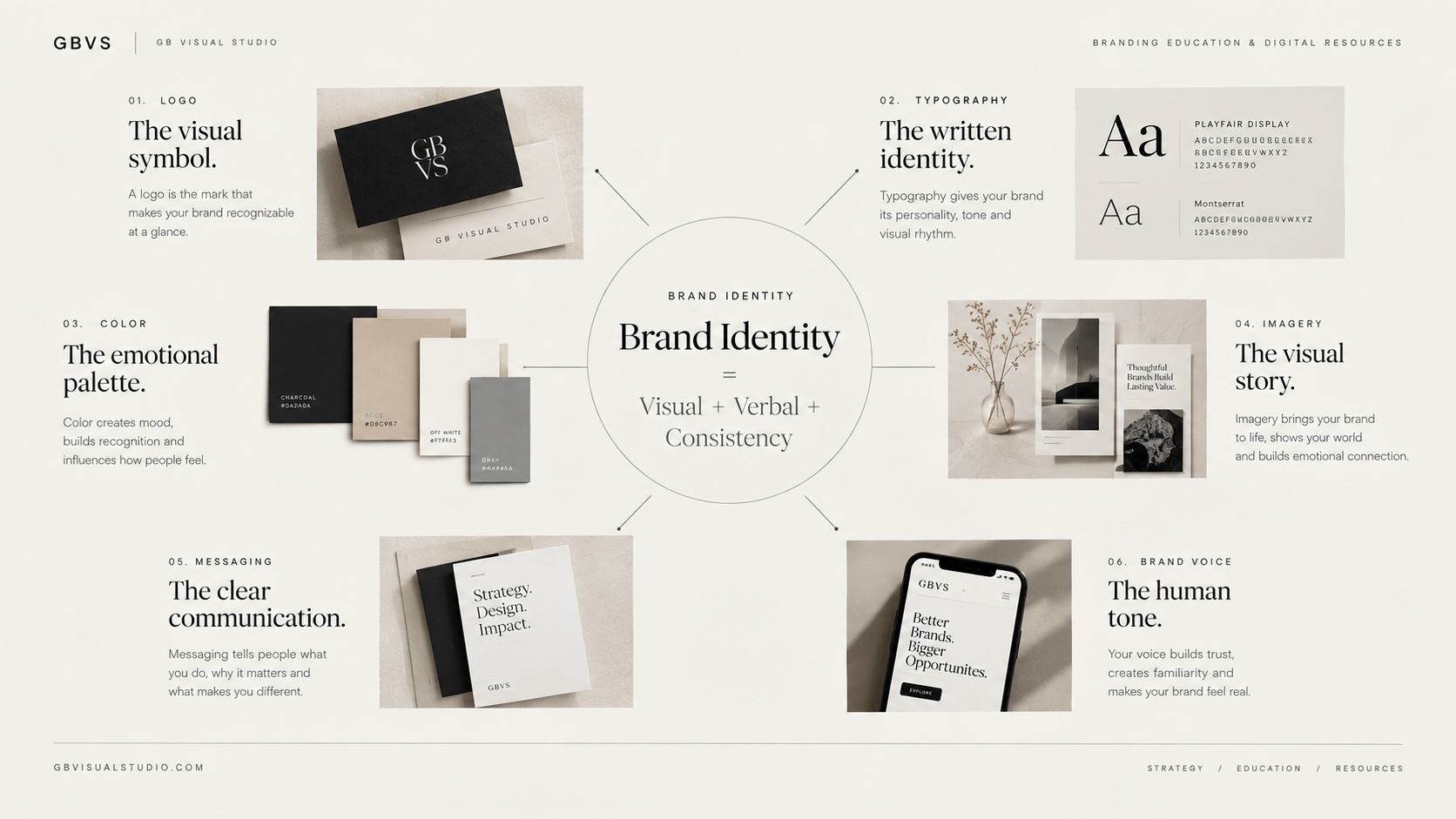
Brand identity includes the collection of visual and verbal elements you intentionally create to represent the business.
That can include:
Your logo.
Your color palette.
Your typography.
Your imagery.
Your graphic elements.
Your brand voice.
Your messaging.
Your design patterns.
Your guidelines.
Your overall visual direction.
Shopify’s current brand identity guide similarly defines identity as a collection of visual and verbal elements including logo, colors, typography, imagery, and voice.
So:
Logo → part of brand identity
Brand identity → part of the broader branding system
This is why changing your logo doesn’t automatically mean you’ve changed your brand.
Logo vs Branding: What's the Difference?
A logo is an asset.
Branding is a process.
Branding involves the strategic and creative work used to shape how a business presents itself and how it connects with its audience.
That can involve positioning, messaging, visual identity, content, customer experience, campaigns, packaging, advertising, and many other activities.
Shopify describes branding as the ongoing process of shaping how a business is perceived, while brand identity consists of the tangible elements produced through that process.
This means you don’t really “finish” branding in the same way that you finish a logo.
You can finish designing a logo file.
But branding continues every time your business communicates.
Every email.
Every product page.
Every advertisement.
Every customer interaction.
Every social post.
Every new touchpoint either reinforces or weakens what people understand about your business.
Why Businesses Obsess Over the Logo
There is a practical reason logos receive so much attention.
They are tangible.
You can see the difference immediately.
Before:
Old logo
After:
New logo
It feels like something significant has changed.
Brand strategy is different.
You can’t easily show a screenshot of “better positioning.”
You can’t put brand clarity into a folder and point to it like a logo file.
That’s why businesses sometimes try to solve strategic problems with visual redesign.
Sales are slow → redesign the logo.
The audience is unclear → redesign the logo.
The messaging isn’t working → redesign the logo.
The business is repositioning → redesign the logo.
But if the underlying problem is strategic, a new logo may simply give the same problem a new appearance.
A Good Logo Still Matters
Saying that the logo isn’t the brand doesn’t mean the logo is unimportant.
It still has an important role in recognition.
A strong logo should generally be appropriate to its context, recognizable, usable across different sizes and applications, and compatible with the broader identity system. Adobe’s current guidance emphasizes recognizability, appropriateness, versatility, and simplicity rather than visual novelty alone.
Your logo may appear:
On a website.
Inside a social profile.
On a product.
In an email signature.
On a presentation.
On packaging.
Inside a digital product.
In advertising.
Because of this, the logo needs to function in real-world applications.
A beautiful logo that only works in one large presentation is not particularly useful.
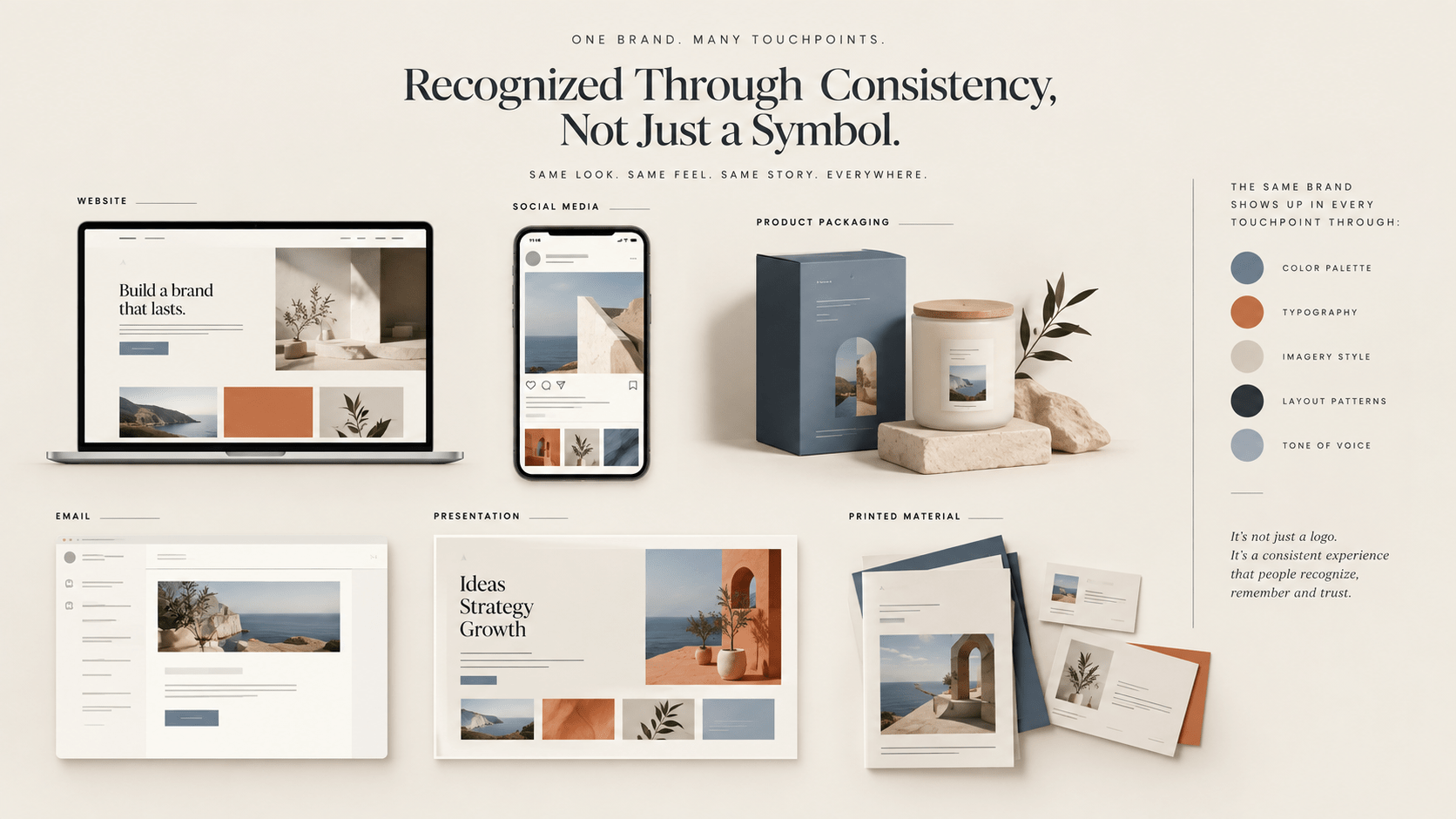
Your Brand Can Be Recognizable Without the Logo
This is one of the most interesting differences between a logo and a broader brand identity.
Recognition doesn’t always require the logo to be visible.
A consistent combination of typography, color, imagery, layout, product design, tone, and other distinctive cues can help people recognize a brand.
Shopify recently highlighted an example of an accessories brand that developed recognition through consistent imagery and content even without prominently using a logo.
This illustrates an important principle:
Recognition can come from a system, not just a symbol.
That’s why your brand identity should have multiple recognizable characteristics.
If removing the logo makes every piece of content completely anonymous, your identity may be relying too heavily on one element.
What Makes Up a Strong Brand Identity?
If the logo is only one part, what else belongs in the system?
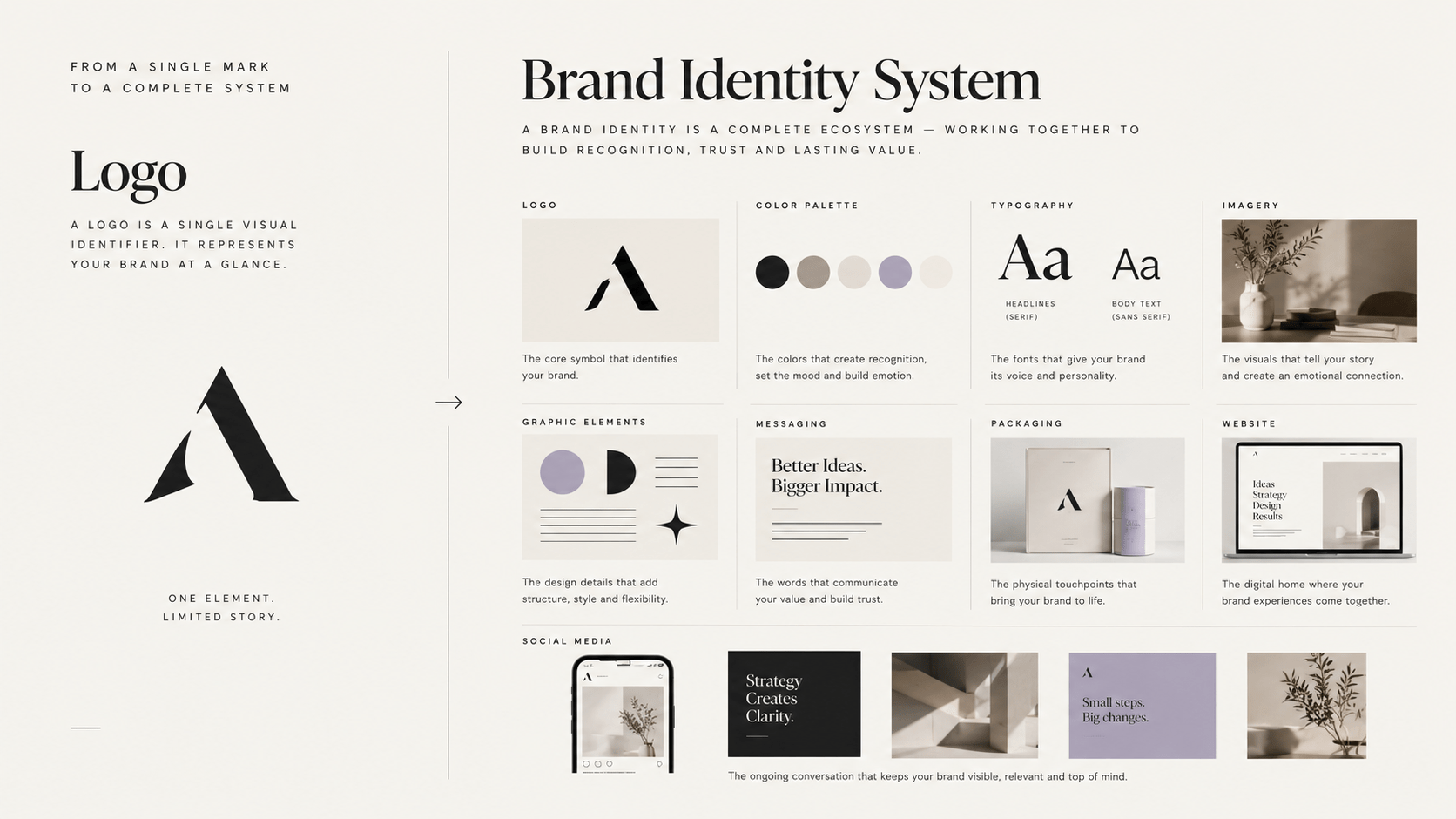
A practical identity might include:
Logo
The primary identifier and its variations.
Color
A defined palette with clear roles and usage rules.
Typography
Your selected typefaces and hierarchy.
Imagery
Photography, illustration, graphics, or other visual treatments.
Layout
How content is structured and presented.
Graphic Language
Shapes, patterns, icons, textures, or other recurring visual elements.
Voice
The characteristics that define how the brand communicates.
Messaging
The core ideas, value propositions, claims, and language associated with the business.
Guidelines
The rules that keep everything working together consistently.
Adobe’s current brand-guide guidance similarly includes logo variations, typography, colors, imagery, illustrations, icons, voice, and messaging direction as components that can be documented within a brand system.
You can explore these components in more detail in 7 Essential Elements of a Strong Brand Identity.
Example: A Logo Change vs a Brand Change
Imagine a fictional business called North & Form, a small interior-design consultancy.
The founder changes the logo from a serif wordmark to a geometric symbol.
The logo looks completely different.
But the website still has the same positioning.
The services are the same.
The customer experience is the same.
The messaging is the same.
The visual system is still inconsistent.
Has the brand fundamentally changed?
Not necessarily.
The logo changed.
Now imagine the business decides to reposition itself toward premium hospitality spaces.
It changes its target audience, service structure, messaging, photography direction, typography, color system, website experience, sales materials, and communication style.
The logo may also change.
That’s a much broader brand transformation.
The distinction matters because it helps you understand what actually needs to change.
When Should You Redesign Your Logo?
A logo doesn’t need to change simply because you’re tired of looking at it.
A redesign or refresh may make sense when there has been a meaningful change in the business or when the existing mark no longer works effectively across important applications.
For example:
A company has significantly repositioned itself.
The target audience has changed.
The business has expanded into new categories.
The current logo has serious usability problems.
The identity has become inconsistent.
The visual system has evolved but the logo no longer fits.
A logo refresh can also modernize an existing identity without completely discarding recognition built over time.
The important question isn’t:
“Does this logo feel old to me?”
Ask:
“Is this logo still serving the business and the identity system?”
That’s a much more strategic question.
When You Shouldn't Redesign the Logo
Sometimes the logo isn’t the problem.
If your business lacks clarity, changing the logo won’t define your audience.
If your website doesn’t communicate your value clearly, a new symbol won’t fix the messaging.
If your social media looks inconsistent, a new logo won’t create consistency.
If your customers have a poor experience, a redesigned wordmark won’t repair the experience.
And if your positioning is unclear, a beautiful logo won’t suddenly make it obvious.
Before starting a redesign, identify the actual problem.
This is where brand strategy becomes more important than decoration.
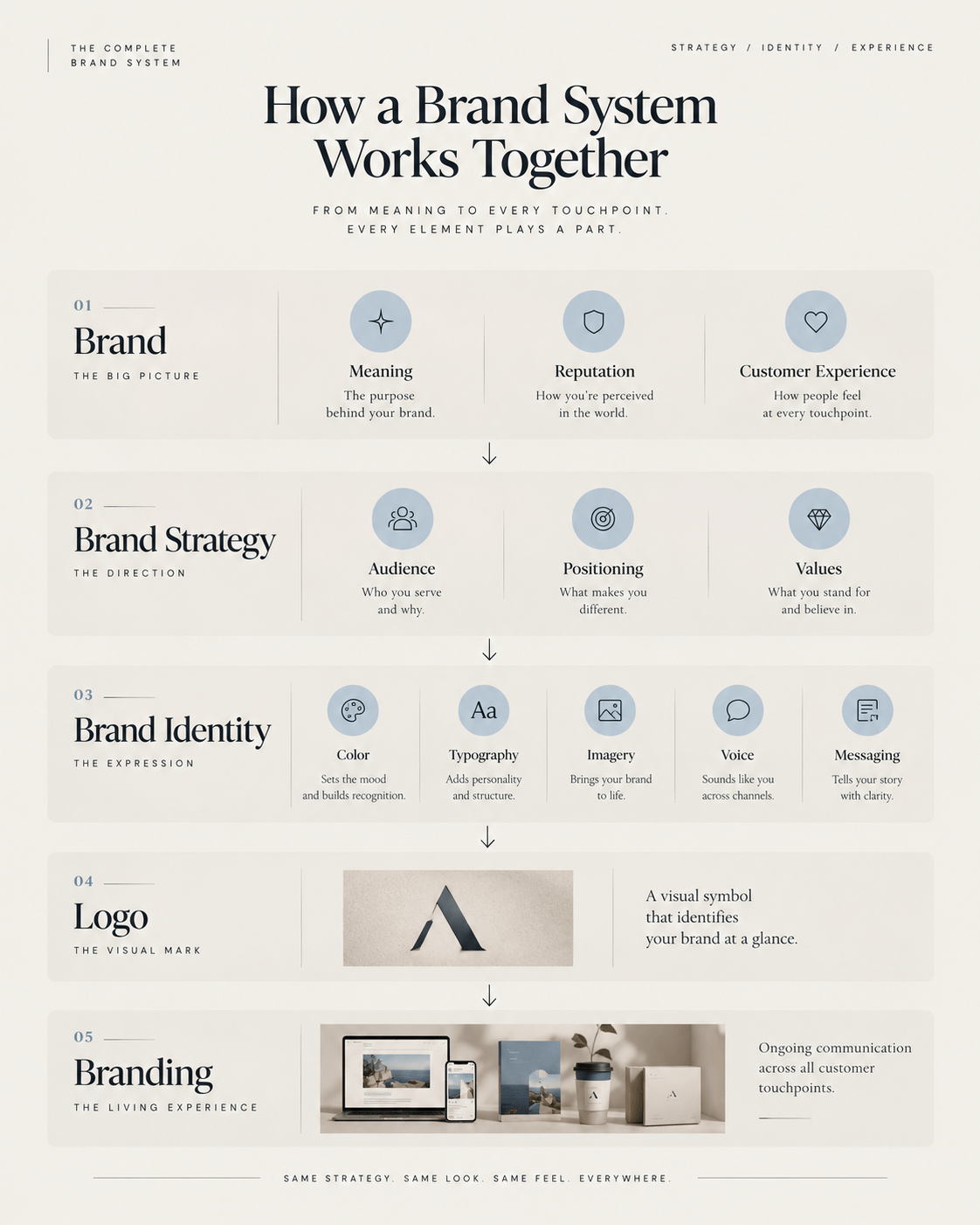
How Logo, Brand Identity, and Branding Work Together
Think of the relationship as a hierarchy.
Brand
The broader meaning, associations, reputation, and experience surrounding the business.
↓
Brand strategy
The strategic decisions that determine where the brand competes, whom it serves, and what it should stand for.
↓
Brand identity
The visual and verbal system created to express that strategy.
↓
Logo
One visual identifier within that identity.
↓
Branding
The ongoing implementation of these decisions across communication and customer touchpoints.
The exact terminology can vary across branding disciplines, but this framework is useful because it prevents one common mistake:
trying to make one visual asset carry the entire brand.
How to Build a Brand Instead of Just a Logo
If you’re starting a business, don’t begin with:
“I need a logo.”
Begin with:
“I need to define what this business should be known for.”
Then work through your foundation.
Clarify your audience.
Define your positioning.
Establish your personality.
Develop your messaging.
Create your visual identity.
Design the logo within that system.
Build templates.
Document your guidelines.
Then apply everything consistently.
This sequence produces a much more useful result than designing a logo in isolation.
If you’re building your identity yourself, continue with How to Build a Brand Identity Without a Designer.
And if you want to understand the complete visual system, read Brand Identity: A Beginner’s Guide to Building a Strong Visual Identity.
Final Thought
Your logo is important.
It just isn’t everything.
A logo can identify your business in a fraction of a second, but it cannot independently communicate your entire positioning, personality, customer experience, reputation, or value.
That’s the job of the broader brand system.
The strongest identities don’t ask the logo to do all the work.
They create multiple recognizable signals that work together: color, typography, imagery, messaging, voice, design language, experience, and consistency.
So if you’re building a business, don’t spend all your energy asking what your logo should look like.
Ask the larger question:
What should people remember about this business after the logo is gone?
That’s where branding begins.
Frequently Asked Questions
Is a logo the same as a brand?
No. A logo is a visual identifier. A brand is the broader set of meanings, associations, experiences, and perceptions connected to a business. A logo is one part of a brand identity system.
What is the difference between a logo and brand identity?
A logo is a single visual identifier. Brand identity is the broader system of visual and verbal elements a business intentionally creates, including the logo, colors, typography, imagery, messaging, and voice.
Is branding just logo design?
No. Branding is an ongoing process involving strategic, creative, and communication decisions that shape how a business presents itself and connects with its audience.
Can a brand be successful without a logo?
A business can build recognition through multiple consistent brand cues, including imagery, color, typography, packaging, messaging, and content. A logo can support recognition, but it isn’t the only possible recognition cue.
When should I redesign my logo?
Consider a redesign when your business has materially changed, your target audience or positioning has shifted, or the existing logo has functional problems. Avoid changing it solely because a new design trend looks appealing.
What should I focus on before designing a logo?
Clarify your audience, positioning, personality, values, differentiation, and messaging first. The logo should then be designed as part of the larger brand identity rather than independently.