Every brand makes decisions.
What it sells.
Who it serves.
How it communicates.
How it treats customers.
What it prioritizes.
What it refuses to compromise on.
Brand values are the principles that help guide those decisions.
They describe what matters to the brand and, more importantly, how those beliefs should show up in its behavior.
This is why simply putting words such as integrity, innovation, excellence, and customer-first on an About page doesn’t automatically create strong brand values.
Almost any business can claim those words.
The real question is:
What does this value change about the way we actually operate?
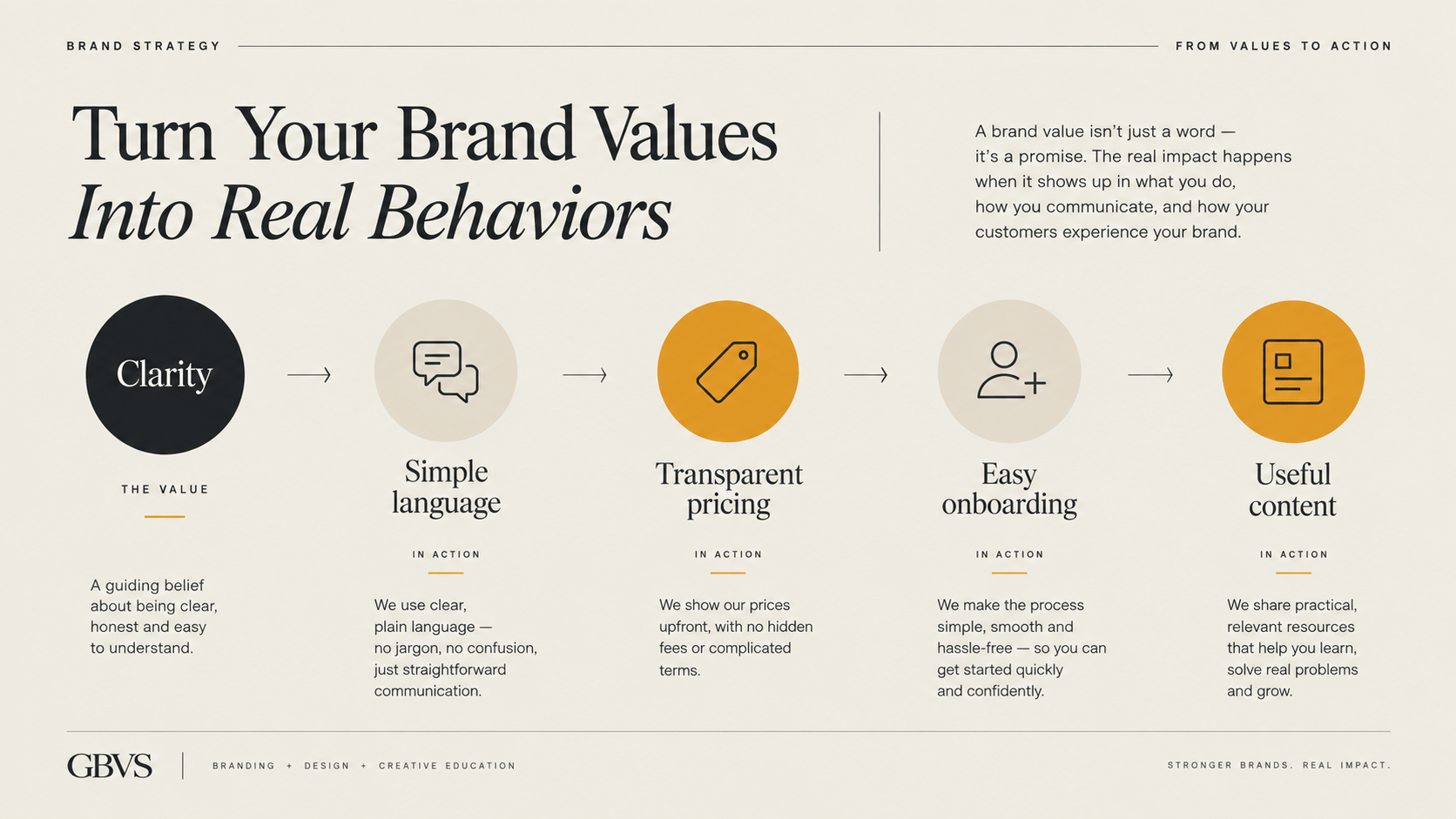
If your brand says it values simplicity, but your website, onboarding process, pricing, and products are unnecessarily complicated, the word has little practical meaning.
Effective brand values aren’t decoration.
They are decision-making tools.
And when they’re clearly defined, they can make your brand strategy, messaging, visual identity, content, and customer experience more coherent.
What You'll Learn
ToggleWhy Brand Values Matter
Brand strategy gives your business direction.
Values help establish the principles behind that direction.
For example, imagine two design studios offering similar services.
One values speed.
Its processes may prioritize quick decisions, streamlined communication, and efficient delivery.
Another values depth.
Its process might involve more research, workshops, iterations, and strategic exploration.
Neither approach is automatically right for every customer.
But the values create different businesses.
This is what makes meaningful values useful.
They influence behavior.
They can help you decide:
Should we accept this project?
Should we launch this product?
How should we communicate with customers?
What kind of partnerships fit us?
What should our content emphasize?
What should we avoid?
If a value doesn’t help answer any of those questions, it may not be doing much strategic work.
Step 1: Start With What Already Matters to Your Business
Don’t begin by searching Google for a list of “50 brand values.”
Start with your business.
Think about the moments when you have made an important decision because something mattered more than convenience.
Perhaps you always explain complicated concepts in simple language.
Maybe you refuse to use manipulative sales tactics.
Maybe you care deeply about craftsmanship.
Maybe you prioritize accessibility.
Maybe you believe customers should understand exactly what they’re paying for.
Maybe you value experimentation.
Those behaviors contain clues.
Write down 10–15 principles that already influence how you work.
Don’t worry about making them sound polished yet.
For example:
We explain things clearly.
We don’t overcomplicate solutions.
We prefer useful design over decoration.
We don’t make promises we can’t support.
We believe learning should be practical.
Those statements are more useful than simply writing:
Clarity. Excellence. Integrity.
You can refine the language later.
Step 2: Look at Your Best Decisions
Your past decisions can reveal your actual values.
Think about projects, products, clients, campaigns, or business choices you’re particularly proud of.
Ask:
Why was this decision important to me?
Maybe you turned down an opportunity because it wasn’t aligned with your audience.
Maybe you spent additional time simplifying a product.
Maybe you chose a smaller but more relevant audience instead of trying to appeal to everyone.
Maybe you invested in education because you believe customers should understand what they’re buying.
Look for recurring patterns.
Those patterns are often more revealing than aspirational value statements.
Your values should describe the principles you genuinely want the business to operate by—not characteristics you think a professional brand is supposed to have.
Step 3: Study Your Audience
Brand values aren’t created in isolation.
Your values should be authentic to the business, but they also need to make sense in the context of the people you serve.
Suppose your audience consists of founders who are overwhelmed by complicated business systems.
If your brand genuinely values simplicity, that can become strategically relevant.
You might reflect that value through:
Clear explanations.
Simple product structures.
Straightforward pricing.
Easy onboarding.
Minimal unnecessary steps.
Your value becomes part of the experience.
This is much stronger than putting “simplicity” on a website and leaving it there.
For more on identifying the people your brand is designed to serve, continue to the upcoming Ideal Customer Profile Guide 2026 in this Brand Strategy cluster.
Step 4: Choose Fewer, Stronger Values
You don’t need 15 core values.
Too many values become difficult to remember and almost impossible to prioritize.
A smaller set is usually easier to apply.
For example:
Clarity
We make complex ideas easier to understand.
Practicality
We focus on useful solutions that can be implemented.
Integrity
We communicate honestly and avoid claims we cannot support.
Craft
We care about the quality and thought behind what we create.
Notice what makes these stronger than a simple list of nouns.
Each value has a behavioral explanation.
That’s the important part.
Step 5: Separate Core Values From Nice-to-Have Values
You might value many things.
That doesn’t mean all of them should become core brand values.
Ask:
If this principle disappeared from the business, would the way we operate meaningfully change?
If the answer is no, it may not be a core value.
For example, perhaps your business appreciates creativity.
But almost every business can say that.
What makes it distinctive is how creativity is practiced.
Maybe your brand believes:
Creativity should solve a communication problem rather than exist purely for decoration.
Now the principle becomes more specific.
This is where generic values become strategic values.
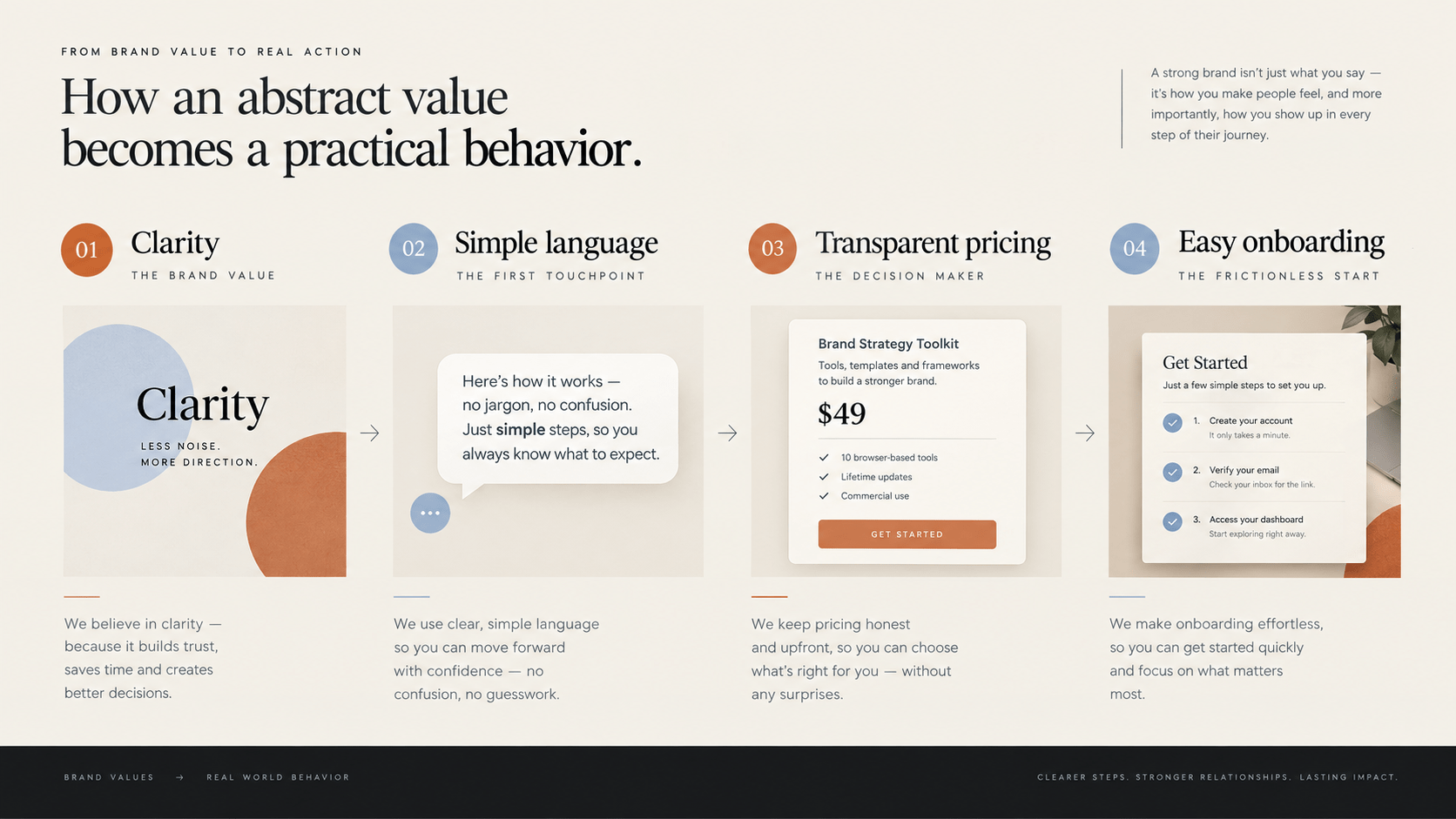
Step 6: Turn Each Value Into a Rule
This is the step most businesses skip.
Take each value and ask:
What does this mean in practice?
For example:
Clarity
Instead of:
“We value clarity.”
Create a behavioral rule:
“We explain products and services in language our customers can understand without unnecessary jargon.”
Transparency
Instead of:
“We value transparency.”
Create:
“We clearly communicate pricing, deliverables, limitations, and expectations before customers make a decision.”
Practicality
Instead of:
“We value practicality.”
Create:
“We prioritize recommendations that customers can realistically implement.”
Now your values can influence actual decisions.
Step 7: Check Whether Your Values Differentiate You
Your values don’t have to be completely unique.
But they should have some connection to how your brand operates.
Compare your proposed values with several competitors.
If every competitor says:
Innovation. Integrity. Excellence. Customer Focus.
you haven’t necessarily done anything wrong.
But ask whether those words actually explain how your business behaves differently.
Instead of trying to invent unusual values simply to stand out, make your existing values specific and observable.
For example:
“We value innovation.”
is vague.
But:
“We continuously test new tools and methods when they make the customer’s work simpler or more effective.”
tells people much more about how the business operates.
Specificity creates meaning.
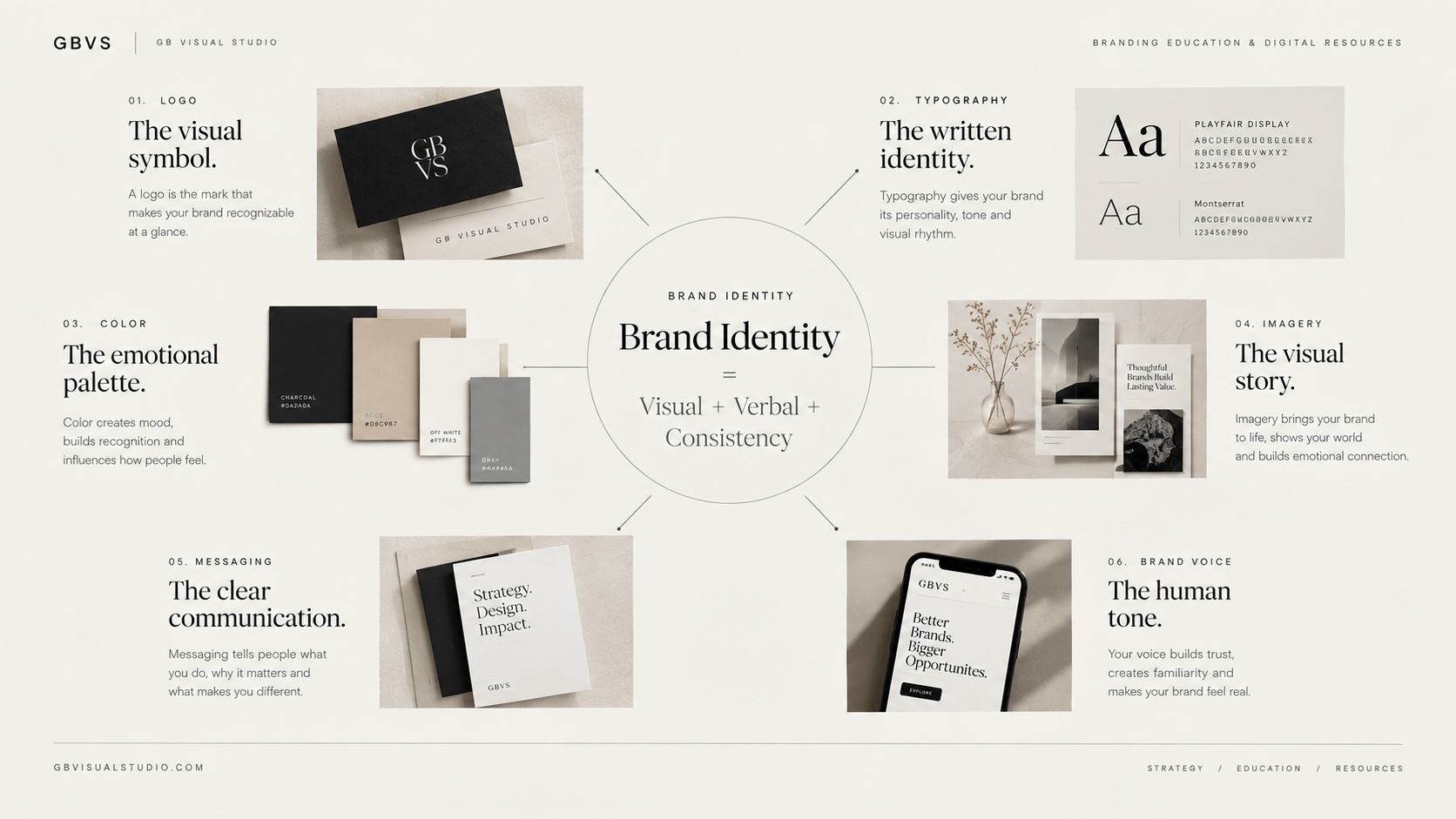
Step 8: Connect Values to Your Brand Identity
Brand values aren’t separate from visual branding.
They should influence it.
If your brand values clarity and simplicity, your visual identity might favor a clean information hierarchy and restrained visual system.
If your brand values energy and experimentation, your visual expression might allow more movement, variation, and visual contrast.
This doesn’t mean there is a fixed color or font for every value.
There isn’t.
The connection should be strategic rather than formulaic.
That’s why your brand values should be established alongside your broader brand strategy rather than chosen after the visual identity has already been created.
Step 9: Use Values in Your Brand Voice
Values can also shape the way your brand communicates.
Suppose your values are:
Clarity + Integrity + Practicality
Your communication might therefore be:
Clear rather than complicated.
Specific rather than exaggerated.
Educational rather than aggressively promotional.
Your values become a filter for content.
Before publishing something, ask:
Does this sound like the brand we claim to be?
That question becomes particularly useful when multiple people—or AI tools—are helping produce content.
For a deeper look at communication style, see the upcoming Brand Voice: A Complete Beginner’s Guide.
Step 10: Test Your Values With Real Decisions
You’ve now created your values.
Don’t immediately put them on your website.
Test them first.
Take a few current business decisions and run them through the values.
For example:
A potential partnership promises exposure but requires communication that doesn’t fit your standards.
A new product idea is profitable but would make your offer significantly more complicated.
A marketing campaign could generate attention but relies on exaggerated claims.
Ask:
What would our values tell us to do?
If your values actually help you decide, they’re working.
If every possible decision can somehow be justified by every value, they may be too vague.
Common Brand Value Mistakes
The first mistake is choosing values because they sound impressive.
Words like innovation and excellence are meaningless if the business can’t explain how they influence behavior.
The second is having too many values.
If employees, collaborators, or even the founder can’t remember them, they won’t guide decisions consistently.
The third is confusing values with goals.
“Become the market leader” is a business goal.
“Make complex information easier to understand” can be a value.
The fourth is confusing values with services.
“Provide branding services” describes what you do.
It doesn’t explain the principle guiding how you do it.
And the fifth is treating values as permanent slogans.
Values can remain stable while their practical expression evolves as the business grows.
A Simple Brand Values Formula
If you’re stuck, use this structure:
We believe [principle] because [reason], so we [specific behavior].
For example:
We believe clarity creates confidence, so we explain complex ideas in straightforward language.
Or:
We believe good design should solve a problem, so we prioritize function and communication before decoration.
This formula forces the value to connect belief with behavior.
That is exactly what makes it useful.
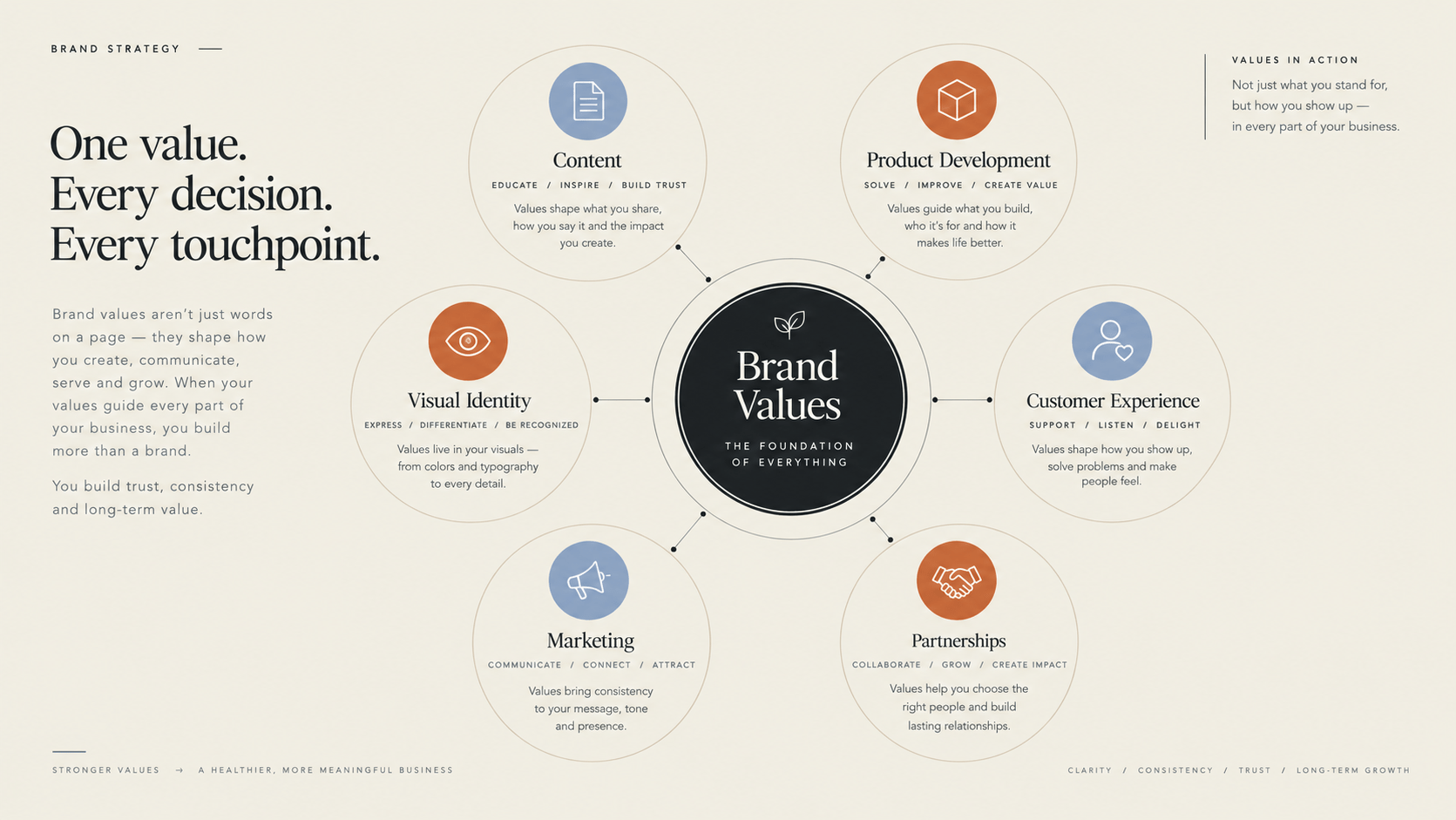
Your Brand Values Should Influence More Than Your Website
Once your values are defined, don’t hide them on an About page.
Use them.
Let them influence your content.
Your product development.
Your customer experience.
Your hiring.
Your partnerships.
Your pricing communication.
Your marketing.
Your visual identity.
Your decision-making.
Over time, repeated behavior creates evidence that the values are real.
That’s much more powerful than simply announcing them.
Final Thought
Defining brand values isn’t about finding five impressive words that look good in a brand presentation.
It’s about identifying the principles that genuinely influence how your business operates.
Start with what already matters.
Look at your decisions.
Understand your audience.
Choose a small number of meaningful principles.
Define what each one actually means.
Turn them into behaviors.
Then use them consistently.
When values work this way, they become part of the brand strategy rather than another branding exercise.
And that’s when they become useful.
Because the strongest brand values aren’t simply things your business says it believes.
They are things your business repeatedly demonstrates.
Frequently Asked Questions
How many brand values should a business have?
There is no universal number. A small set of meaningful values is generally easier to remember and apply than a long list. The important factor is whether the values genuinely influence business decisions and behavior.
What are examples of brand values?
Examples include clarity, integrity, craftsmanship, accessibility, curiosity, simplicity, transparency, sustainability, community, and experimentation. The important part is defining what each value means specifically for your business.
What is the difference between brand values and company values?
The terms are sometimes used interchangeably. In practice, company values can describe the principles guiding the organization internally, while brand values often emphasize the principles that shape how the brand behaves and is experienced externally. The distinction depends on how the organization defines its terminology.
Should brand values be included in brand guidelines?
Yes. If values influence your brand voice, messaging, customer experience, or creative decisions, documenting them can help maintain consistency as the business grows.
Can brand values change?
They can evolve when the business changes significantly. However, they should not be changed simply because a new trend or marketing direction appears. Meaningful changes in business purpose, audience, positioning, or operating principles are stronger reasons to reconsider them.
How do brand values affect branding?
Values can influence brand personality, voice, messaging, visual direction, content, customer experience, partnerships, and business decisions. They provide principles that help connect these different parts of the brand.